Oligopoly | A-Level Economics Notes
These revision notes cover everything you need to know about Oligopoly for A-Level Economics. They're designed for students studying AQA A-Level Economics, Edexcel A-Level Economics, and Edexcel International A-Level Economics. Written by Jaisul Naik, UCL Economics graduate and A-Level Economics tutor since 2017.
What is an oligopoly?
An oligopoly is a market structure dominated by a few firms.
Oligopolistic markets consist of:
- High barriers to entry and exit
- Interdependence of firms
- Product differentiation
Oligopolies can vary in terms of the way they conduct themselves. They can be collusive or non-collusive.
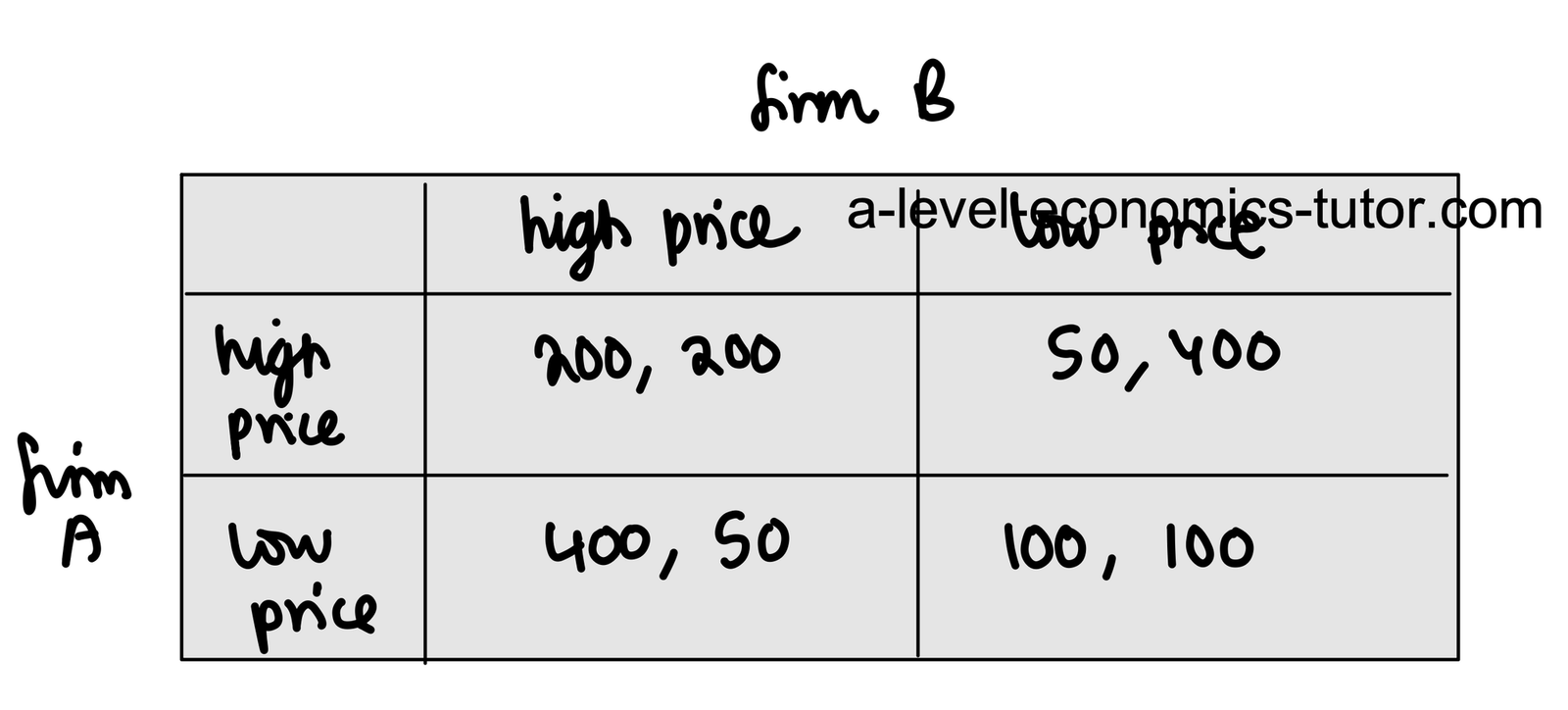
Draw a simple game theory model

What is collusion?
Collusion is when two or more firms agree to set high prices.
This is more likely to be possible if the two firms have a high market share and a similar market share.
After colluding, they act as a monopoly with their combined market share.
What is tacit collusion?
Tacit collusion is an informal agreement between firms to set higher prices.
What is overt collusion?
Overt collusion is an formal agreement between firms to set higher prices.
Use game theory to explain the reasons for collusive behaviour
- If we assume that Firm A sets a high price, Firm B would undercut them and set a low price. This would lead to the highest profit of 400 units.
- If Firm A expects Firm B to set a low price, Firm A would match them as they don't want to lose market share or lose out on supernormal profit.
- As a result, lower prices are the most likely outcome in an oligopoly (Nash Equilibrium).
- Firms could agree to set high prices through tacit collusion. This requires trust but it would allow the firms to make £10m profit each.
Use game theory to explain the reasons for non-collusive behaviour
Collusion is unlikely to happen because firms are worried that:
- if one firm undercuts them, they lose a lot of their market share.
- if one firm snitches or the CMA finds out about collusion, the firms get fined heavily.
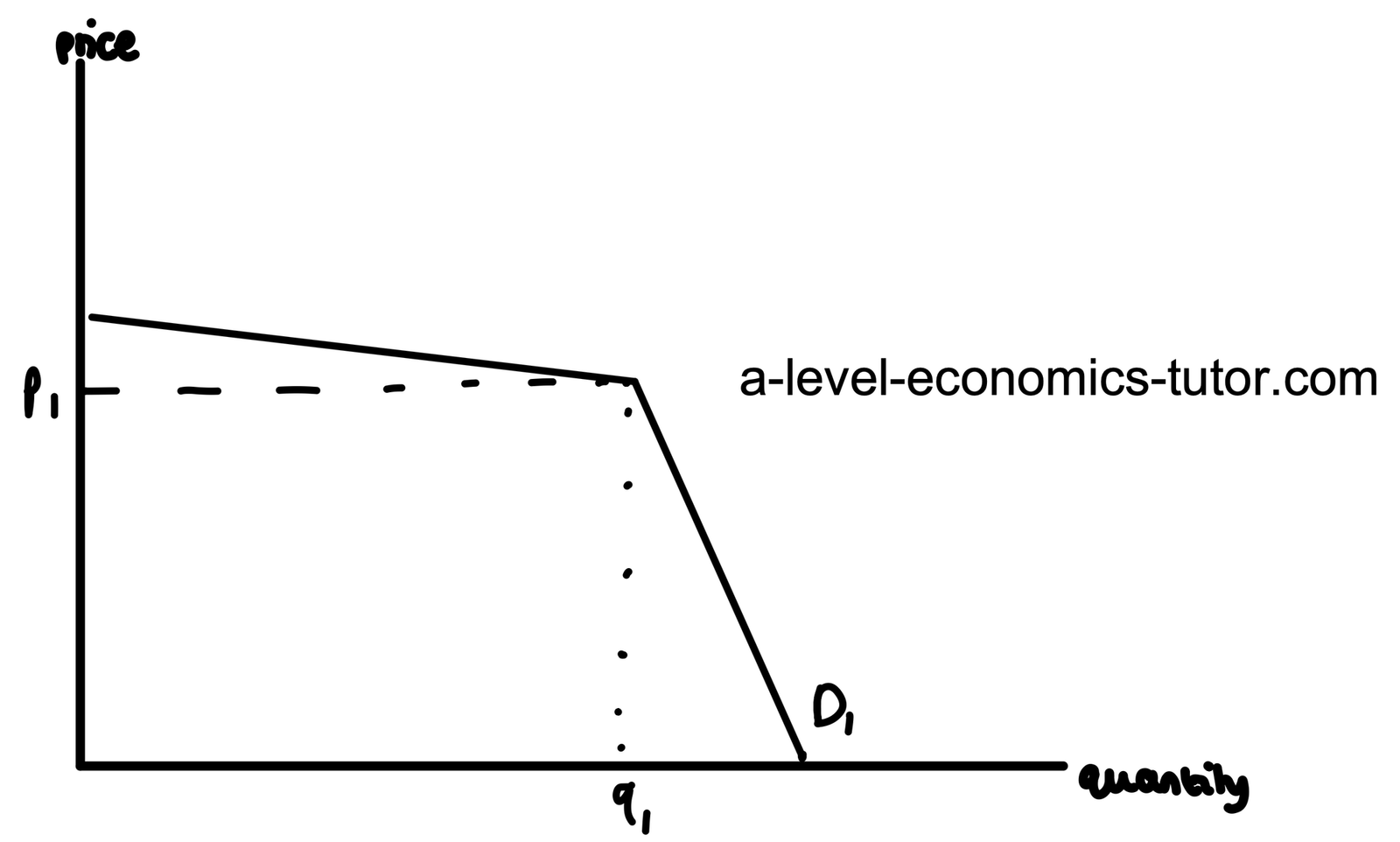
Draw a kinked demand curve
The kinked demand curve shows the outcome in a competitive oligopoly.
Use the kinked demand curve to explain non-price competition
The kinked demand curve shows that firms in a competitive oligopoly stick to the price p1, and don't often change their prices.
- Firms in an oligopoly are interdependent.
- Firms would not reduce their prices from p1 because they would not gain much demand, as other firms would follow with low prices.
- Firms would also not raise their prices from p1 as they would lose customers.
- Firms use non-price competition instead to try to gain market share e.g. loyalty cards to increase customer loyalty.
What is price leadership?
Prices are usually set by the most dominant firm in the market due to their cost advantage.
What are price wars?
- Price wars can start if firms try to lower prices to gain market share.
- This causes competitors to also match prices.
- For example, Aldi Price Match in supermarkets.
What is predatory pricing?
Predatory pricing occurs when a firm might set a price below average cost in order to drive out other firms in the industry
Predatory pricing is illegal under most competition laws.
What is limit pricing?
Limit pricing is where an incumbent firm sets a price low enough to deter new entrants into the industry.
The diagram below is optional and it shows how a price leader can make a profit at the same time as deterring a new firm from entering due to its economies of scale.

What is the main advantage of oligopolies?
The main advantage of oligopolies is price stability and high levels of customer satisfaction due to a focus on non-price competition instead of price competition.
What is the main disadvantage of oligopolies?
The main disadvantage of oligopolies is the threat of collusion, which would lead to high prices.
Summary questions
- What is an oligopoly?
- Draw a simple game theory model
- What is collusion?
- What is tacit collusion?
- What is overt collusion?
- Use game theory to explain the reasons for collusive behaviour
- Use game theory to explain the reasons for non-collusive behaviour
- What are the outcomes in a collusive oligopoly?
- What are the reasons for non-price competition? use the kinked demand curve
- What are price wars?
- What is predatory pricing?
- What is limit pricing?
- What is the main advantage of oligopolies?
- What is the main disadvantage of oligopolies?
A-Level Economics Tutoring
I offer one-to-one and small group A-Level Economics tutoring for students across the UK and internationally. With 87+ five-star Google reviews and tutoring experience since 2017, I specialise in helping students understand difficult concepts and improve their exam technique.