Evaluate the possible conflicts between macroeconomic objectives when seeking to control inflation
Edexcel A-Level Economics June 2025
In January 2023 the UK prime minister, Rishi Sunak, promised to halve inflation by the end of the year. In July 2023 the Bank of England governor, Andrew Bailey, said: “It is crucial that we… return inflation to its 2% target and provide the environment of price stability in which the UK economy can thrive. This is the best contribution monetary policy can make to the prosperity of the United Kingdom.
Evaluate the possible conflicts between macroeconomic objectives when seeking to control inflation. (25 marks)
- Paragraph 1
- Argument: one possible conflict due to lower inflation is an increase in cyclical unemployment
- Diagram: left shift in AD, negative multiplier
- Evaluation: depends on the size of the multiplier and the state of the economy
- Paragraph 2
- Argument: another conflict specifically due to higher interest rates is a increase in the current account deficit
- Diagram: exchange rates diagram
- Evaluation: lower inflation will eventually lead to an increase in competitiveness
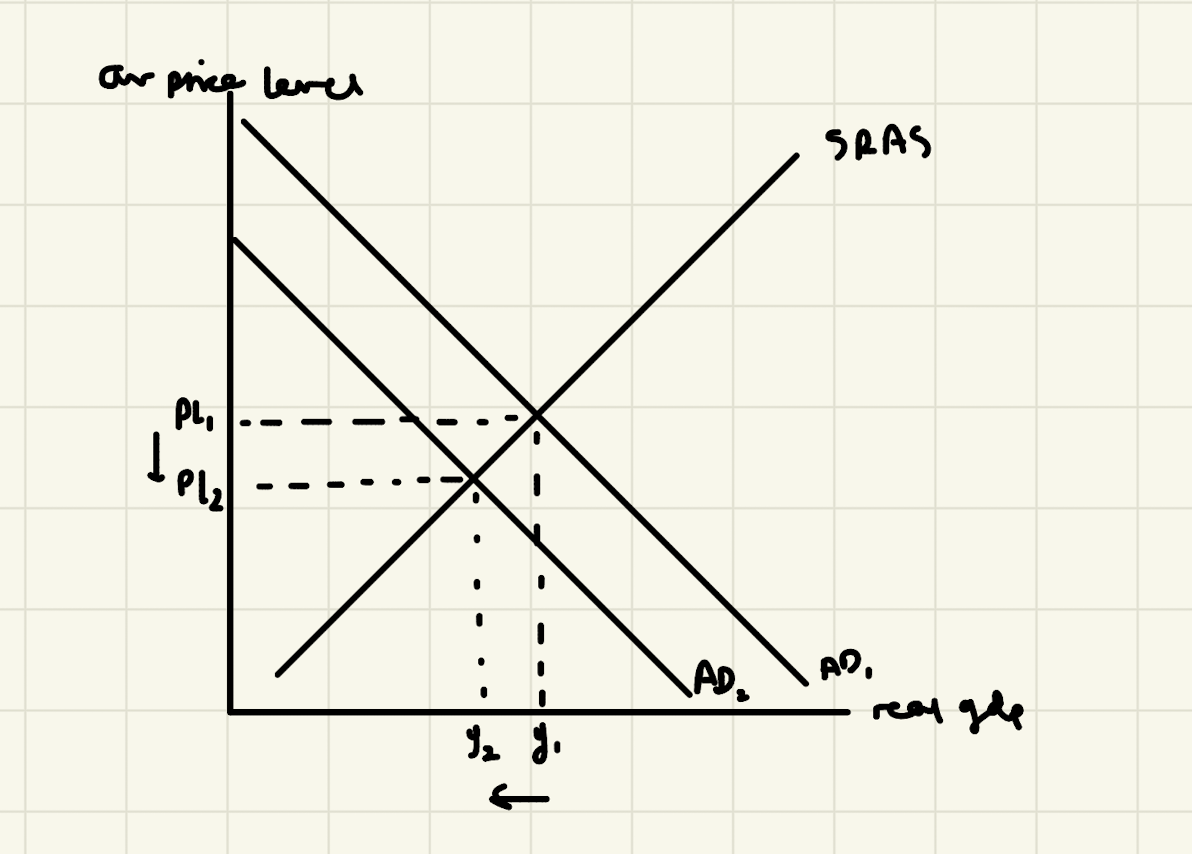
One possible conflict from trying to reduce inflation to the 2% target is an increase in cyclical unemployment. Cyclical unemployment is when unemployment is caused by a lack of aggregate demand during a downturn or a recession in the economy. Assuming that the government use contractionary demand-side policies to reduce the rate of inflation rate, this would cause an increase in cyclical unemployment. For example, the government could use contractionary fiscal policy which means they increase taxes or decrease government spending. For example, they could increase income taxes. We have seen this in recent years in the form of fiscal drag, which is when tax brackets do not change to reflect inflation, meaning that workers' incomes are taxed more. Higher income taxes mean that workers have less disposable income, which means consumer spending would fall. This leads to a left shift in aggregate demand, causing the price level to fall from p1 to p2 towards the 2% target. The trade-off is that real gdp also falls from y1 to y2 as a result of lower demand for goods and services. This is shown by the diagram below. This then means that the derived demand for workers falls, causing an increase in cyclical unemployment. Additionally, the trade-off could worsen as increasing income taxes could also lead to a negative multiplier effect. As consumer spending and consumer confidence falls, this could lead to a fall in business confidence, causing a fall in business investment. As this is another component of aggregate demand, AD could fall even further, resulting in an even larger decrease in real gdp and increase in unemployment.
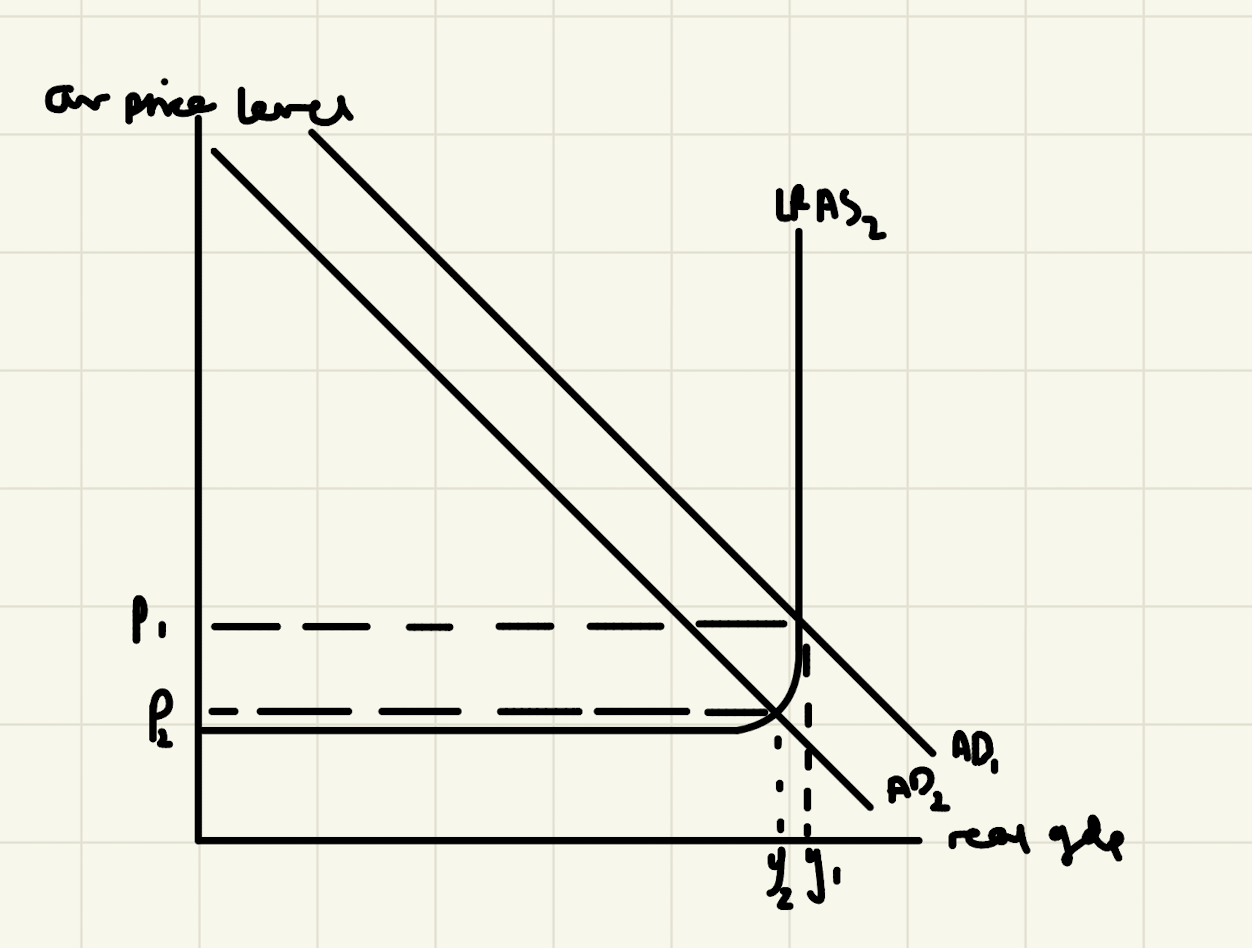
However, the trade-off between lower inflation and higher unemployment would vary depending on the original state of the economy and also the size of a potential multiplier effect. This can be seen on the Keynesian long-run aggregate supply curve below. It shows that if the economy was originally experiencing a positive output gap, the government may be able to decrease the inflation rate without causing too much of an increase in unemployment since p1 falls significantly to p2 and output doesn't fall by too much. A positive output gap is when the actual rate of economic growth is higher than the trend rate of economic growth, meaning that the economy is working beyond full capacity. This is likely to be the case as in 2022, inflation hit a recent record of around 11%. Additionally, the size of the multiplier depends on the equation k=1/(1-MPC) so therefore, if the government raise income taxes for high income households, the multiplier would be much lower, which is more suited to carefully controlling inflation since high income households have a lower MPC.
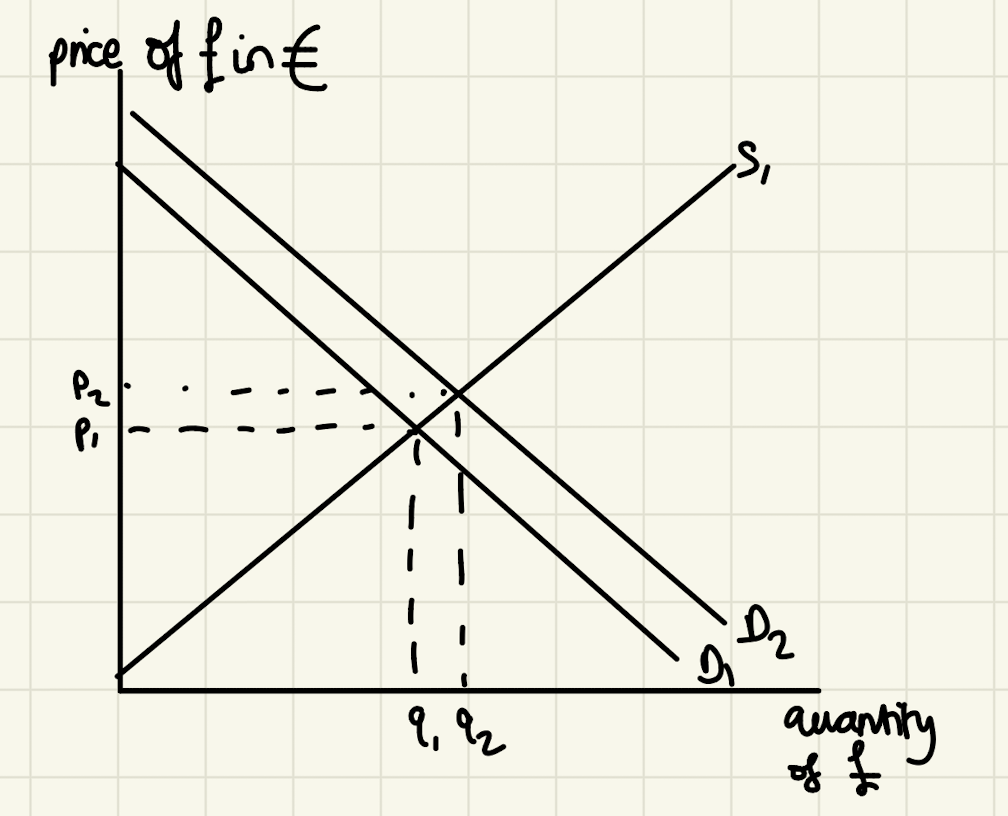
Another possible conflict caused by controlling inflation could be a weaker current account. This is only going to be the case if contractionary monetary policy is being used. Andrew Bailey mentioned the 'contribution monetary policy can make'. Contractionary monetary policy involves the Bank of England increasing base interest rates. Interest rates are the cost of borrowing or the reward for saving. Whilst this is likely to reduce aggregate demand, it also causes an increase in demand for the pound in the form of hot money flows since people want to take advantage of the higher savings rate in the UK. This causes an increase in demand for the pound which causes an appreciation, as shown by the diagram below. This means that exports become more expensive and imports become cheaper. In theory, this should worsen the current account.
However, a weaker current account is not likely to be a long-term trade-off with lower inflation; is just a consequence of the Bank of England raising interest rates as a method to reduce inflation. Instead, when inflation eventually falls, the average price level falls and UK goods and services become cheaper. The extract mentions Rishi Sunak's promise to halve inflation. This means that UK exports become more competitive, making them more attractive to consumers in foreign countries.
In my opinion, the current account deficit is not the most worrying trade-off as it would be a temporary effect of higher interest rates, so the government should focus on limiting the potential increase in unemployment. A large increase in unemployment would be damaging as it could lead to a crisis of consumer confidence and cause a negative multiplier effect and potentially a recession. It could also cause knock on effects such as an increase in the budget deficit as it leads to more claimants of unemployment benefits as well as a decrease in income tax receipts. The government and the central bank should be careful to not raise income taxes or interest rates by too much to avoid this spiral. The government should also consider alternatives such as supply-side policies. These have a huge time lag so they would not be able to reduce inflation in a short amount of time, but if implemented successfully they can reduce the risk of high inflation in the future, without causing any major trade-offs with the other macroeconomic objectives. We know this because supply-side policies cause an increase in LRAS, which allow the price level to fall whilst the economy continues to grow.
A-Level Economics Tutoring
I offer one-to-one and small group A-Level Economics tutoring for students across the UK and internationally. With 87+ five-star Google reviews and tutoring experience since 2017, I specialise in helping students understand difficult concepts and improve their exam technique.