Discuss whether the rail network can be considered to be a natural monopoly
Edexcel A-Level Economics Paper 1 June 2020 Extract
With reference to Extract A, paragraph 3, discuss whether the rail network can be considered to be a natural monopoly. (12 marks)
On the one hand, the rail network can be considered a natural monopoly. This is a market structure where the most efficient number of firms is likely to be one. This would be the case if firms in the rail network have an L-shaped long-run average cost curve, as shown below. This happens because the firms experience extremely high sunk costs. The extract mentions that the rail network is made up of 2500 stations and 32000km of tracks, all of which would have required considerable investment. Therefore, these firms’ economies of scale would outweigh their diseconomies of scale even when output is very high. This means that a firm would have to produce a really high output for it to operate at its minimum efficient scale in the long run and achieve productive efficiency. This would be easier if it wasn’t competing with other firms.
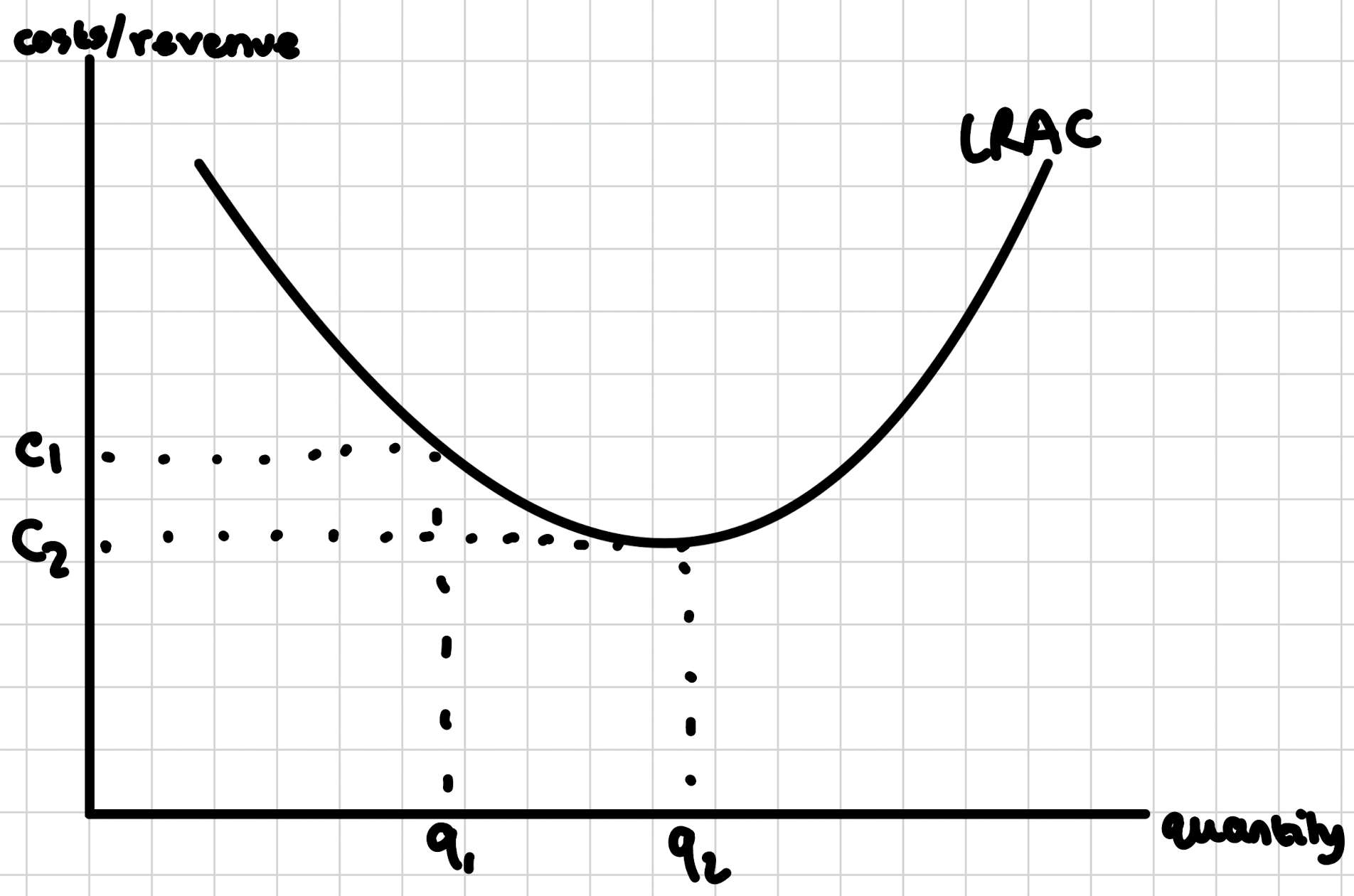
However, some members of the government believe that rail networks can be open to competition. Line 13 mentions that 'companies can bid to build new rail lines'. If this is the case, each firm would lose market share. Then the market structure could be better described as an oligopoly where a few firms dominate the market, rather than a natural monopoly. This means that firms lose some of their price making power as they would lose market share if they get undercut. We saw this happen when Royal Mail got privatised. It faced competition from DPD and DHL and Evri.
A-Level Economics Tutoring
I offer one-to-one and small group A-Level Economics tutoring for students across the UK and internationally. With 87+ five-star Google reviews and tutoring experience since 2017, I specialise in helping students understand difficult concepts and improve their exam technique.