Discuss the possible impact of supermarket monopsony power on both food suppliers and consumers
Edexcel A-Level Economics Paper 1 June 2017 Extract
With reference to Figure 2 and Extract A, discuss the possible impact of supermarket monopsony power on both food suppliers and consumers. (12 marks)
Monopsony power is where a buyer in a market has significant bargaining power when buying factors of production.
Food suppliers are likely to experience lower revenues because they will be under-paid for their food as they have no option but to sell to monopsony employers of these factors of production, such as Tesco. The GCA is investigating the abuse of this power, with a YouGov poll showing 31% of Tesco's food suppliers claiming they are failing to meet the GCC. The diagram below shows they will experience a lower average revenue of p2 rather than p1 if monopsony power is exploited. They will also make less supernormal profit as shown by the red rectangle compared to the black rectangle.
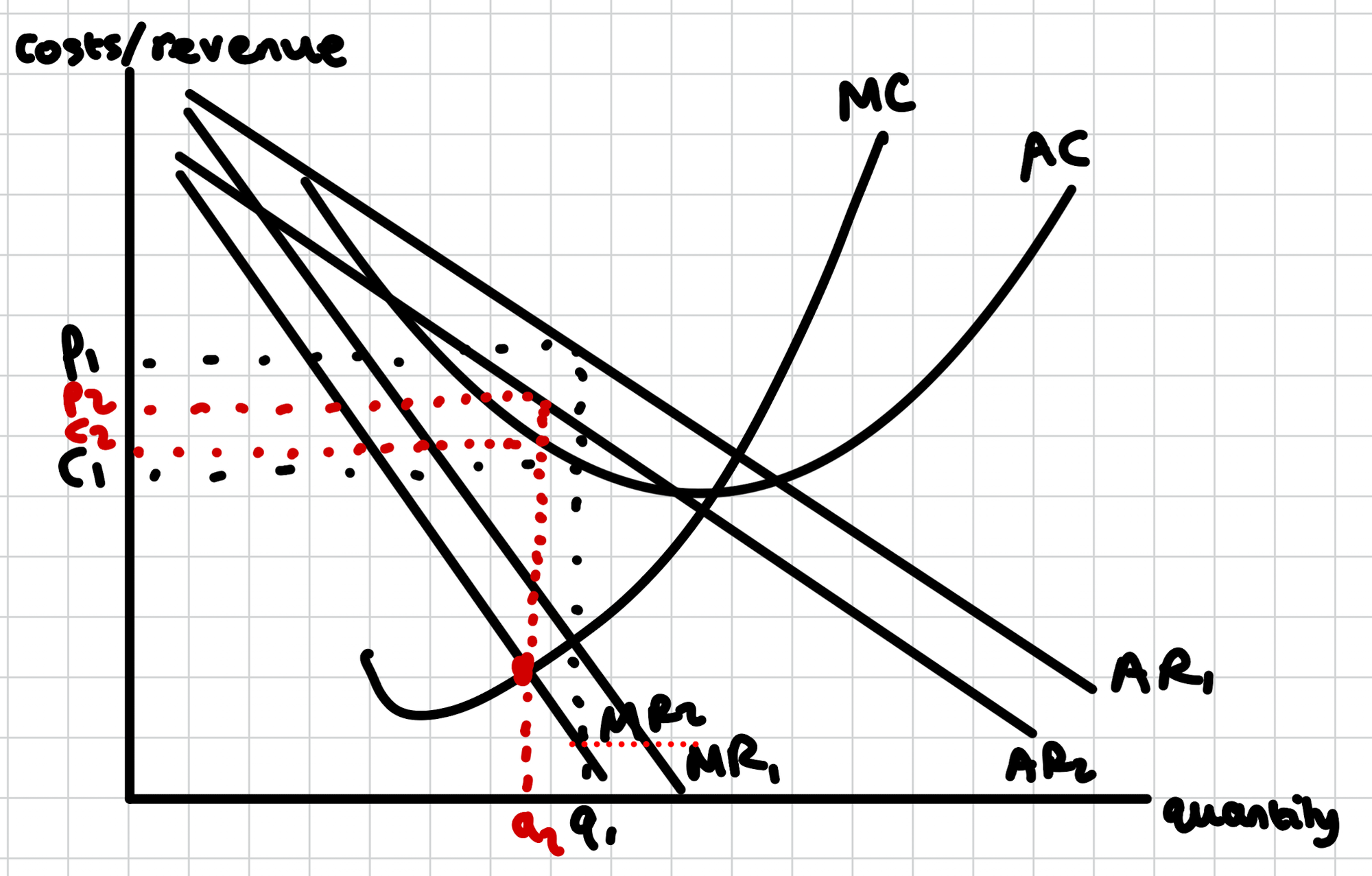
However, monopoly food suppliers, e.g. Unilever, can act as a counterweight to monopsony power as their control of key brands in supermarket sales can allow them to negotiate more strongly with the supermarkets, so their revenues won't fall as significantly and neither will profits.
Consumers are likely to enjoy lower prices, as monopsonies like Tesco can benefit from lower costs when buying food. This has contributed towards supermarkets engaging in a price war, which has led to prices falling by 1.7% over two years, which leads to lower prices p2 rather than p1 as shown in the diagram below, and greater consumer surplus, which is the difference between how much consumers are willing to pay at most compared to what they actually end up paying.
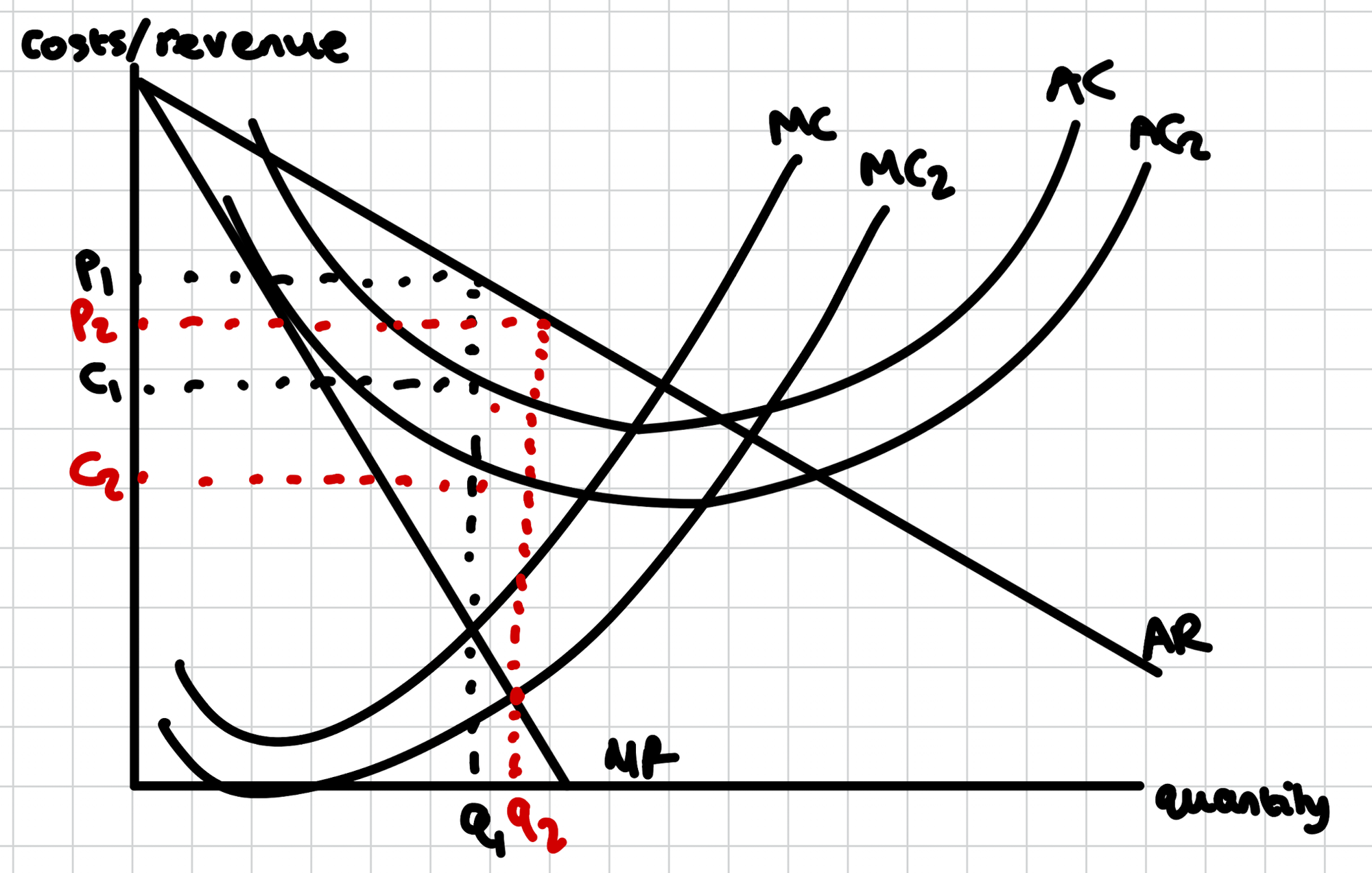
However as food suppliers are facing falling profits and are investing less the quality of food may fall or there may be less innovation in terms of flavour. The quantity supplied by the food suppliers has also fallen from Q to Q₁, which may lead to shortages. Moreover, in order to reduce costs in the long-run, food suppliers could reduce the size of their products, e.g. smaller quantities in jars, in order to reduce costs and improve profit margins, but this will lead to a fall in the quality of good for consumers and falling consumer welfare.
A-Level Economics Tutoring
I offer one-to-one and small group A-Level Economics tutoring for students across the UK and internationally. With 87+ five-star Google reviews and tutoring experience since 2017, I specialise in helping students understand difficult concepts and improve their exam technique.