Discuss the advantages and disadvantages of contestable markets
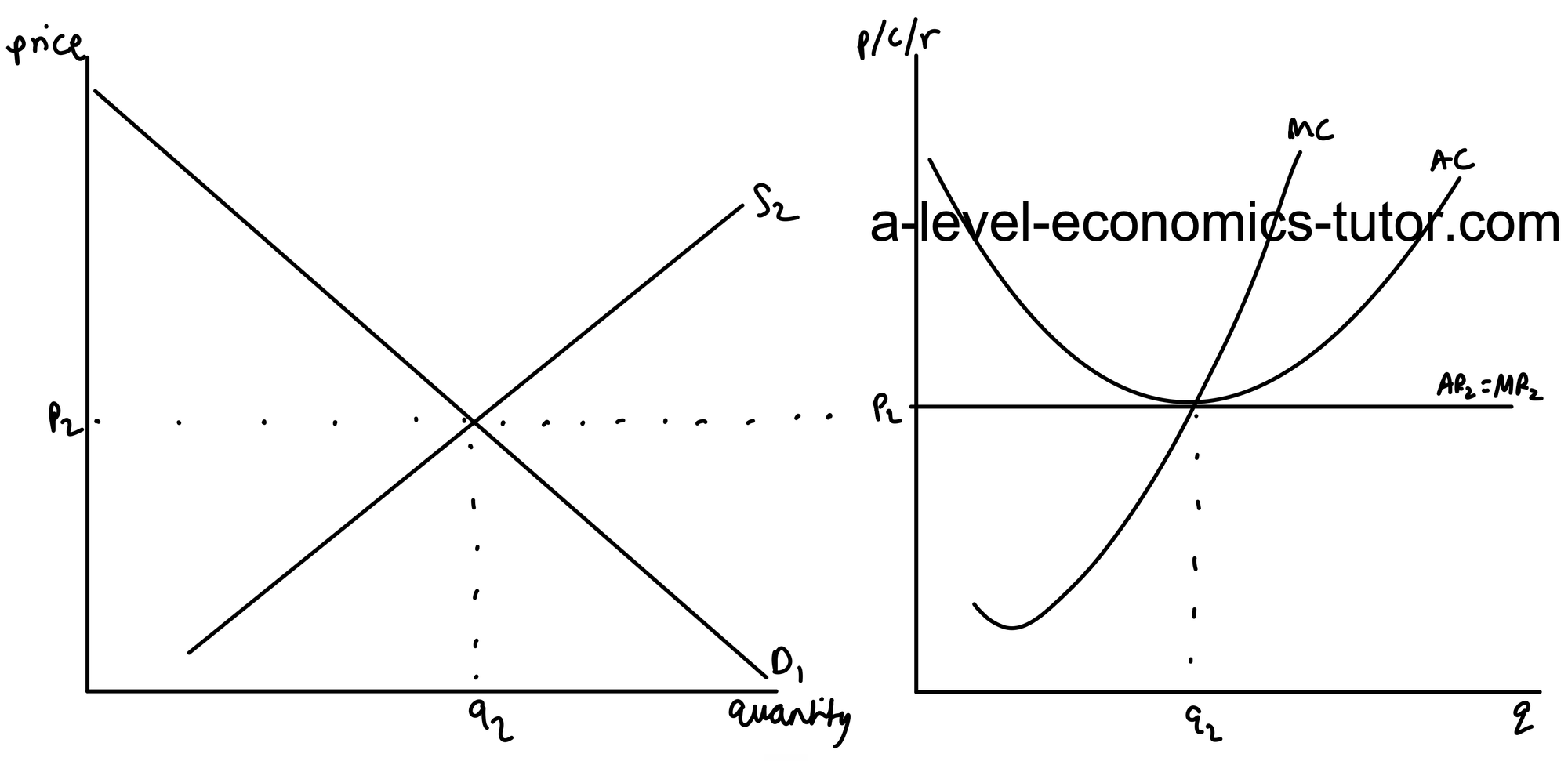
One advantage of perfect competition is that firms are allocatively efficient in the short-run and the long-run. Perfect competition consists of no barriers to entry and exit, homogeneous products, and perfect information. This means that firms are price takers. This applies in the short run and the long run, and the diagram below shows the outcome in the long run. Firms aim to maximise profits, so they produce at the point where marginal costs = marginal revenue. In perfect competition, marginal revenue always equals average revenue because firms are price takers. They are only able to charge the market price (where supply equals demand), as they would lose all of their customers if they charged any price above this. Therefore, firms produce at the point where marginal costs = average revenue, and therefore they are allocatively efficient, meaning that social welfare is being maximised. In comparison to the outcomes in a monopoly, output is higher and prices are lower in this market, which means that consumer surplus is being maximised. This is the difference between the prices consumers pay and the highest price they’d be willing to pay for the good or service.
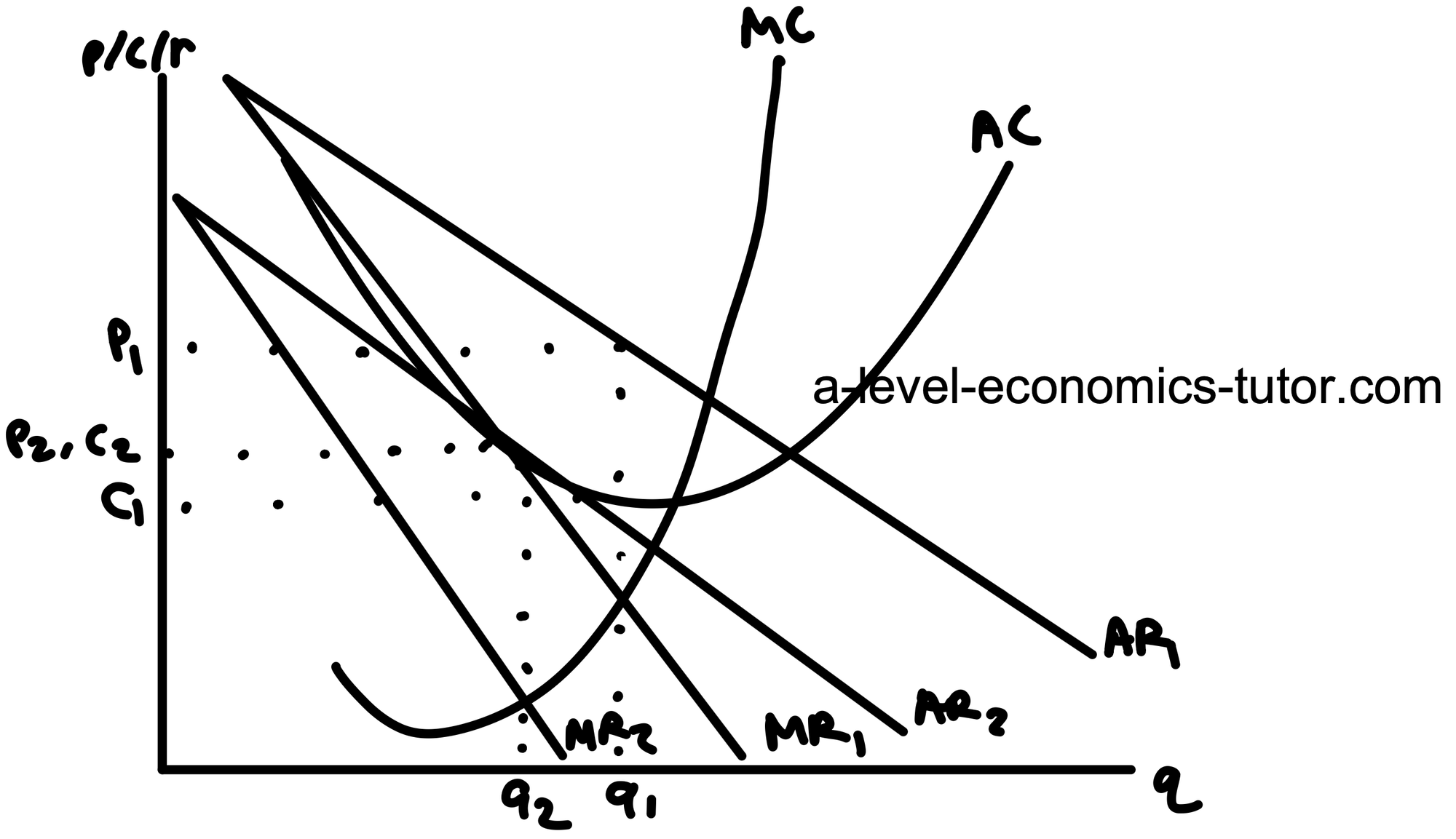
One advantage of monopolistic competition is lower prices. Monopolistic competition consists of low barriers to entry, and firms sell slightly differentiated products. In the short run, firms are able to make supernormal profits. This, alongside the fact that barriers to entry are low, provides an incentive for new firms to enter the market. This means that market supply increases causing the market share, and revenues, of existing firms to fall. This is shown in the diagram below, where the profit maximising level of output changes from MC=MR1 to MC=MR2, which leads to the price falling from p1 to p2. Whilst firms are not fully able to achieve allocative efficiency, prices do fall. This means that consumer surplus increases; a lower price means a greater difference between the prices that consumers pay in relation to the prices that they would have been willing to pay.
One advantage of increased competition is productive efficiency because firms must produce at the lowest point of their average costs curve in the long-run. In the short-run, existing firms can make supernormal profits but this incentivises new firms to enter the market. These possible new entrants have perfect information of the market and they are able to easily enter the market as there are no barriers to entry. Since firms are price-takers, they each face a perfectly elastic average revenue curve. This must be level with the lowest point of the average costs curve in the long-run or market supply would increase even further. The diagram shows that, in the long-run, firms are productively efficient if they are producing at the level of output where marginal costs = average costs. Firstly, this means that firms are fully exploiting their economies of scale, meaning that they are enjoying the benefits of increasing their output; hiring specialist managers, and bulk-buying. Secondly, it means that firms in this industry are producing the highest possible output with their available factors of production, meaning that factors of production are not being wasted.
However, increases in competition may not always lead to productively efficient outcomes. The diagram below shows the difference between a firm in the short-run and long-run when they are part of a monopolistically competitive market. Monopolistic competition consists of low barriers to entry and slight product differentiation, which makes it a much more realistic real-world market structure than perfect competition. Firms can make supernormal profits in the short-run, but new firms are incentivised to enter the market in the long-run. This means that market supply increases and existing firms' market share decreases. The diagram shows that their revenue curves fall, and this leads to a decrease in output and an increase in costs. Because firms are now only able to make normal profits, they must produce further away from their minimum efficient scale (lowest point of their average costs curve). This means that firms are unable to buy as many materials in bulk, or maximise the use of their technology, or their marketing. Factors of production in this firm, or industry are unlikely to be fully utilised.
However, one disadvantage of contestable markets is that firms are only able to make normal profits in the long run. Assuming that there is good or perfect information about existing firms, possible entrants are aware that existing firms are making supernormal profits in the short run. Additionally, there are no barriers to entry, and therefore it is possible for new firms to enter the markets. In the long run, market supply increases and each firm generates less revenue due to lower market share. This means that existing firms are only able to make normal profits in the long run. Normal profit is the minimum level of profit needed for a firm to remain in the market in the long run, as it is the exact amount of profit that covers a firm's costs and opportunity costs of operating the business. Because all of this profit is needed to cover the business owner's opportunity cost, the business owner is not willing or able to reinvest any of its profits into the business. This means that firms would find it difficult to improve or innovate their products in markets that are contestable, and therefore firms are usually unable to achieve dynamic efficiency.
A-Level Economics Tutoring
I offer one-to-one and small group A-Level Economics tutoring for students across the UK and internationally. With 100+ five-star Google reviews and tutoring experience since 2017, I specialise in helping students understand difficult concepts and improve their exam technique.