Discuss the advantages and disadvantages of globalisation
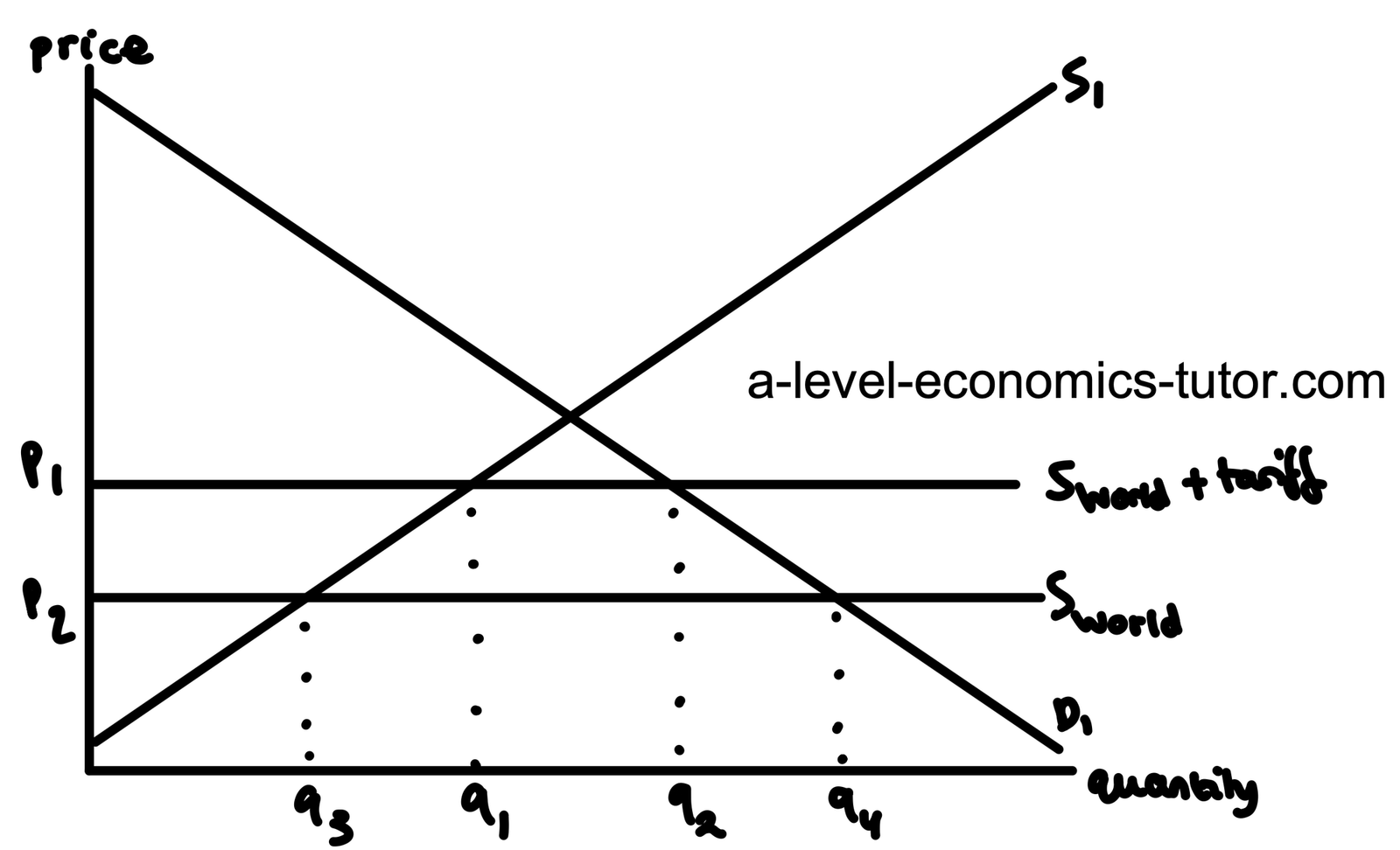
One advantage of globalisation and free trade is lower prices. Globalisation is the increased integration and interdependence of countries around the world. This is likely to involve countries forming trade agreements, which allow trade to be unrestricted. The diagram below shows the effect of a tariff removal. Initially, this country is producing q1 domestically, and importing q1q2. The removal of a tariff means that the world supply curve falls from Sworld + tariff to Sworld. As a result, domestic output falls to q3 and imports increase to q3q4. As a result of lower tariffs, imports become cheaper and consumers can benefit from lower prices; prices fall from p1 to p2. This is what causes an expansion along D1 and a contraction along S1, which leads to the changes in the volume of imports and the volume of domestic output. The two shaded triangles show an increase in social welfare, mainly as a result of an increase in consumer surplus; the difference between the prices consumers pay and the maximum price they would have been willing to pay for those goods and services.
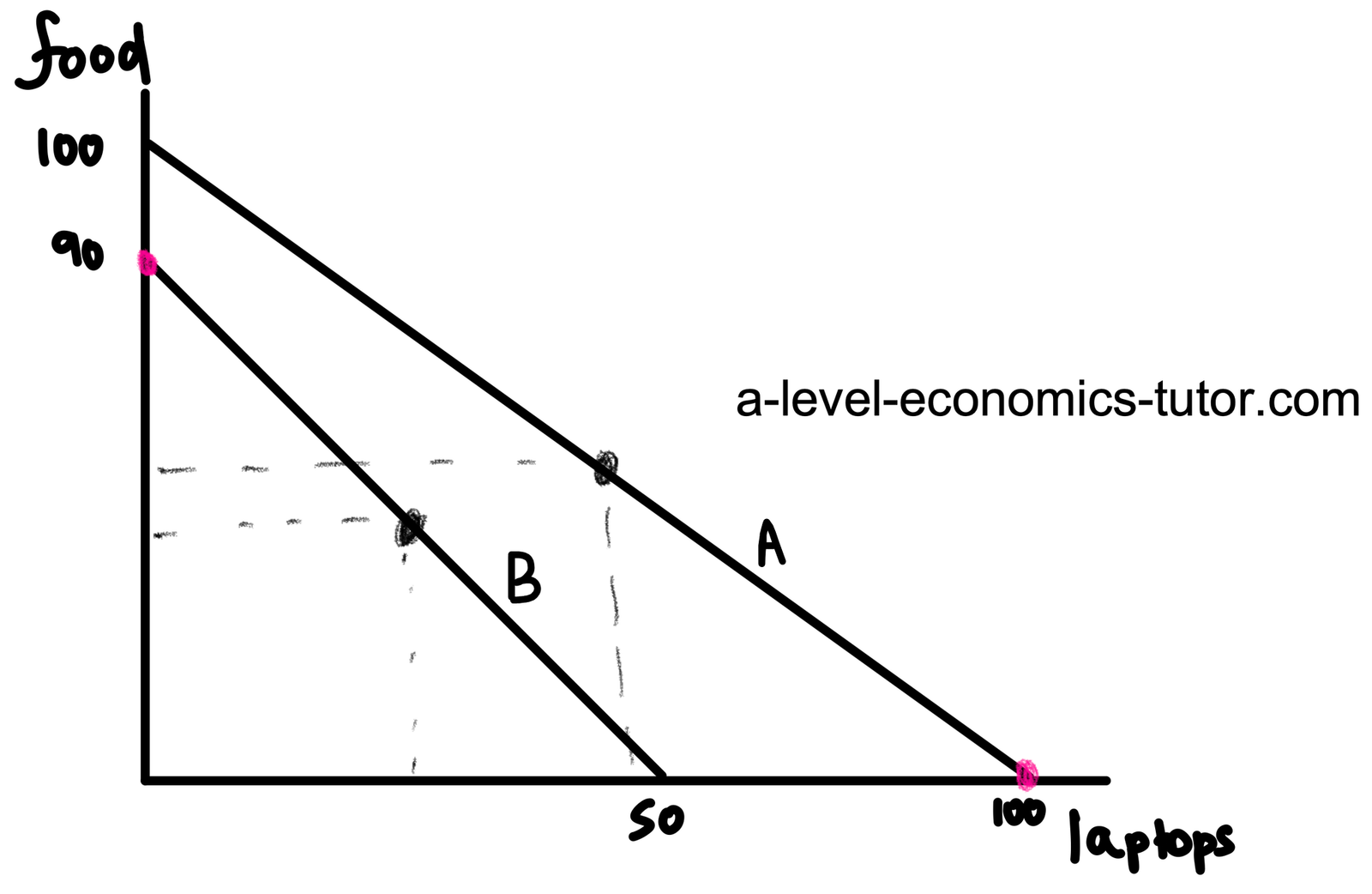
One advantage of globalisation and free trade is that it encourages countries to specialise. Specialisation can lead to an increase in world output. Specialisation occurs when countries focus on producing one particular good or service. Countries are encouraged to specialise on producing the good or service where they have a comparative advantage; the good or service they can produce at the lowest opportunity cost. The model below explains how specialisation should lead to an increase in total output. Here, we have two countries (country A and B) who can produce any combination of food and laptops that is shown on their production possibility curves (PPFs). If we assumed that each country was unable to trade, they would have to produce a combination of food and laptops. Assuming that they produce exactly half way along their PPF, country A would produce 50 units of food and 50 units of laptops and country B would produce 45 units of food and 25 units of laptop, so total output would be 170 units without specialisation. However, country A would be encouraged to specialise in the production of laptops and country B would be encouraged to specialise in the production of food. This is because: country A has an opportunity cost of 1 unit of food for every laptop, whereas country B has an opportunity cost of 1.8 units of food for every laptop. Then, total world output would be 190. Overall, this model shows that total world output would increase when countries specialise in the goods or services where they have a comparative advantage. For example, Brazil originally had a comparative advantage in algricultural resources such as coffee, they pursued protectionism in other areas. Now, some of the largest companies in the aerospace industry are from Brazil.
One disadvantage of globalisation and free trade is that it leads to over-dependence, and this can impact both developed and developing countries. As countries specialise in fewer goods and services, other industries are likely to decline. In developed countries such as the UK, industries like steel have declined due to China having a comparative advantage in its production. Therefore, as we import more steel, the demand for steel workers in the UK has fallen significantly, leading to structural unemployment; a long-term unemployment that has persisted due to poor levels of occupational and geographical immobility of labour. Ultimately, this costs the UK government as they need to spend more on supply-side policies like training schemes, or HS2, to make it easier for people around the UK to find new jobs. Meanwhile, some developing countries may be forced to focus on producing primary products, which is damaging to their growth, as the value of primary products generally declines over time.
The disadvantage of the comparative advantage model is its assumptions. Firstly, the model assumes that there are negligible costs associated with trade, such as transport costs and environmental damage. If we account for them, the gains from specialisation would be much lower than the model suggests. Secondly, the model assumes constant returns to scale; which is when, in the long run, an increase in factors of production leads to a proportional increase in output. In reality, a country can have different returns to scale for different goods and services. In the present moment, a country may not have a comparative advantage but they may be able to develop one by protecting their infant industries and allowing them to expand production.
A-Level Economics Tutoring
I offer one-to-one and small group A-Level Economics tutoring for students across the UK and internationally. With 100+ five-star Google reviews and tutoring experience since 2017, I specialise in helping students understand difficult concepts and improve their exam technique.