Explain how perfect competition should lead to outcomes which are both productively and allocatively efficient
AQA A-Level Economics Paper 1 June 2021
Explain how perfect competition should lead to outcomes which are both productively and allocatively efficient. (15 marks)
Productive efficiency occurs when a firm is producing at the lowest point of their average costs curve (MC=AC). Allocative efficiency occurs when a firm is producing at the point where average revenue equals marginal cost (AR=MC).
Perfect competition is a market structure that consists of no barriers to entry, perfect information, and homogenous products. Firms must act as price-takers. The diagram below shows the outcome of a firm in a perfectly competitive market in the short-run. Firms aim to maximise profits, so they produce at the point where marginal costs = marginal revenue (MC=MR). This means that firms can make supernormal profit in the short run, as shown by the shaded rectangle op1c1q1. In the short-run, firms are allocatively efficient as price equals marginal cost.
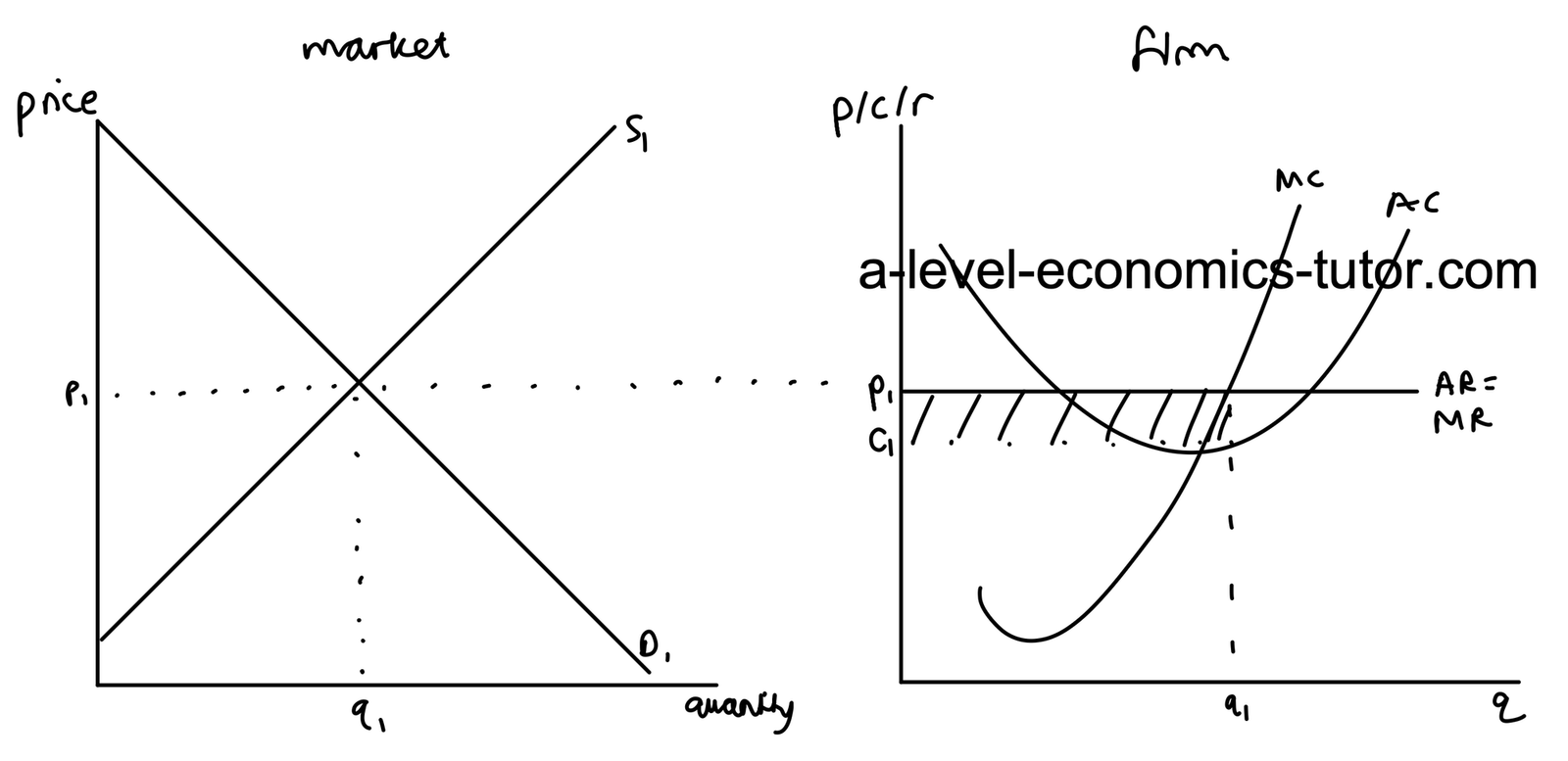
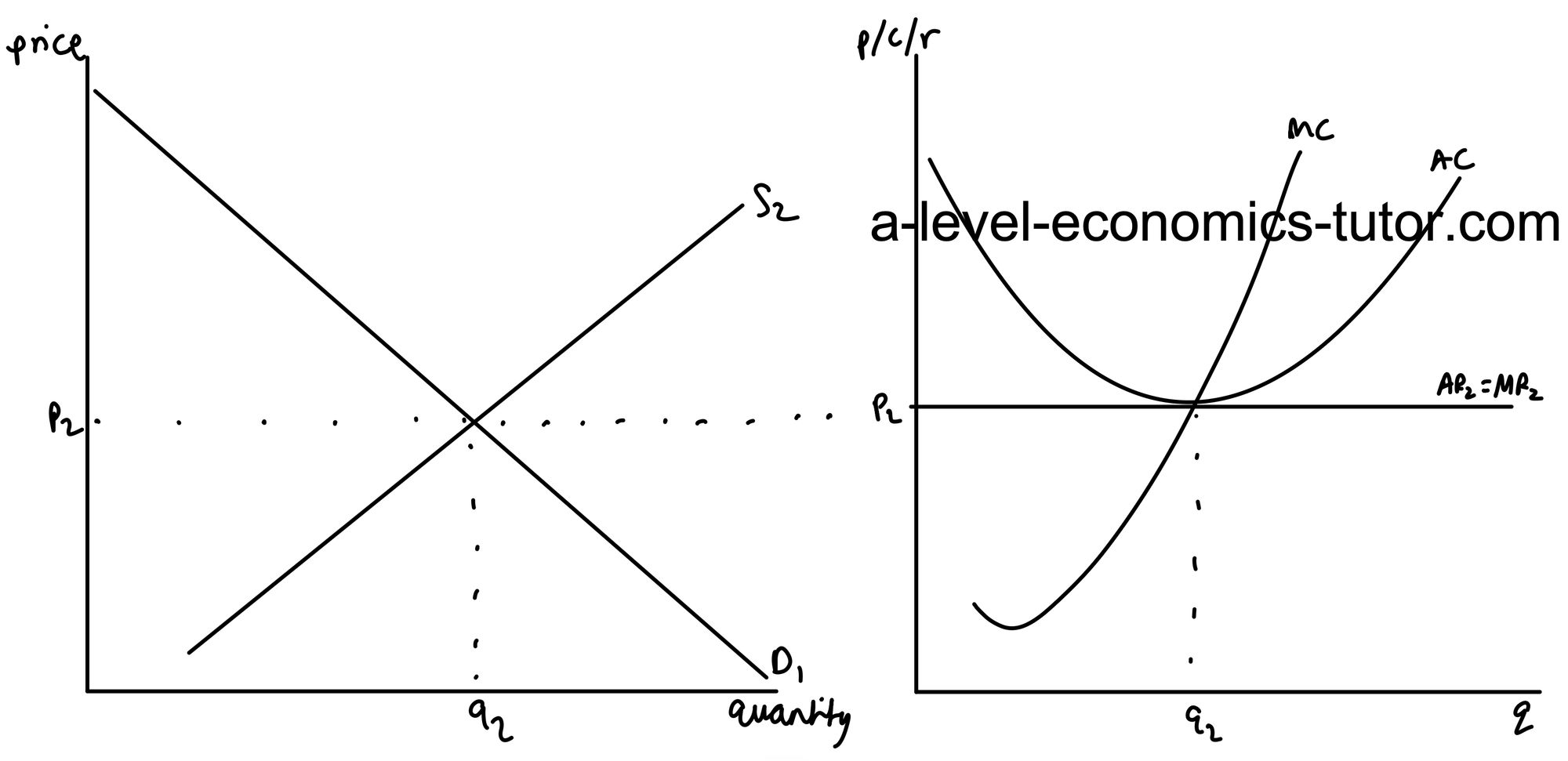
Since there are no barriers to entry, profit-maximising firms would be easily able to enter the market. They are incentivised to do so because they know that existing firms are making profit in excess of normal profits, meaning firms are able to at least cover the cost and the opportunity cost of entering the market. As a result of new firms entering the market, market supply increases. Therefore, each firms’ average revenue falls as they have to accept a lower market price. This eventually leads to a new long-run profit maximising equilibrium where existing firms are only able to make normal profit. In the long-run, firms are allocatively efficient and productively efficient. Firms are productively efficient because they are producing at q2 where MC=AC. At this point, average costs are being minimised, and firms are fully exploiting their economies of scale. If all firms in the economy are productively efficient, it means that the economy is producing the maximum possible output with the available factors of production. Firms are also allocatively efficient, and this is because price equals the marginal cost of the last unit produced. The market is at its natural equilibrium, and this means that total welfare is being maximised, especially consumer surplus.
A-Level Economics Tutoring
I offer one-to-one and small group A-Level Economics tutoring for students across the UK and internationally. With 100+ five-star Google reviews and tutoring experience since 2017, I specialise in helping students understand difficult concepts and improve their exam technique.