Comparative Advantage | A-Level Economics Model Paragraph
One benefit of free trade is that it enables countries to specialise. Specialisation can lead to an increase in world output. Free trade is the act of trading without protecionist barriers. Comparative advantage is when a country produces the good or service with the lowest opportunity cost. Comparative advantage theory can be described by using a model of two countries producing two goods (country A and B producing cars and bikes). The diagram below shows the production possibility curves for this.
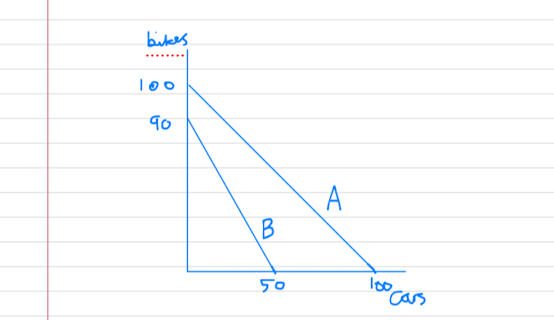
In this example, if each country produced at the half way point on their PPF, then country A would be able to make 50 bikes and 50 cars whilst country B would be able to make 45 bikes and 25 cars. The total world output would be 170 units. However, if country A specialised in cars and country B specialised in bikes then the total world output would be 190. Therefore, total world output would be higher with each country specialising in the good that it has comparative advantage in. We know that country A has a comparative advantage in cars because it has an opportunity cost of 1 bike per car, whereas country B has an opportunity cost of 1.8 bikes per car.
However, there are two reasons why specialisation may not actually lead to a significant increase in output. Firstly, the model only applies to when there is free trade and no additional costs such as transport. Secondly, the model assumes constant returns to scale which is when average costs remain the same at all levels of output. In reality, a country may not seem to have a comparative advantage but if they were to increase output and benefit from economies of scale, they could instead develop a comparative advantage. This means it is better for countries to produce multiple goods or services, especially when developing. Additionally, any economic shocks caused by sudden fluctuations in currencies, protectionism, natural disasters, or conflict could cause sudden shifts in a country's PPF, and this would also have a signficant effect on any trade partners. Cost-push inflation is a common consequence of an external shock.
A-Level Economics Tutoring
I offer one-to-one and small group A-Level Economics tutoring for students across the UK and internationally. With 87+ five-star Google reviews and tutoring experience since 2017, I specialise in helping students understand difficult concepts and improve their exam technique.