Contractionary Fiscal Policy to Reduce a Current Account Deficit | A-Level Economics Model Paragraph
Contractionary fiscal policy
Contractionary fiscal policy can be another measure to reduce a country's current account deficit. It occurs when the government either increases taxes or decreases spending to influence the economy. One example is increasing income taxes. As disposable incomes fall, spending decreases. This is costly, but it also makes the UK more competitive by lowering the price level. This leads to an increase in exports and a decrease in imports, thereby improving the current account.
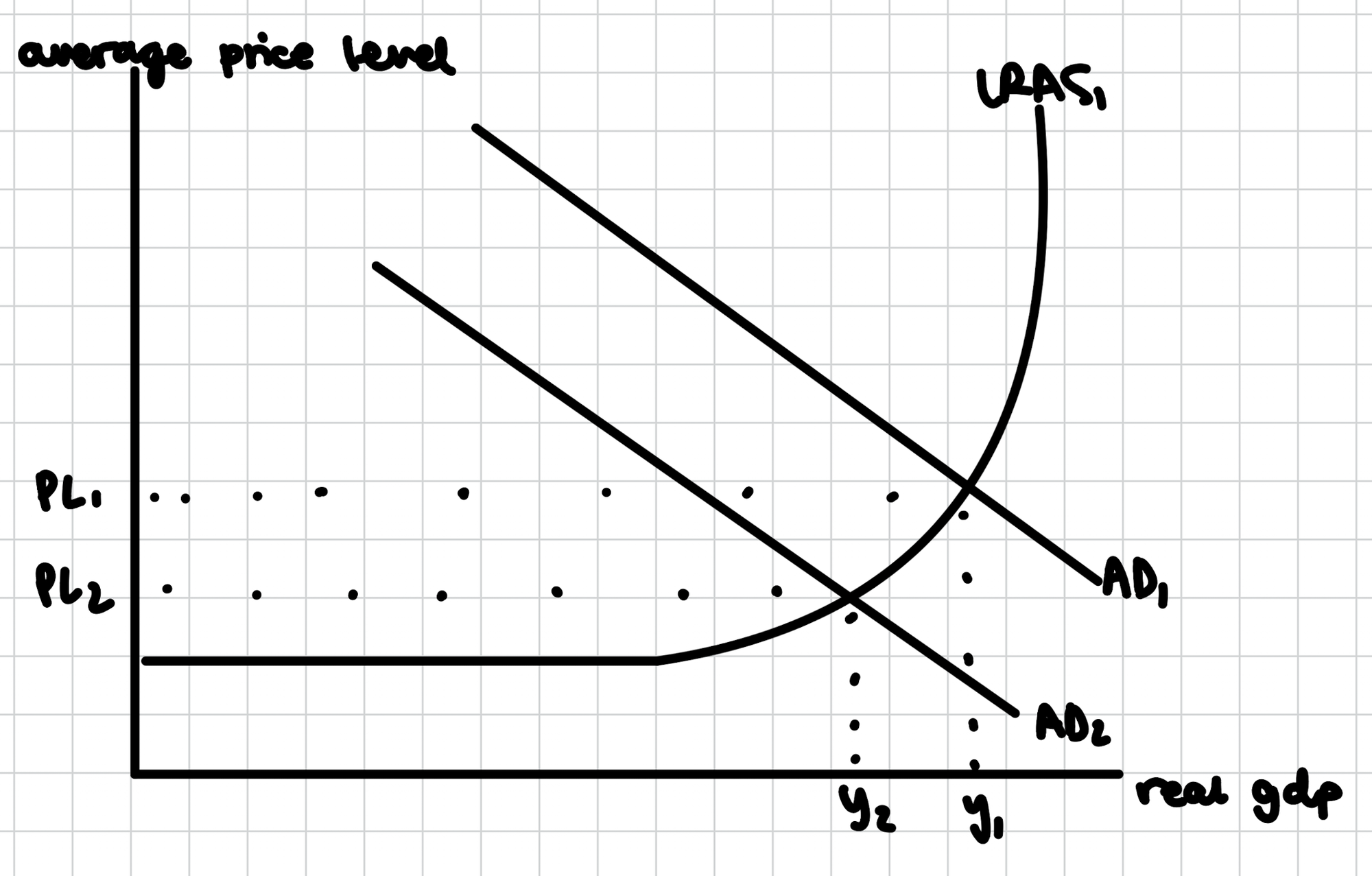
However, whilst using higher income taxes leads to an improvement in the current account, it leads to a worsening of other macroeconomic objectives. The diagram also shows that real GDP decreased from Y1 to Y2, suggesting that economic growth has slowed down. As fewer goods and services are being produced, there is less need for workers. This can cause other issues such as unemployment. Therefore, the government needs to decide if the trade-off is worth it, as a current account deficit may not be such a huge issue that requires such an extreme policy.
A-Level Economics Tutoring
I offer one-to-one and small group A-Level Economics tutoring for students across the UK and internationally. With 87+ five-star Google reviews and tutoring experience since 2017, I specialise in helping students understand difficult concepts and improve their exam technique.