Supply-side Policies | Notes

These revision notes cover everything you need to know about Supply-Side Policies for A-Level Economics. They're designed for students studying AQA A-Level Economics, Edexcel A-Level Economics, and Edexcel International A-Level Economics. Written by Jaisul Naik, UCL Economics graduate and A-Level Economics tutor since 2017.


What are supply-side policies?

Supply-side policies are the policies that the government can use to increase the productive potential of the economy.

The productive potential (LRAS) represents the output of the economy when all factors of production are fully employed.

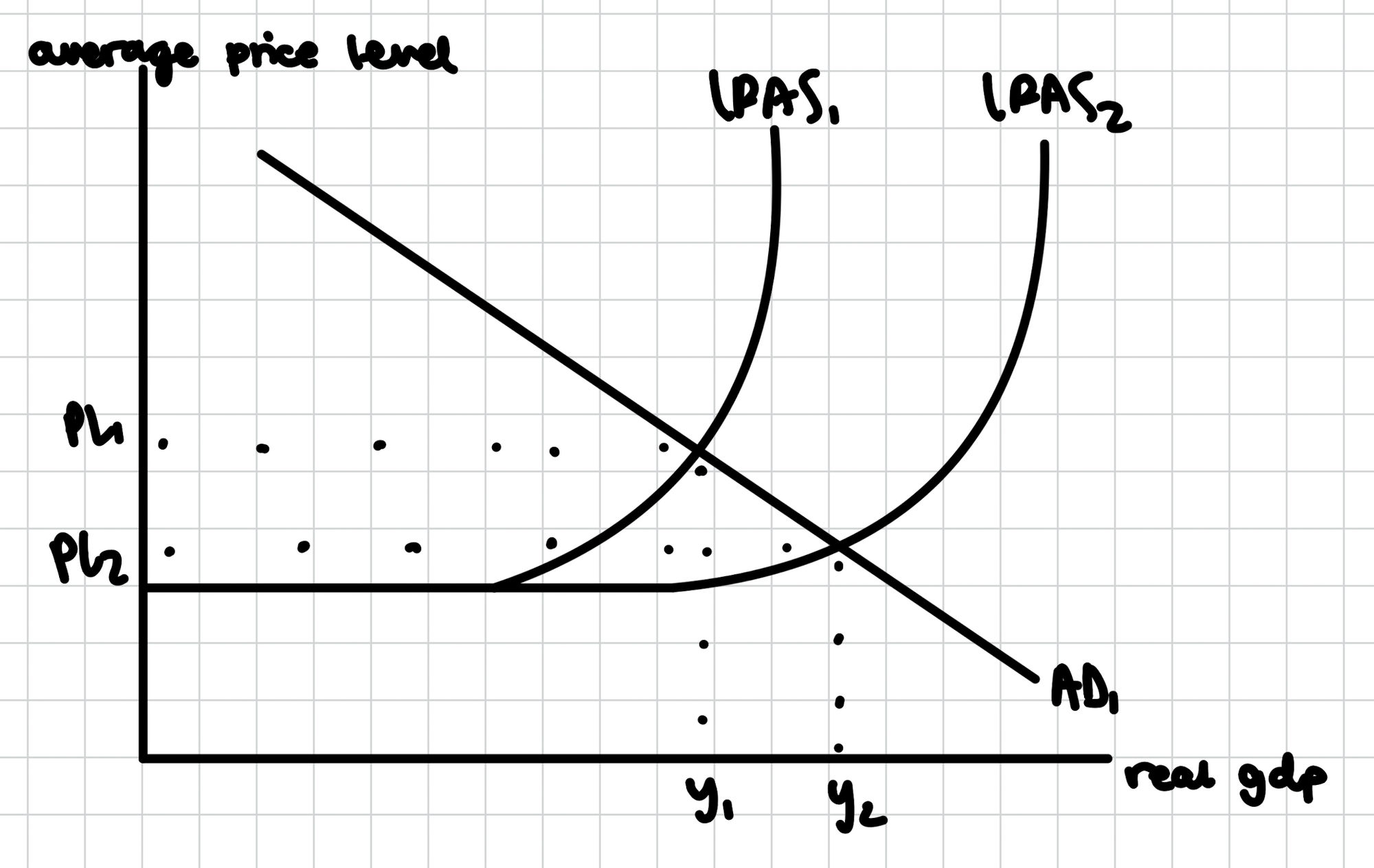
Supply-side policies cause a right shift in long-run aggregate supply.

This is due to an improvement in the quality or quantity of factors of production.
What is the difference between interventionist and market-based supply-side policies?

Free market policies work by reducing government intervention and making markets more free, with the aim of improving productivity.

Interventionist policies work by increasing government intervention, with the aim of improving productivity.

What is the impact of supply-side policies on macroeconomics performance?

Supply side policies cause a right shift in long-run aggregate supply curve when they are complete.

This leads to an increase in economic growth and a decrease in the price level.

This type of economic growth is known as long-run economic growth or potential growth.

In the immediate future, supply-side policies can also affect aggregate demand due to changes in government spending or taxes.

Increasing spending on education and training

  1. The government could increase spending on education and training.
  2. For example, they could improve or offer improved apprenticeships and training schemes.
  3. This means that workers can develop more skills, meaning an improvement in human capital.
  4. This would allow businesses to increase their productivity (output per worker per hour).
  5. Businesses can produce more goods and services when all factors of production are fully employed so there is an increase in the productive potential of the ecoomy.
  6. This can be illustrated by a right shift in the long run aggregate supply curve.

Increasing spending on infrastructure

  1. The government could increase spending on infrastructure.
  2. For example, the government have spent £40 billion so far on HS2.
  3. Better transport would allow businesses to increase productivity (output per worker per hour).
  4. This means that businesses can produce more goods and services when all factors of production are fully employed.
  5. This means there is an increase in productive potential.
  6. This can be illustrated by a right shift in the long run aggregate supply curve.

Lower corporation taxes

  1. Lower corporation taxes would allow businesses to keep more of their profits.
  2. Ireland has a much lower corporation tax than the UK (12.5%) for most businesses.
  3. This has two benefits. Firstly it incentivises more businesses to set up in the country.
  4. Additionally, it allows businesses to increase investment in capital, which allows productive potential to increase.
  5. This causes a right shift in the long run aggregate supply curve.

Lower income taxes

  1. Lower income taxes increases the incentive for people to work.
  2. It can encourage people to work over-time or work harder to achieve promotions.
  3. It can also incentivise skilled workers to move into the UK rather than other places like Dubai.
  4. An increase in the number of skilled workers in the economy would boost productivity, which would allow businesses to produce more when all factors of production are fully employed.
  5. This causes a right shift in the long run aggregate supply curve.

Cut in welfare payments

  1. The government could reduce welfare payments such as Jobseekers Allowance, or they could incease the pension age.
  2. This increases the incentive for people to enter the workforce.
  3. This causes an increase in the supply of labour and it could also result in a fall in wages for low-income jobs.
  4. This allows businesses to reduce their average cost and therefore increase their productivity.
  5. This leads to an increase in productive potential which causes a right shift in the long run aggregate supply curve.

What are the downsides of most supply-side policies?

  1. opportunity cost
  2. time lag

For example, HS2 has already cost the UK government £40bn and it is yet to be completed.

However, supply side policies can also lead to more output, which over time can lead to more government revenue from income tax and corporation tax.


Summary questions

  1. what are supply-side policies?
  2. what is the difference between interventionist and market-based supply-side policies?
  3. what is the impact of supply-side policies on macroeconomics performance?
  4. spending on education and training
  5. spending on infrastructure
  6. lower corporation taxes
  7. lower income taxes
  8. cut in welfare payments
  9. what are the downsides of most supply-side policies?

A-Level Economics Tutoring

I offer one-to-one and small group A-Level Economics tutoring for students across the UK and internationally. With 87+ five-star Google reviews and tutoring experience since 2017, I specialise in helping students understand difficult concepts and improve their exam technique.