Subsidies | A-Level Economics Model Paragraph
Discuss the Effects of a Subsidy on a Market with Positive Externalities
A subsidy is a payment given by the government to firms, causing supply to shift to the right. The diagram below shows the impact of a subsidy on gym membership. Supply is the number of goods and services that firms are willing and able to produce at each price. The right shift in supply causes an extension in demand and a fall in price from p1 to p2. Therefore there are more people who are willing and able to buy a gym membership so the equilibrium quantity increases from q1 to q2. This reduces the market failure in the market for gym memberships, where they were previously being under-consumed due to the externalities being ignored in the free market.
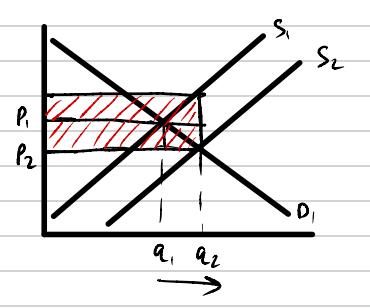
However, a subsidy has a huge opportunity cost and there is a risk of a further misallocation of resources and therefore a risk of government failure. The first issue with subsidies is the huge opportunity cost. Opportunity cost is the value of the next best alternative, and the size of the subsidy is shown by the shaded rectangle. For example, the money used on the subsidy could go into the NHS or to solve other more importnat market failures. Additionally, firms could become dependent on the subsidies, causing the government to maintain this cost over many years. An even worse outcome would be firms misusing the subsidies and not using it to increase output. This could be a more likely outcome when firms have monopoly power in a market.
A-Level Economics Tutoring
I offer one-to-one and small group A-Level Economics tutoring for students across the UK and internationally. With 87+ five-star Google reviews and tutoring experience since 2017, I specialise in helping students understand difficult concepts and improve their exam technique.