Policies to Increase Economic Growth | A-Level Economics Model Paragraph
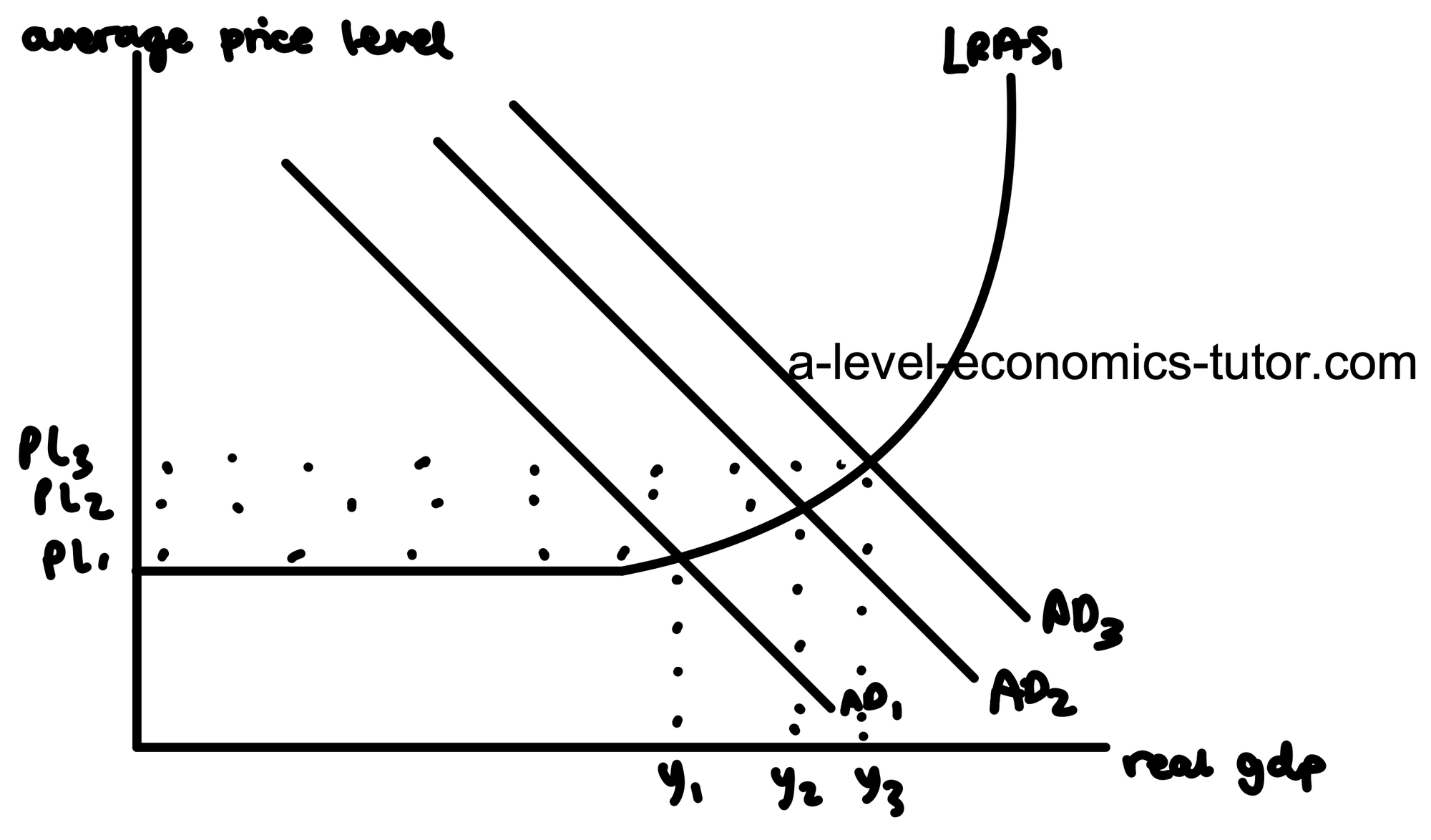
One way to promote economic growth is the use of expansionary fiscal policy. This is when the government increases spending or decreases taxes to influence the level of aggregate demand in the economy. One example is the government reducing income taxes. This allows consumers to have more disposable income. This means that consumer spending (C) is likely to increase, which causes aggregate demand (AD) to increase since C is a component of AD. Initially, this causes real GDP to increase from y1 to y2, and then to y3 through a multiplier effect, as shown on the diagram below. As aggregate demand increases, there is greater demand for goods and services, which leads to an increase in the derived demand for labour. This leads to a decrease in unemployment. As incomes increase further, this causes consumer confidence and consumer spending will increase even further. Additionally, as businesses get closer to full capacity, they are likely to increase their spending on capital (accelerator theory). As consumer spending and business investment increase, aggregate demand increases further. Overall, there is an increase in economic growth from y1 to y3 and an increase in the price level from pl1 to pl3, which shows that expansionary fiscal policy can be useful in promoting economic growth.
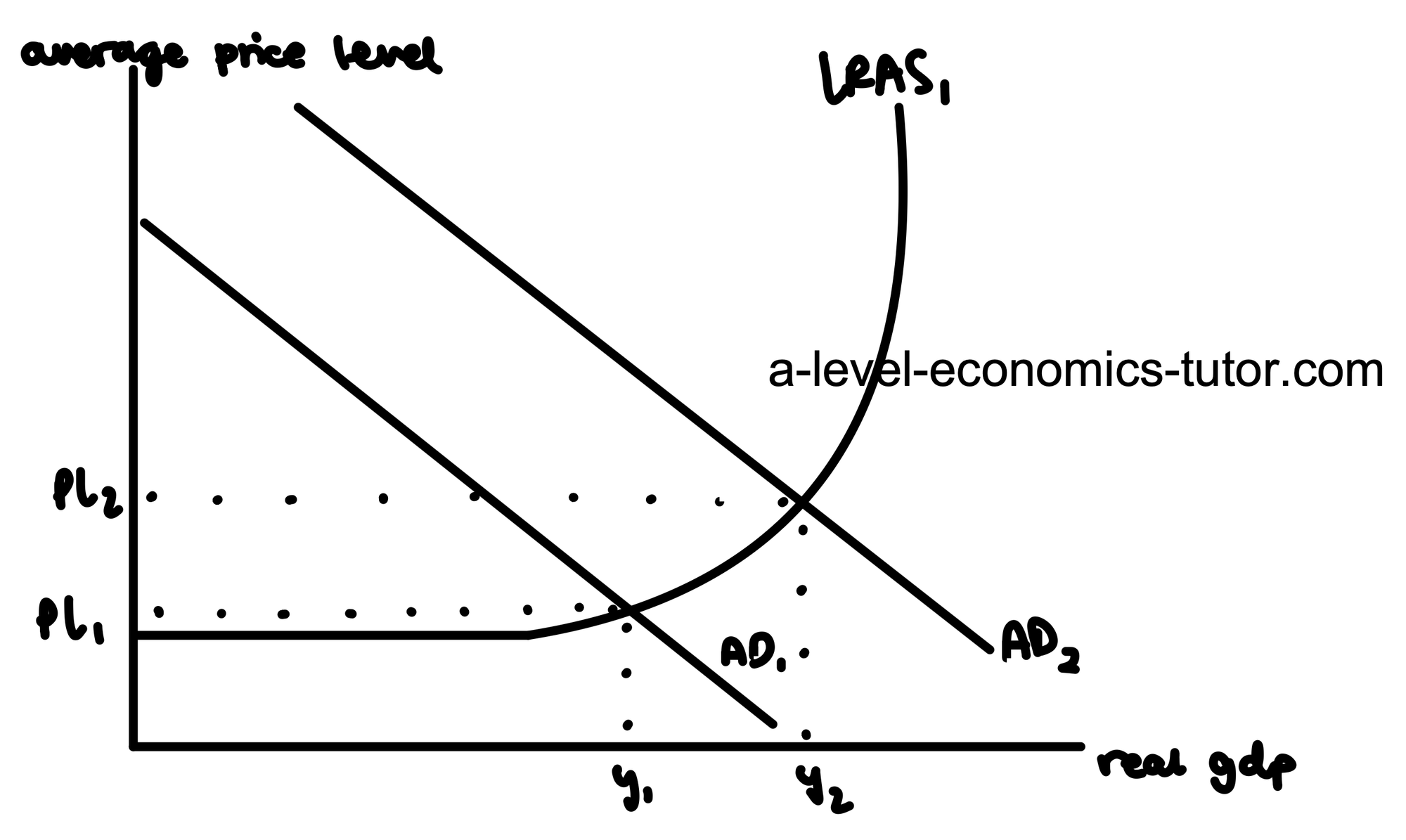
One way to promote economic growth is through the use of expansionary monetary policy. This involves the central bank reducing interest rates in order to influence the components of aggregate demand. Consumer spending is likely to increase due to cheaper borrowing costs. Homeowners are likely to see a boost in disposable incomes as their monthly mortgage payments are likely to fall. Additionally, there might be a wealth effect. Lower interest rates make it more attractive to buy a home. This leads to an increase in the demand and therefore the value of homes. Therefore, homeowners can enjoy greater wealth and greater consumer confidence. As consumer spending (C) increases, business confidence is likely to increase. Additionally, businesses expect to reach closer to full capacity so they are likely to increase investment (I) by spending more on capital goods. Finally, as interest rates fall, there is likely to be a net outflow of hot money. This causes a currency depreciation, making exports cheaper and imports more expensive. Overall, a decrease in interest rates can lead to an increase in C, I and (X-M), causing aggregate demand to increase. The diagram shows AD shifting to the right, leading to an increase in economic growth from y1 to y2, indicating a successful economic recovery. The average price level also increases from pl1 to pl2 as a result of greater demand chasing the same number of goods and services.
A-Level Economics Tutoring
I offer one-to-one and small group A-Level Economics tutoring for students across the UK and internationally. With 87+ five-star Google reviews and tutoring experience since 2017, I specialise in helping students understand difficult concepts and improve their exam technique.