Non-Price Competition | A-Level Economics Model Paragraph
On the other hand, you could argue that supermarkets serve customers well. This is largely because of non-price competition. The supermarket sector is quite likely to be a more competitive oligopoly because authorities such as the CMA usually investigate potential mergers and prevent them if they lead to a firm having too much monopoly power. For example, the CMA prevented Sainsbury's and Asda from merging in 2019 (Extract C). This means that supermarkets is more likely to be a competitive oligopoly where firms are unable to compete on price. Firms know that they cannot raise prices as they would lose market share. Firms also know that it is not worth reducing prices as they would only gain a small amount of market share as other firms would also reduce their prices. The Kinked Demand below shows this. This means that firms would focus on non-price competition to try to increase their market share. This allows customers to benefit from variety and quality of customer service, recipes, taste, quality, and special offers from each supermarket. Depending on prices, firms may also make enough profit to re-invest which would lead to dynamic efficiency and greater improvements in products over time through innovation. So, overall competitive oligopolies can be hugely beneficial for consumers.
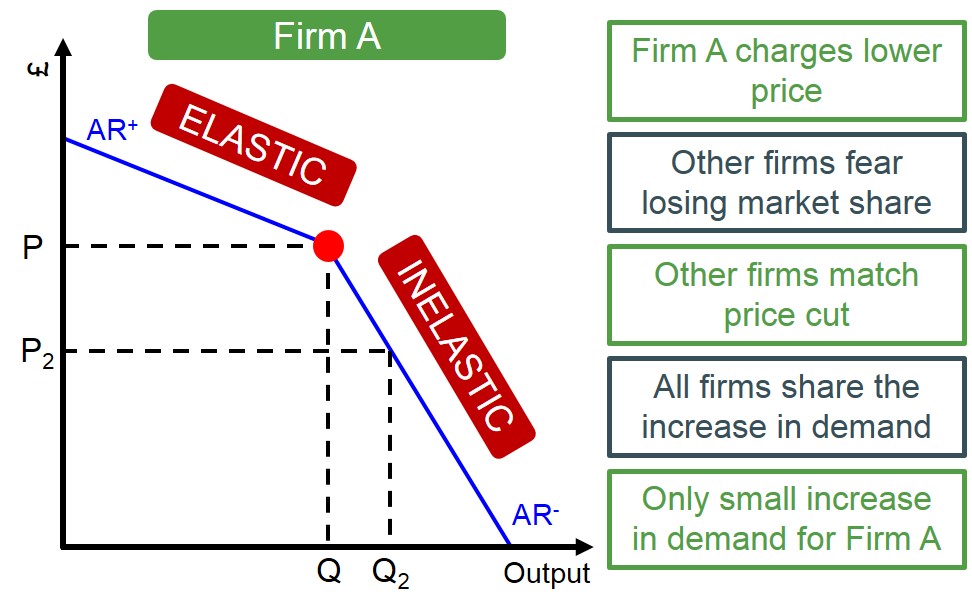
However, oligopolies can greatly vary from one to another so factors such as concentration ratio and market share can make a big difference. For example, the theory of the Kinked Demand curve and price rigidity may not hold in real life because some firms may have some price making power due to brand loyalty, or also in the case of local monopolies. For example, Burger King at an airport or a petrol station on a motorway would be one of the only firms of its kind in the area. Therefore, in that particular branch, they have the ability to set higher prices and exploit customers. So, theories about oligopolies are not always fully consistent with markets in the real world. We also see this with supermarkets like Tesco owning multiple shops in each area which can act as a barrier to entry to other supermarkets. Furthermore, supermarkets may own petrol stations on motorways and this would be another example of a local monopoly where they can set higher prices.
A-Level Economics Tutoring
I offer one-to-one and small group A-Level Economics tutoring for students across the UK and internationally. With 87+ five-star Google reviews and tutoring experience since 2017, I specialise in helping students understand difficult concepts and improve their exam technique.