Natural Monopoly | A-Level Economics Notes
These revision notes cover everything you need to know about Natural Monopoly for A-Level Economics. They're designed for students studying AQA A-Level Economics, Edexcel A-Level Economics, and Edexcel International A-Level Economics. Written by Jaisul Naik, UCL Economics graduate and A-Level Economics tutor since 2017.
What is a natural monopoly?
A natural monopoly is a market structure where the most efficient number of firms in the market is one.
A natural monopoly has an L-shaped LRAC curve. Natural monopolies like train companies have extemely high fixed costs due to the infrastructure needed to set up their business. This means that their economies of scale will outweigh its diseconomies of scale even at high levels of output.
The diagram explains that the most efficient number of firms is one as it allows the existing firm to raise output and therefore lower costs, which allows them to move closer to their minimum efficient scale and achieve productive efficiency.
Natural monopoly diagram
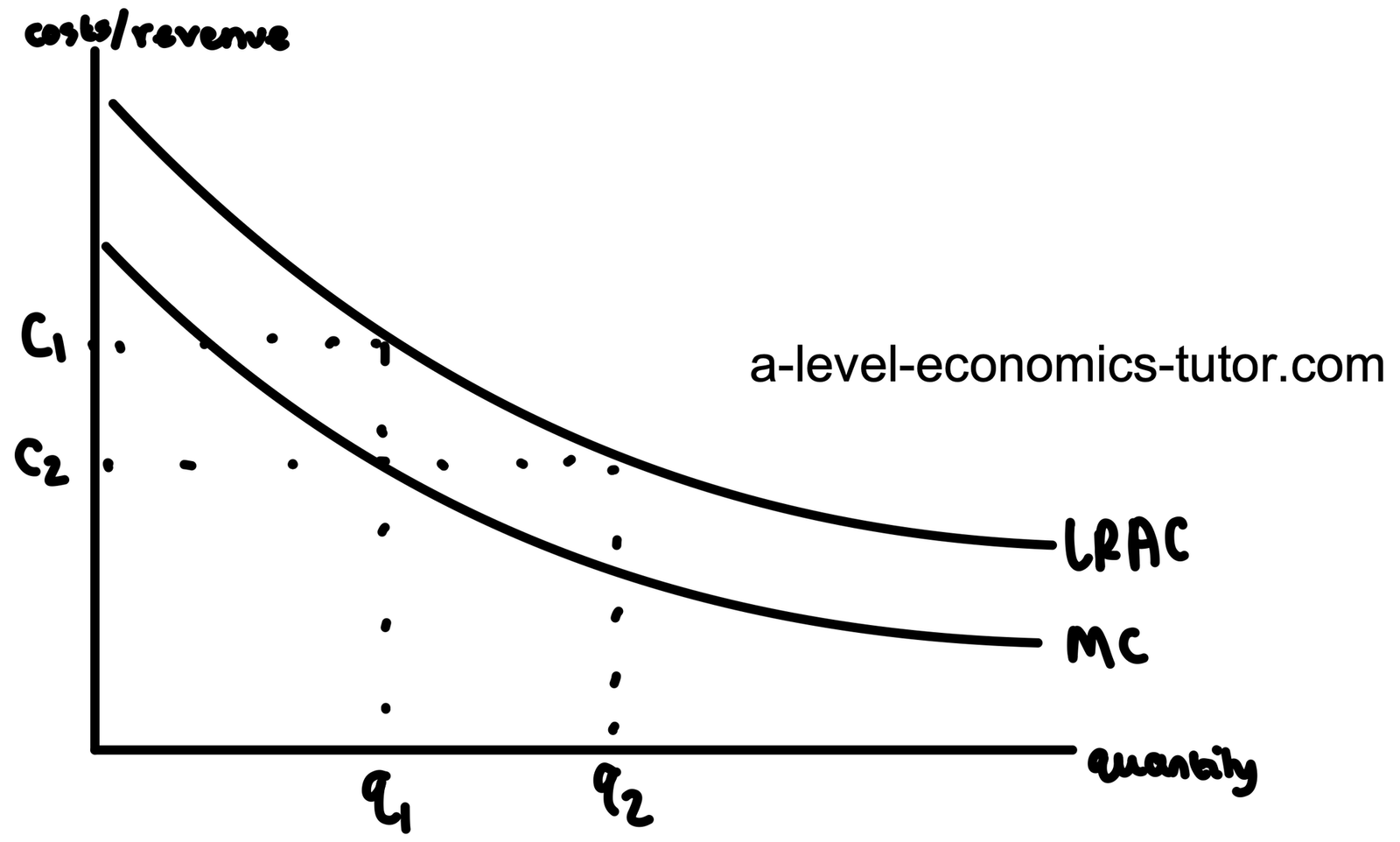
This diagram shows that it is more efficient for only one firm to operate in the market, as they can produce more output themselves, which means that long-run average costs are lower.
What is minimum efficient scale?
Minimum efficient scale (MES) is the lowest point on the LRAC curve. It is also the range of output where a business can achieve productive efficiency.