Indirect Taxes | A-Level Economics Model Paragraph
Discuss the Effects of an Indirect Tax on a Market with Negative Externalities
An indirect tax is an extra cost of production imposed on firms by the government. It causes supply to shift to the left, as shown by the diagram below. Supply is the quantity of goods and services that firms are able to produce at each price. As firms have greater costs, they are willing and able to produce less at each price. The left shift in supply causes a contraction in demand and an increase in price from p1 to p2, and a fall in quantity from q1 to q2. This means that fast food consumption decreases, which reduces the size of the negative externalities and reduces the size of the market failure.
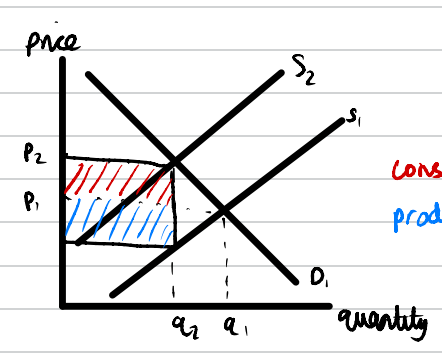
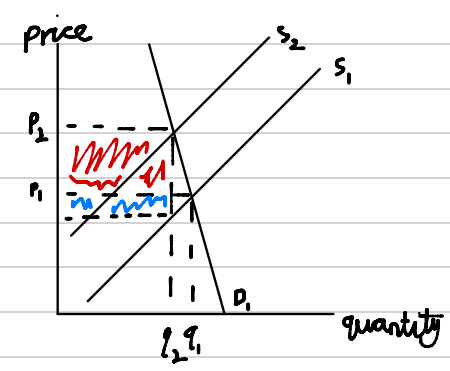
However, an indirect tax could be ineffective and it could cause government failure in the form of information gaps and unintended consequences. For example, the government may not be able to identify if the good or service is inelastic in demand. However, goods like fast food are actually more likely to be inelastic in demand because it is somewhat addictive and also it costs a small proportion of income, so consumers would continue to buy it despite an increase in price. This means that there would be a small decrease in quantity demanded relative to the change in price, as shown by the diagram below. Therefore, the externalities and the market failure would still remain. Additionally, the shaded rectangles show that the consumer burden is far higher than the producer burden. Indirect taxes are regressive and therefore they will affect low-income households more. One positive is the tax revenue that is generated. This is shown by the shaded rectangle and it can be used on other forms of government intervention such as subsidies for healthy food or gyms.
A-Level Economics Tutoring
I offer one-to-one and small group A-Level Economics tutoring for students across the UK and internationally. With 87+ five-star Google reviews and tutoring experience since 2017, I specialise in helping students understand difficult concepts and improve their exam technique.