Government Intervention | A-Level Economics Notes

These revision notes cover everything you need to know about Government Intervention for A-Level Economics. They're designed for students studying AQA A-Level Economics, Edexcel A-Level Economics, and Edexcel International A-Level Economics. Written by Jaisul Naik, UCL Economics graduate and A-Level Economics tutor since 2017.


Indirect taxes

Definition

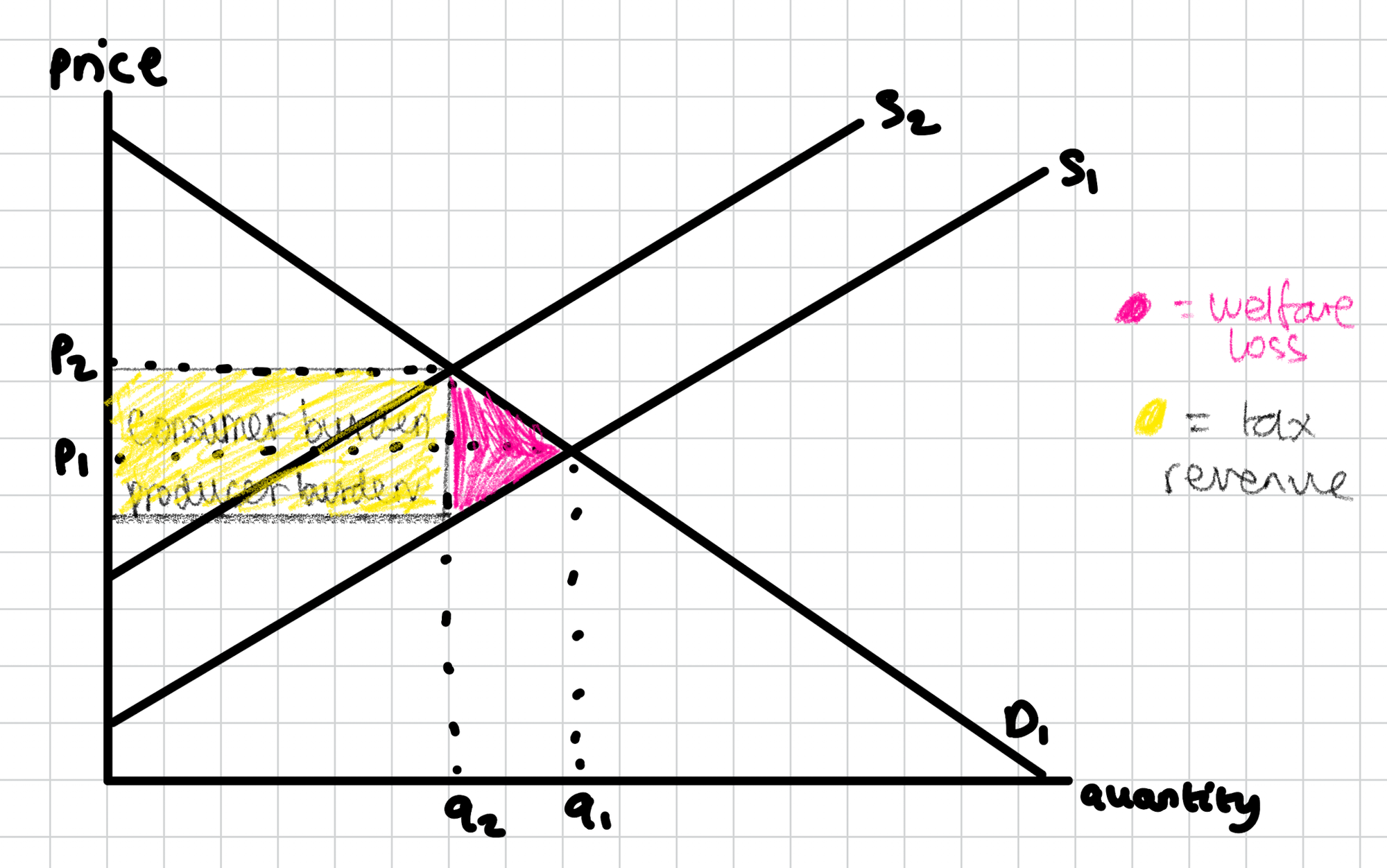
An indirect tax is an extra cost imposed by the government on firms. It causes supply to shift to the left.

Example

Sugar tax, fuel duty.

Diagram
Evaluation

Information gaps

The government may have imperfect information about the PED of the product. This means they may not tax the good by the ideal amount, which means that social welfare will not be maximised as the good or service might continue to be over-consumed.

What is a subsidy?

Definition

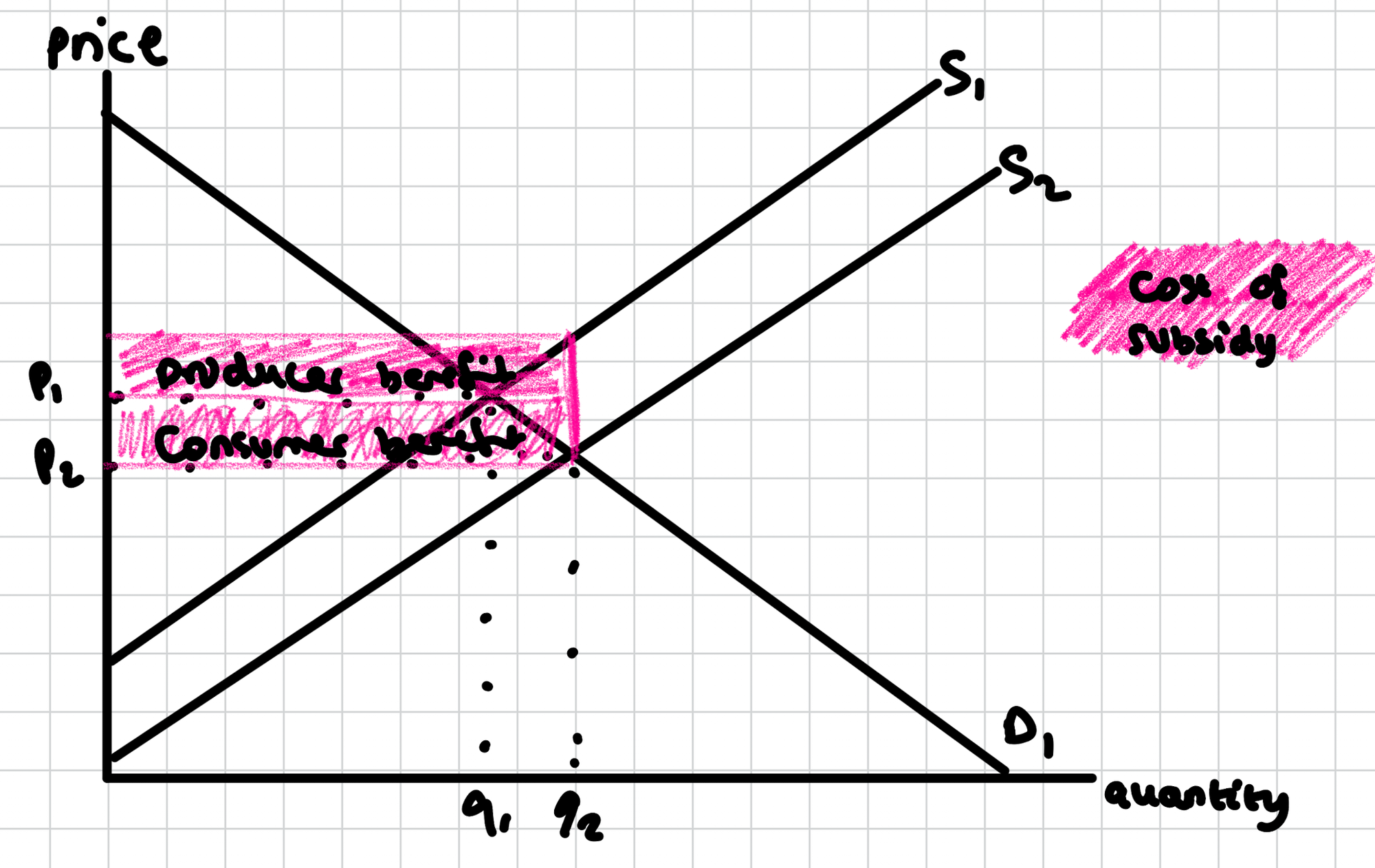
A subsidy is a payment given by the government to firms. It causes supply to shift to the right.

Example

Childcare subsidies, energy bills.

Diagram
Evaluation

Opportunity cost

One downside of subsidies is opportunity cost which is the value of the next best alternative. Providing subsidies means there is less money availabble for the government to spend in other areas.

Unintended consequences

Another downside with subsidies is that firms might become dependent on the subsidies. Also, depending on how much market power the firms have, they may become inefficient and waste money in other areas since the government is covering more of their costs.

Maximum prices

Definition

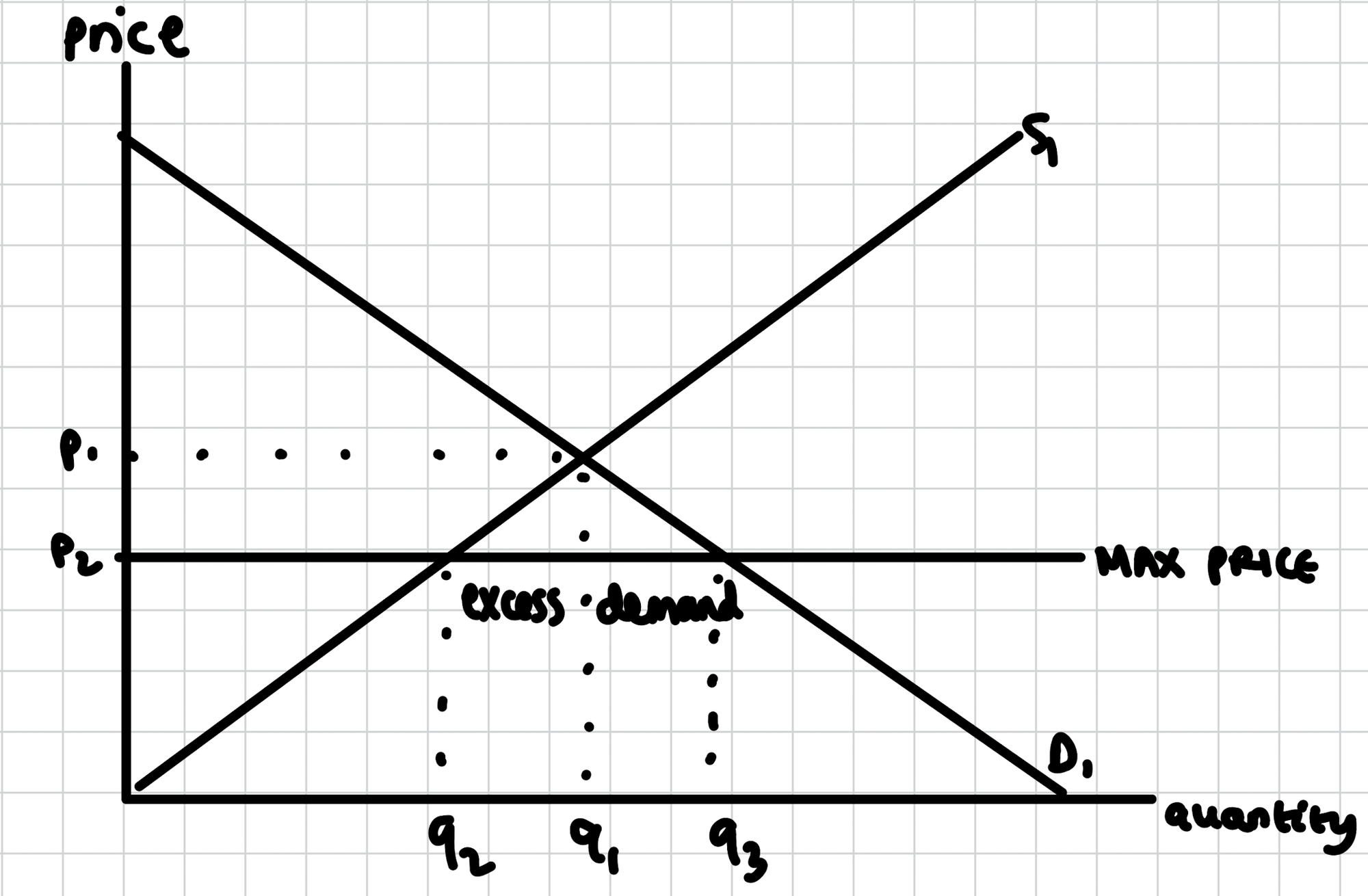
A maximum price is a price above which it is illegal to trade. It should be set below the equilibrium price to have any effect.

Example

Rent controls, maximum price on UK universities.

Diagram
Maximum price diagram A-Level Economics

Evaluation

Distorted markets

A maximum price can prove to be ineffective as it can distort price signals. A lower prices causes a contraction along the supply curve which causes excess demand. This means there is likely to be an under-consumption of the good or service, which means there is likely to be a worsening of the market failure.

Minimum prices

Definition

A minimum price is a price below which it is illegal to trade. It should be set above the equilibrium price to have any effect.

Example

65p per unit of alcohol in Scotland

Diagram

Evaluation

Unintended consequences

A minimum price can prove to be ineffective as it can both distort price signals and cause unintended consequences. A higher prices causes an expansion along the supply curve and a contraction along the demand curve. Some consumers will continue to buy the product despite the higher price. Producers woud know that consumers are still interested in the product at the old market price but know they can't legally find it. This can lead to the creation of black markets.

Tradable pollution permits?

Definition

Tradable pollution permits are permits that are sold or allocated by the government. The permit allows firms to emit a set amount of pollution in a given time period.

Example

UK Emission Trading Scheme, China Cap and Trade Program

Diagram

Evaluation

Excessive administrative costs

The cost to monitor and enforce the policy may outweigh the social welfare gain from the intervention.

Provision of information

Definitions

Information gaps exist when information is either asymmetric or imperfect.

Asymmetric information exists when one party has more information about a transaction than another party.

Imperfect information exists when an economic agent does not have all the information needed to make a rational decision, or the information is distorted in some way.

Provision of information is when the government uses advertising campaigns to allow consumers or producers to better understand the effects of a transaction.

Example

Old advertising campaigns regarding smoking.

Diagram

You can use a demand and supply diagram e.g. advertising campaigns can cause demand to shift left or right.

You can also use an externalities diagram.

You can also shift the MPB curve to show the effects of information provision.

Evaluation

Opportunity cost

Information may easily be ignored. This can be more likely if information is presented poorly; the government should consider behavioural reasons for people's behaviour and the possible use of nudges.

Regulation

Definition

Regulation is when the government impose rules to control/ban/enforce certain behaviour.

Example

The UK government banned cigarettes for those born after 2008.

Diagram

You can use an externalities diagram to explain the reasons for regulation.

Evaluation

Unintended consequences

Strict regulation can lead to the creation of black markets, which can cause even more problems, such as an increase in policing costs.


Summary questions

  1. What is an an indirect tax?
    1. definition
    2. example
    3. diagram
    4. evaluation
  2. What is a subsidy?
    1. definition
    2. example
    3. diagram
    4. evaluation
  3. What is a maximum price?
    1. definition
    2. example
    3. diagram
    4. evaluation
  4. What is a minimum price?
    1. definition
    2. example
    3. diagram
    4. evaluation
  5. What are tradable pollution permits?
    1. definition
    2. example
    3. diagram
    4. evaluation
  6. What is provision of information?
    1. definition
    2. example
    3. diagram
    4. evaluation
  7. What is regulation?
    1. definition
    2. example
    3. diagram
    4. evaluation

A-Level Economics Tutoring

I offer one-to-one and small group A-Level Economics tutoring for students across the UK and internationally. With 87+ five-star Google reviews and tutoring experience since 2017, I specialise in helping students understand difficult concepts and improve their exam technique.