Explain the difference between complete and partial market failure
AQA A-Level Economics Paper 1 June 2022
Explain the difference between complete and partial market failure. (15 marks)
Complete market failure occurs when the free market fails to provide a good entirely, resulting in a missing market. This happens in the case of public goods, which are goods that are both non-rival and non-excludable. These characteristics cause the free-rider problem to occur. A good is non-excludable if it is impossible to prevent someone from accessing it regardless of whether they have paid, and non-rival if one person's consumption does not reduce the amount available for others. The non-excludable nature of public goods means that there is no incentive for consumers to pay, as they can free-ride on the contribution of others. For example, once a pavement has been built or a street lamp has been installed, there is no incentive for users to continue to contribute. Producers would be aware that there is no incentive to provide the good or service in the first place, as they would not be able to profit. This means that there would be a missing market for street lamps if they were left to the free market.
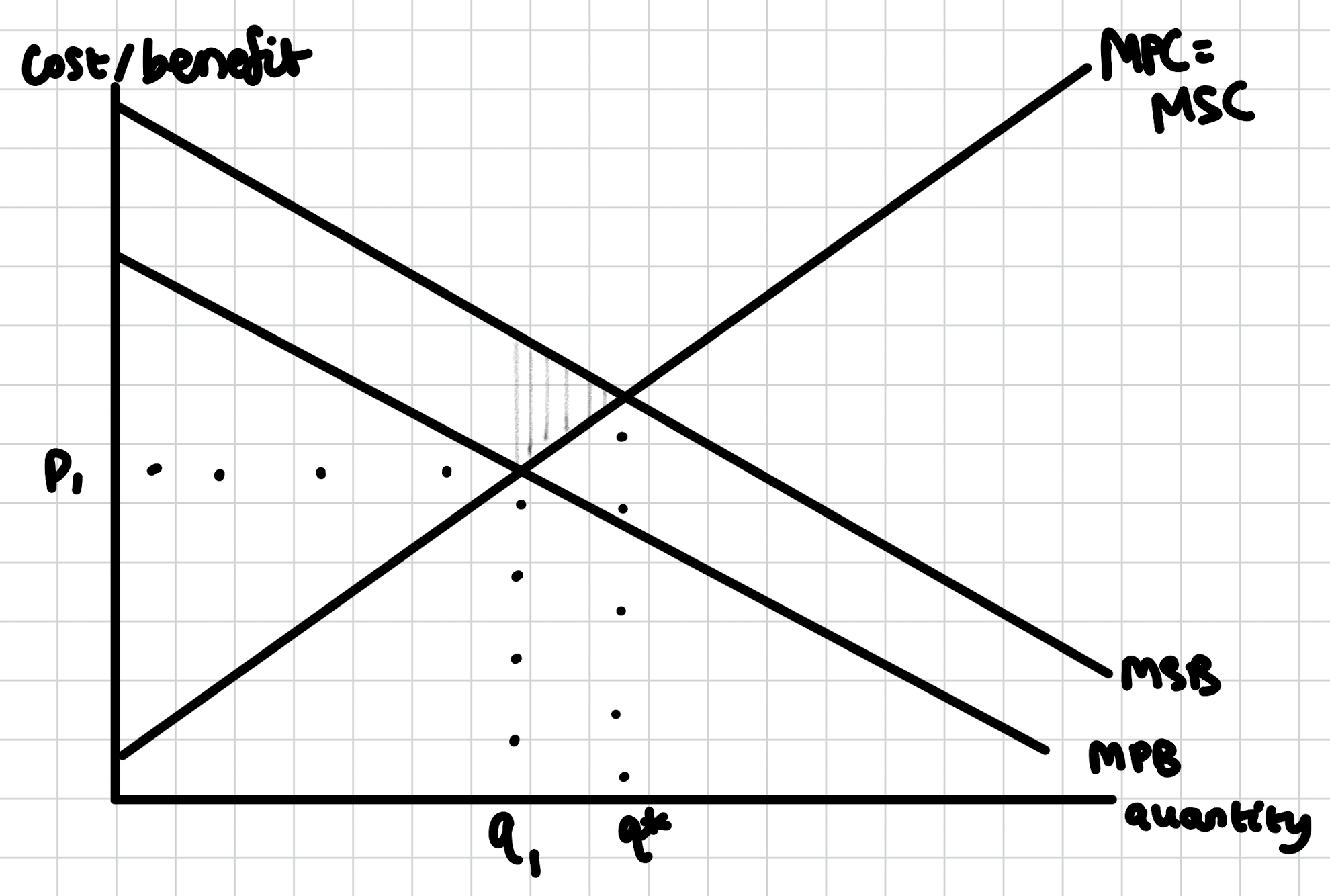
Partial market failure occurs when a good or service is provided inefficiently by the free market. This can be seen in the case of under-consumption of merit goods like bicycle helmets. Bicycle helmets have positive externalities in consumption, which means that there are positive spillover effects from the transaction on a third party. The third party refers to anyone outside of the buyer and seller. For example, the use of a bicycle helmet provides a benefit to the user itself, as they feel safer. The use of the bike helmet also provides a benefit to the rest of society, as there is less risk of a serious accident and therefore less burden on the NHS. The buyer and seller are unlikely to consider the external benefit and therefore bike helmets will be under-consumed by the free market, as shown in the diagram below. The triangle pointing between the free-market outcome at q1 (MPC=MPB) to the socially optimal level of output (MSC=MSB) at q2 shows the loss in social welfare as a result of the under-consumption.
A-Level Economics Tutoring
I offer one-to-one and small group A-Level Economics tutoring for students across the UK and internationally. With 87+ five-star Google reviews and tutoring experience since 2017, I specialise in helping students understand difficult concepts and improve their exam technique.