Explain why, in a free market, sugary drinks may be overconsumed
AQA A-Level Economics Paper 1 June 2017
Explain why, in a free market, sugary drinks may be overconsumed. (15 marks)
A market is a place where buyers and sellers meet to exchange goods and services. A free market has no government intervention so price and quantity is determined by demand and supply.
- The first reason why sugary drinks are overconsumed in free markets is because of market failure.
- Demerit goods like sugary drinks have negative externalities in consumption.
- These get ignored in the free market.
- When sugary drinks are consumed, there is a cost imposed on the third party.
- The third party can refer to anyone apart from the buyer or seller.
- For example, a regular consumer of sugary drinks enjoys the taste but may have worse health. This creates a burden on the NHS, which creates a burden on taxpayers.
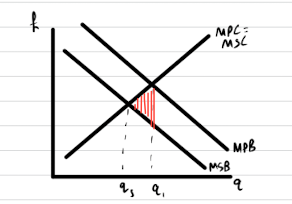
- The diagram shows a free market equilibrium where MPC = MPB.
- Since social benefit = private benefit + external benefit, there is a divergence between the MSB curve and the MPB curve.
- The MSB curve is lower than the MPB curve as it factors in the negative externalities in consumption.
- q1 is the free market equilibrium and qs shows the socially optimal quantity where externalities are considered. It is where MSC=MSB.
- Therefore, this diagram shows sugary drinks are being over-consumed.
- Another reason why sugary drinks are over-consumed can be explained by behavioural economics.
- Behavioural economics uses psychology to understand the limitation of the assumption that consumers are completely rational.
- Behavioural economics allows us to understand that consumers have bounded rationality and bounded self-control.
- Bounded rationality exists because of a lack of time, poor information, and computational weakness.consumers.
- This means that agents instead rely on rule of thumb (mental shortcuts) to make day-to-day decisions.
- Rule of thumb allow consumers to save time and mental effort but also lead to consumers making decisions that are not optimised.
- These rules of thumb lead to biases and issues such as social norms, where someone may feel that society finds it strange that someone never drinks sugary drinks, despite the fact that they are unhealthy.
- Hence, demand for sugary drinks is higher than it should be and this could be reduced by government intervention such as provision of information or through behavioural economics techniques such as nudges.
A-Level Economics Tutoring
I offer one-to-one and small group A-Level Economics tutoring for students across the UK and internationally. With 87+ five-star Google reviews and tutoring experience since 2017, I specialise in helping students understand difficult concepts and improve their exam technique.