Evaluate the view that the supermarket sector is serving customers' interests well
AQA A-Level Economics Paper 1 June 2022
Evaluate the view that the supermarket sector is serving customers' interests well. (25 marks)
- Plan
- Paragraph 1
- Argument: threat of collusion
- Diagram: two-firm, two-outcome model, monopoly power
- Evaluation: unlikely in supermarket sector due to CMA
- Paragraph 2:
- Clear argument: possibility of non-price competition
- Diagram: kinked demand curve
- Evaluation: high costs, local monopoly, dynamic efficiency?
- Judgement: it is serving customers well but we should monitor to prevent any collusion
- Paragraph 1
Oligopolies are market structures with a few firms. Oligopolies can often serve customers well but this significantly depends on the behaviour of firms in the market and the threat of collusion. They can be collusive or competitive.
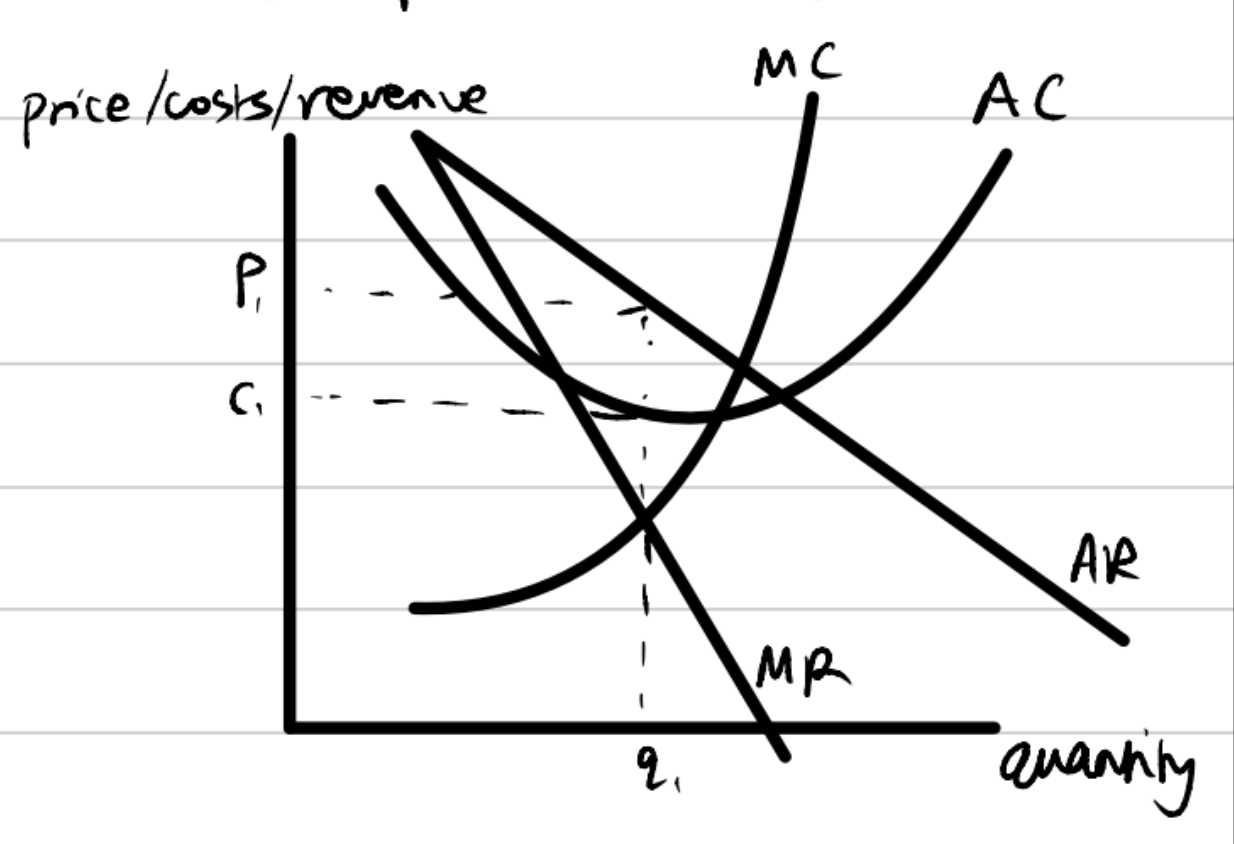
The supermarket sector could be damaging to consumers due to the risk of collusion. Extract F Line 1 mentions that economists have been worried about the lack of competition in the industry. Despite collusion being illegal in the UK, there is always a risk of tacit collusion taking place as it is informal and harder to spot. Collusive oligopolies can form if firms with a high market share secretly agree to limit quantity and set high prices. Game theory allows us to understand the benefits and the risks of different pricing strategies. Prisoner's Dilemma explains how firms that are interdependent may approach pricing. Firms know that they cannot set a high price unless they collude. This is because there is a huge risk a competitor would undercut them and steal all the profits. Therefore, the Nash equilibrium is for both firms to set lower prices. However, firms know that they could both set a high price if there is trust between them. If they can form an agreement not to undercut each other, firms can set a higher price and maximise profits. The first diagram shows this in terms of prisoners who may both choose to deny a crime assuming they have full trust that the other prisoner does not confess. The second diagram shows that these oligopolistic firms could then benefit from colluding by exploiting their price-making power and profit maximising. This leads to a high price and a low output of p1 and q1. This outcome is allocatively inefficient as AR does not equal to MC, which means that consumer surplus is nowhere near maximised. Extract F described that the second and third largest supermarkets attempted a merger, which would have given them signficant monopoly power, alongside Tesco, compared to any other supermarket.

However, even if firms could collude, there is arguably the benefit that they could use the high profits for re-investment and this would lead to innovations and quality products in the long run. This is called dynamic efficiency and this would benefit consumers over time. For example, pharmaceutical companies make a lot of profit but this also enabled them to quickly create innovative products, including the Covid vaccine at a very fast rate. We might also see supermarkets often re-investing in their recipes and their bakeries to create the best products for consumers.
On the other hand, you could argue that supermarkets serve customers well. This is largely because of non-price competition. The supermarket sector is quite likely to be a more competitive oligopoly because authorities such as the CMA usually investigate potential mergers and prevent them if they lead to a firm having too much monopoly power. For example, the CMA prevented Sainsbury's and Asda from merging in 2019 (Extract C). This means that supermarkets is more likely to be a competitive oligopoly where firms are unable to compete on price. Firms know that they cannot raise prices as they would lose market share. Firms also know that it is not worth reducing prices as they would only gain a small amount of market share as other firms would also reduce their prices. The Kinked Demand below shows this. This means that firms would focus on non-price competition to try to increase their market share. This allows customers to benefit from variety and quality of customer service, recipes, taste, quality, and special offers from each supermarket. Depending on prices, firms may also make enough profit to re-invest which would lead to dynamic efficiency and greater improvements in products over time through innovation. So, overall competitive oligopolies can be hugely beneficial for consumers.
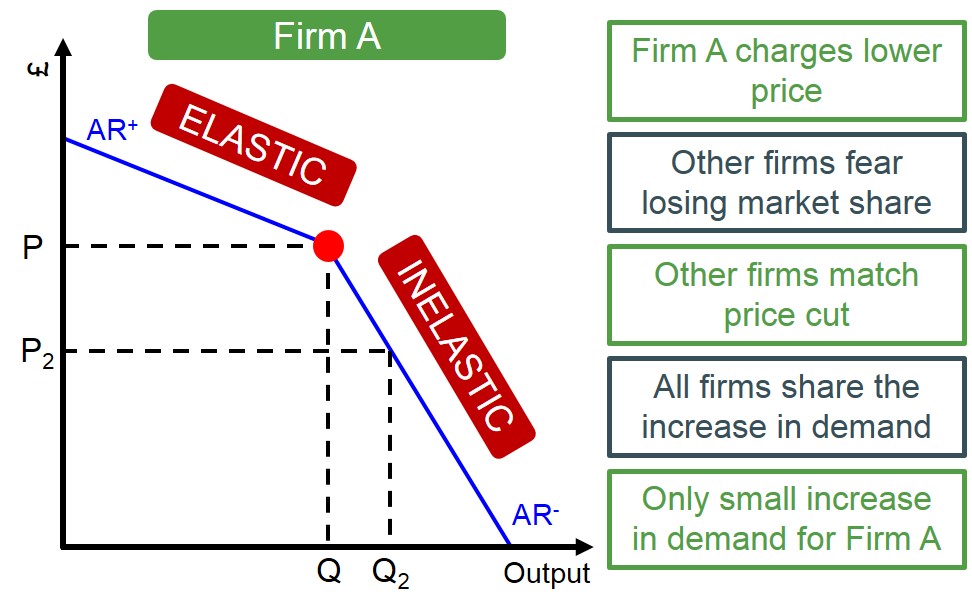
However, oligopolies can greatly vary from one to another so factors such as concentration ratio and market share can make a big difference. For example, the theory of the Kinked Demand curve and price rigidity may not hold in real life because some firms may have some price making power due to brand loyalty, or also in the case of local monopolies. For example, Burger King at an airport or a petrol station on a motorway would be one of the only firms of its kind in the area. Therefore, in that particular branch, they have the ability to set higher prices and exploit customers. So, theories about oligopolies are not always fully consistent with markets in the real world. We also see this with supermarkets like Tesco owning multiple shops in each area which can act as a barrier to entry to other supermarkets. Furthermore, supermarkets may own petrol stations on motorways and this would be another example of a local monopoly where they can set higher prices.
In conclusion, I would judge that the supermarket sector is currently serving customers well because of the non-price competition leading to great variety in branding, and good customer service at each of the supermarkets. However, it is important to continue to monitor the supermarket sector to prevent any potentially large mergers, as signifgicant monopoly power could lead to higher prices for customers. The CMA should also consider regulating local monopolies from exploiting customers.
A-Level Economics Tutoring
I offer one-to-one and small group A-Level Economics tutoring for students across the UK and internationally. With 87+ five-star Google reviews and tutoring experience since 2017, I specialise in helping students understand difficult concepts and improve their exam technique.