Evaluate the disadvantages of a current account deficit
Edexcel International A-Level Economics Unit 4 January 2026 A
In 2023 the current account deficit on the balance of payments in South Africa was $6.14bn and in Argentina it was $21.5bn. Evaluate the disadvantages of a current account deficit. Refer to a country of your choice in your answer. (20 marks)
Plan
- Paragraph 1
- Argument: CA deficit slows down economic growth
- Diagram: AD shifting left
- Evaluation: X-M is only a small % of AD
- Paragraph 2
- Argument: CA deficit causes currency deprecation
- Diagram: demand and supply of curency
- Evaluation: depends if deficit is structural/cyclical
A current account deficit occurs when there is more money leaving the country than entering in a given year. The current account includes trade in goods, services, primary income and secondary income. An equilibrium on the current account is one of the main macroeconomic objectives for many countries.
One disadvantage of a current account deficit in the UK is that it can slow down economic growth. A current account deficit occurs when the value of imports is greater than the value of exports. Net exports (X-M) is one of the determinants of aggregate demand, which is the total planned spending in the economy. If the UK experiences a current account deficit, there would be a decrease in the value of (X-M) and therefore a left shift in the AD curve. The diagram below shows that the outcome is a decrease in output from y1 to y2. This suggests there would be a fall in real GDP (negative economic growth) and also an increase in unemployment. This is because demand for labour is derived from the demand for goods and services, which is now lower due to a fall in demand for UK exports and also a fall in consumer spending (as consumers are buying more imports instead). An increase in unemployment is damaging as it means that more people have low or no disposable income and this can lead to an increase in inequality and a fall in living standards.
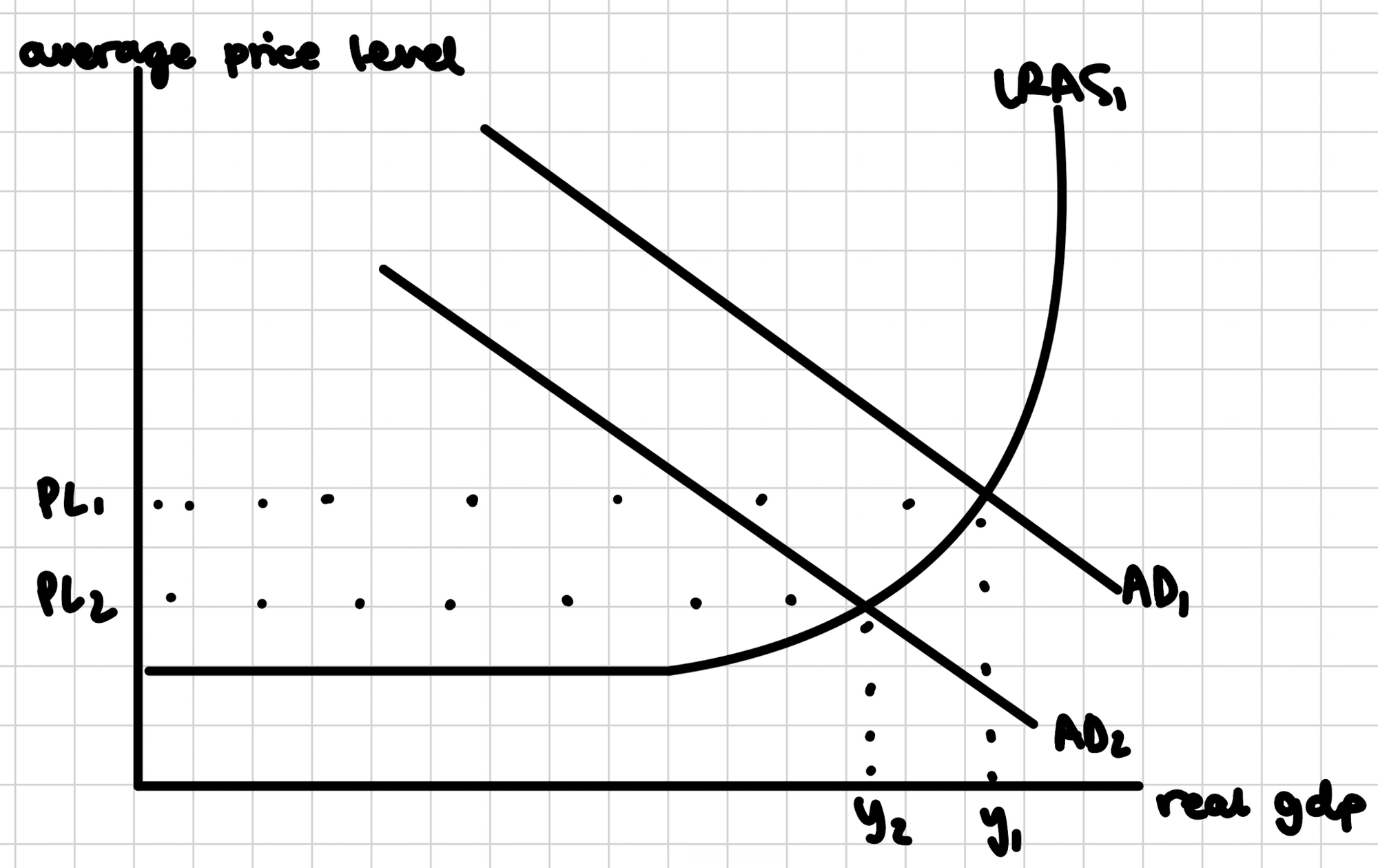
However, in the UK, consumer spending (C) is the largest determinant of aggregate demand (around 60%) so a fall in net exports may not have a significant impact on aggregate demand as long as consumer spending remains high. A trade deficit could be cyclical, meaning it is actually a sign of strong economic growth in the UK. As the economy grows, the trade balance will naturally worsen due to two main reasons. Firstly, as the average price level increases, competitiveness worsens, whilst imports become relatively cheaper. Secondly, as the economy grows, incomes increase, therefore consumers have a higher marginal propensity to import things like cars, holiday packages, and clothing, which are considered luxury goods, so demand increases in line with incomes.
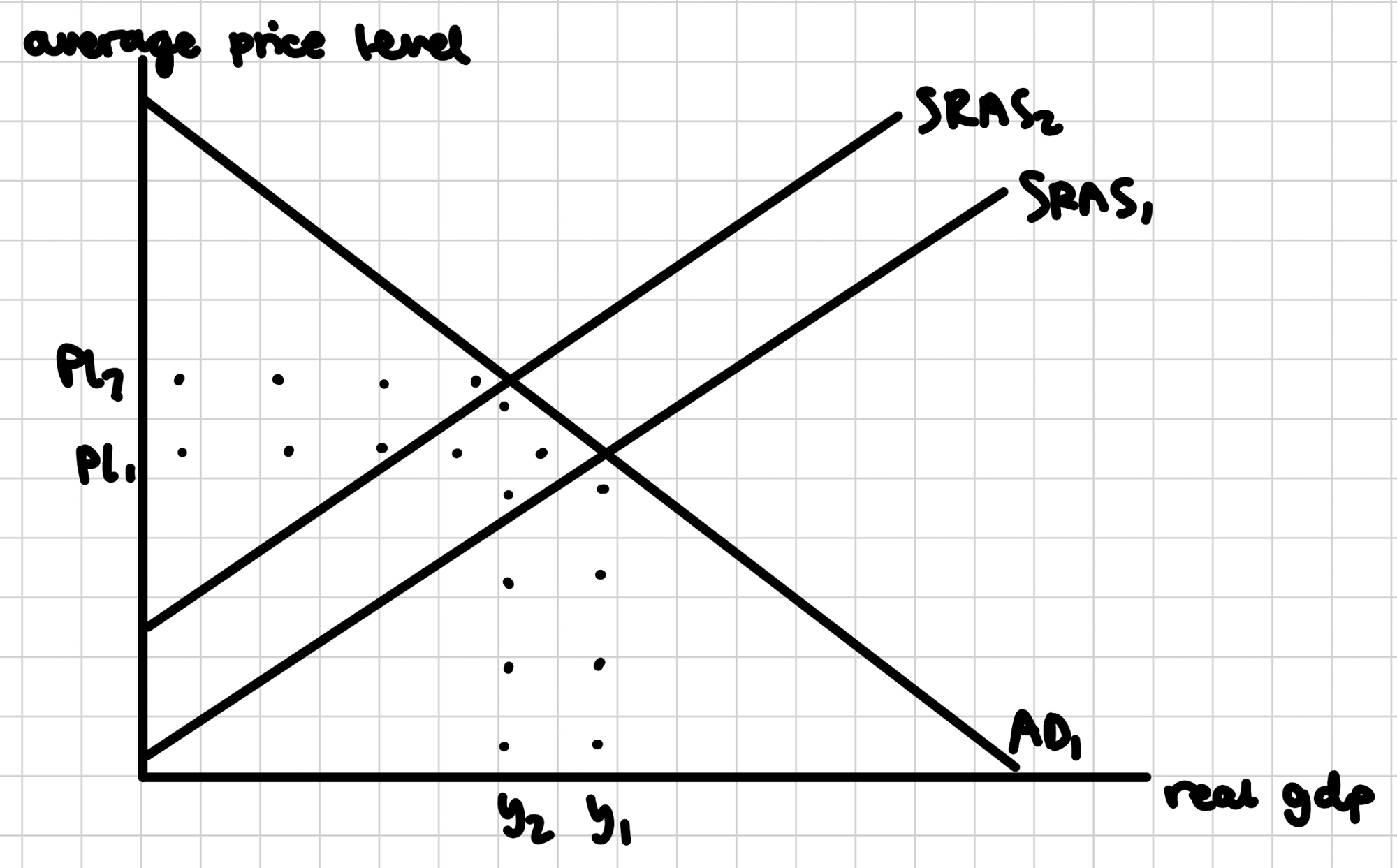
Another disadvantage of a persistent current account deficit is that means that the country is more vulnerable to an economic shock. One of the main causes of a current account deficit is poor competitiveness, which could itself be caused by low productivity or high costs. If a country like the UK has not implemented sufficient supply-side policies, it becomes increasingly difficult for them to export goods. This slowly makes consumers and firms in the UK dependent on imports, which leaves them vulnerable to shocks. Examples of UK imports include oil and gas, as well as manufactured goods. If there is an external shock, such as conflict or a shortage in supply, this means the price of imports suddenly rise. As a result of factors such as high oil prices, firms in the UK face significantly higher costs of production, due to higher energy bills. The effect of this is cost push inflation, as seen in the diagram below. UK inflation exceeded 10% in 2022 and this could happen again in 2026, due to higher energy, fuel and food costs. High inflation is damaging as it reduces the value of money and consumers see a decline in standards of living unless they are provided an increase in pay.
However, many people would argue that a current account deficit is not a cause for concern if a country is running a floating exchange rate system. This is when the value of the currency is determined by market forces. So, when a country has a current account deficit, there is higher demand for imports and lower demand for exports. This means there is a higher supply of the pound on the market and a lower demand for the pound. This would cause the pound to depreciate. A weaker pound makes UK exports cheaper and more competitive and makes imports into the UK more expensive. Therefore, in theory, exports should increase and imports should decrease, which means that a current account deficit can self-correct without any government intervention.
In conclusion, the main disadvantages of a current account deficit are slower economic growth and over-dependence on other countries. Whether a current account deficit is significantly bad depends more on the cause of the deficit. As mentioned, a cyclical current account deficit is a sign of a strong economy, and deficits naturally tend to increase during periods of growth. This would not be a cause for concern. However, persistent current account deficits due to a weak supply side or poor competitiveness are a cause for concern, as they lead to overdependence on other economies. This makes countries prone or vulnerable to economic shocks when oil prices rise and protectionist measures are put in place.
A-Level Economics Tutoring
I offer one-to-one and small group A-Level Economics tutoring for students across the UK and internationally. With 87+ five-star Google reviews and tutoring experience since 2017, I specialise in helping students understand difficult concepts and improve their exam technique.