Evaluate the view that technological change tends to bring industries closer to the market structure of perfect competition
AQA A-Level Economics Paper 1 November 2021
Price comparison websites were used to purchase 53% of car insurance policies in 2017, improving competition and reducing prices for consumers. In other sectors, dominant firms such as Amazon have used innovation to capture market share. In the UK, 70% of online consumers say that Amazon is the first online retailer they visit when buying goods.
Evaluate the view that technological change tends to bring industries closer to the market structure of perfect competition. (25 marks)
Plan
- Paragraph 1:
- Argument: on the one hand, technological change makes the characteristics of perfect competition more realistic e.g. the market for second-hand mobile phones
- Diagram: perfect competition long-run diagram
- Evaluation: however, perfect competition might not necessarily be the best outcome for an industry
- Paragraph 2:
- Argument: on the other hand, technological change can bring some industries further away due to internal economies of scale
- Diagram: monopoly diagram
- Evaluation: however, a monopoly might provide the best outcomes in some industries e.g. natural monopolies
Perfect competition is a market structure that consists of many buyers and sellers, homogeneous products, perfect information, and no barriers to entry or exit. Perfect competition is mostly used as a benchmark to compare other market structures to.
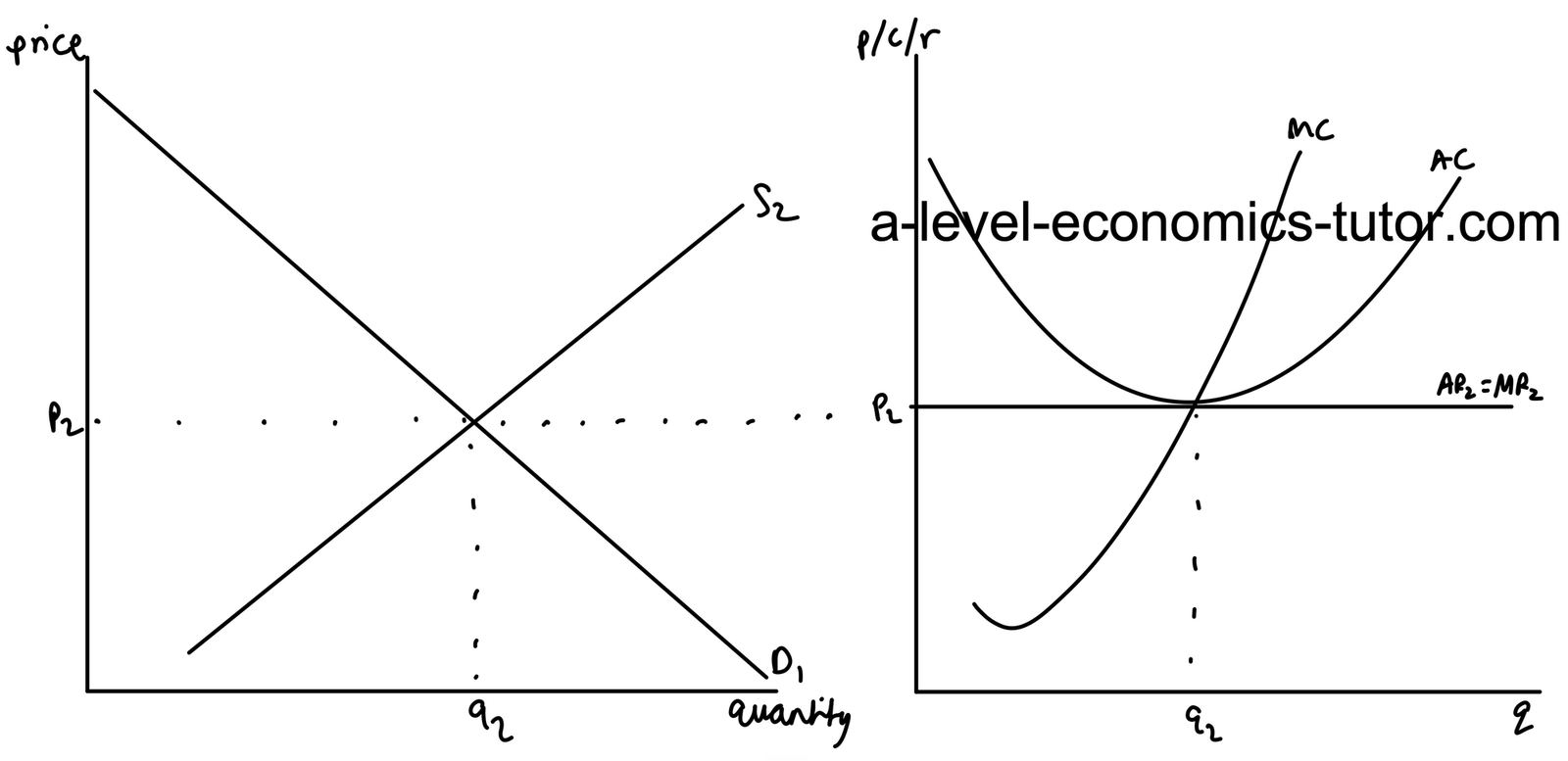
On the one hand, you could argue that technological change has made the characteristics of a perfectly competitive market significantly more realistic. For example, the market for second-hand mobile phones has become more competitive due to technological change. Firstly, barriers to entry are lower as sellers can list their devices on platforms like eBay at little or no cost, and they do not need to pay for a physical store. Secondly, there is close to perfect information for both competitors and consumers about the prices that various sellers are charging. Previously, consumers would have to travel to various locations to compare prices. Thirdly, you could also argue that there is little or no product differentiation as sellers must categorise their devices with a grade such as "like new". There are also many other examples where characteristics have changed. Information is far more readily available due to comparison sites, Google search and AI search. Overall, these changes mean that firms must act as price-takers meaning that their average revenue curves are perfectly elastic; firms are unable to charge more than the market price as they would lose customers. In the long-run, this means that new firms enter so existing firms can only make normal profit, as shown on the diagram below. In the long-run, firms produce an output of q2 where they can charge a price of p2. In comparison, firms in these markets would have had a greater degree of monopoly power before these advancements in technology.
However, it is questionable whether or not it is even beneficial for many industries to move closer to perfect competition. Firms in perfectly competitive markets are usually productively and allocatively efficient in the long run but they are unable to achieve dynamic efficiency. Firms are productively efficient because they have no choice but to produce at the lowest point on their average costs curve if they want to survive in the market. Additionally, because average revenue = marginal costs (AR=MC), social welfare, and consumer surplus, is being maximised. But, because firms are only able to make a normal profit, they do not have the ability to re-invest. This means that firms in extremely competitive industries are unable to innovate or improve their products over time.
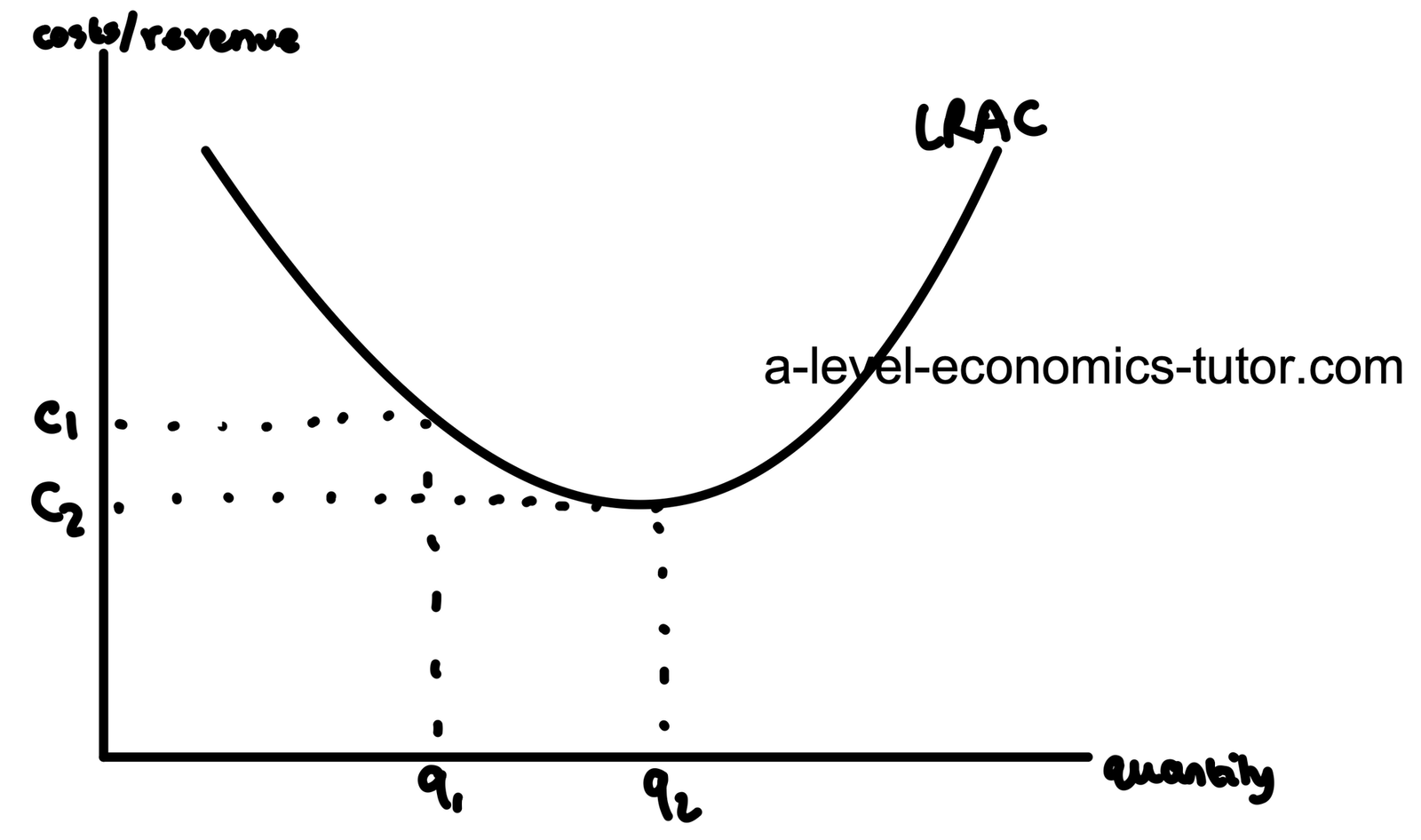
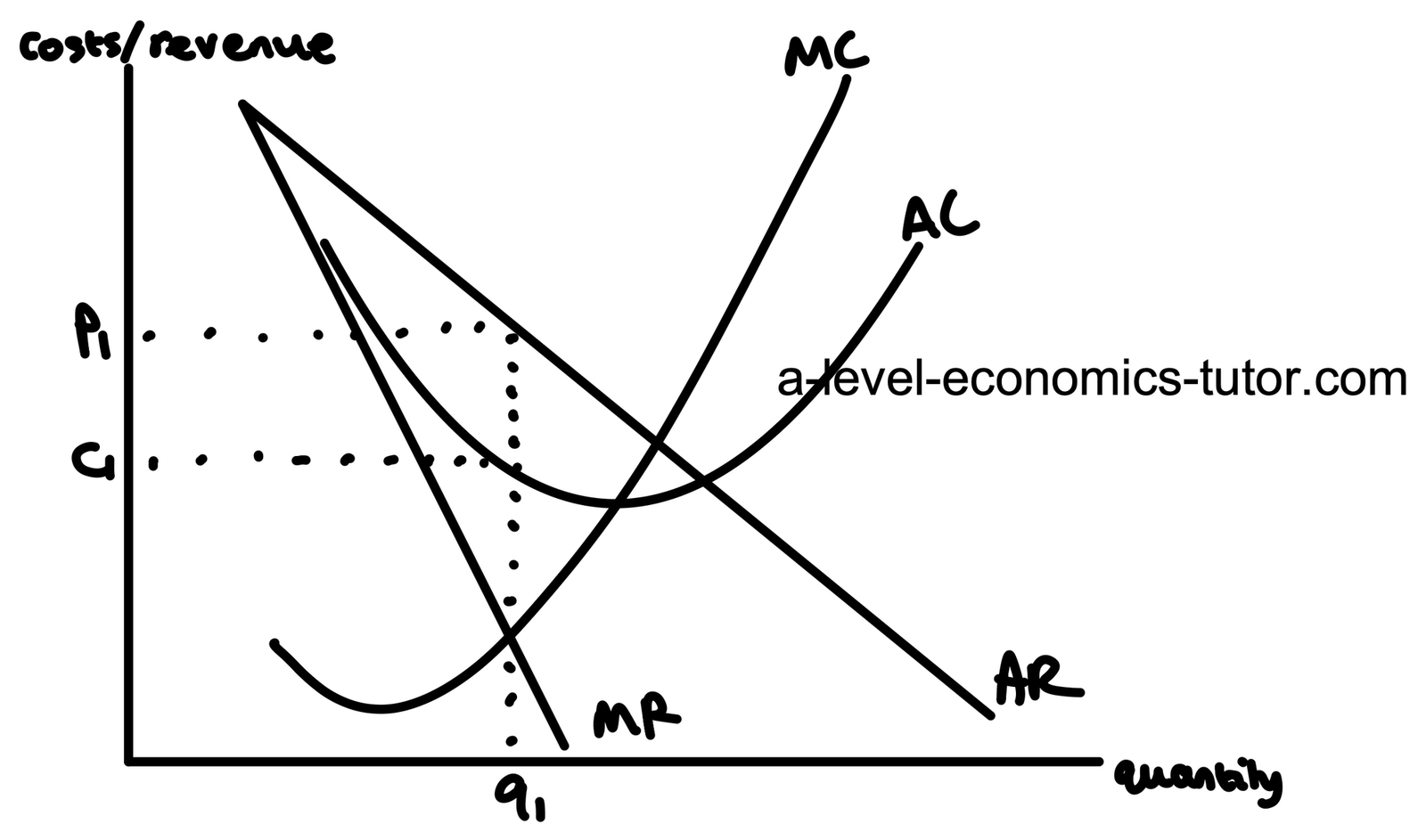
On the other hand, technological advancements can move industries further from perfect competition. If one firm holds the best technology, it can grow its output and market share rapidly, as Amazon and Uber have done through their platforms. As output rises, these firms exploit internal economies of scale. For example, marketing costs per unit fall as they are spread over a larger range of output. The diagram shows how a smaller firm would have higher costs c1 and would not be able to compete on costs, and therefore price, as a larger firm that has costs c2. Economies of scale therefore act as a barrier to entry, which allows the existing firm to hold monopoly power and act as a price-maker. The monopoly can maximise profits by producing at the point where MC = MR, under-providing and over-charging customers for their goods and services.
However, it is possible that a monopoly is the best market structure in certain industries. There are two main reasons for this. Firstly, industries like pharmaceuticals require significant amounts of reinvestment and innovation. This would only be possible if the large firms are making consistently high levels of supernormal profits. Otherwise, customers would see no improvement in medicine. Highly competitive markets usually lack dynamic efficiency. The second reason is that some industries are seen as natural monopolies; industries where the most efficient number of firms in the market is one. This happens because there are extremely high fixed costs in these industries. For example, the water industry requires a company to invest in significant amounts of infrastructure. Because of these high fixed costs, a firm's economies of scale outweigh its diseconomies of scale, even at high outputs. This means that it would be inefficient for the market to be shared by many firms as each firm would have a lower output and higher costs.
In conclusion, I believe that technological change does make perfect competition more of a reality. Characteristics, such as perfect information, would not have been possible without advancements such as the internet or AI. At the same time, there are some industries that should arguably always remain as monopolies or natural monopolies despite technological advancements, such as the pharmaceutical industry. Overall, we can conclude that perfect competition is a useful benchmark, and a more realistic market structure, but not always the best market structure.
A-Level Economics Tutoring
I offer one-to-one and small group A-Level Economics tutoring for students across the UK and internationally. With 100+ five-star Google reviews and tutoring experience since 2017, I specialise in helping students understand difficult concepts and improve their exam technique.