Education and Training | A-Level Economics Model Paragraph
Explain the effect of education and training on a labour market
Another policy to reduce the gender pay gap could be to improve the education and training available to women. In a free labour market, wages are determined by supply and demand of labour alone. So, if the demand for female workers is lower than the demand of male workers, then the best policies would focus on reducing this gap. Demand for labour at any given wage is determined by demand for the final good or service, substitutability of capital, and productivity of the workers. If the government can improve training schemes for women, then this would improve their productivity, which would improve their marginal revenue product (MRP). MRP is how much extra revenue each unit of labour contributes to a firm. This would lead to an increase in the demand for female workers. The diagram below shows this. Wages would increase from W1 to W2 and quantity of female workers employed go up from Q to Q2.
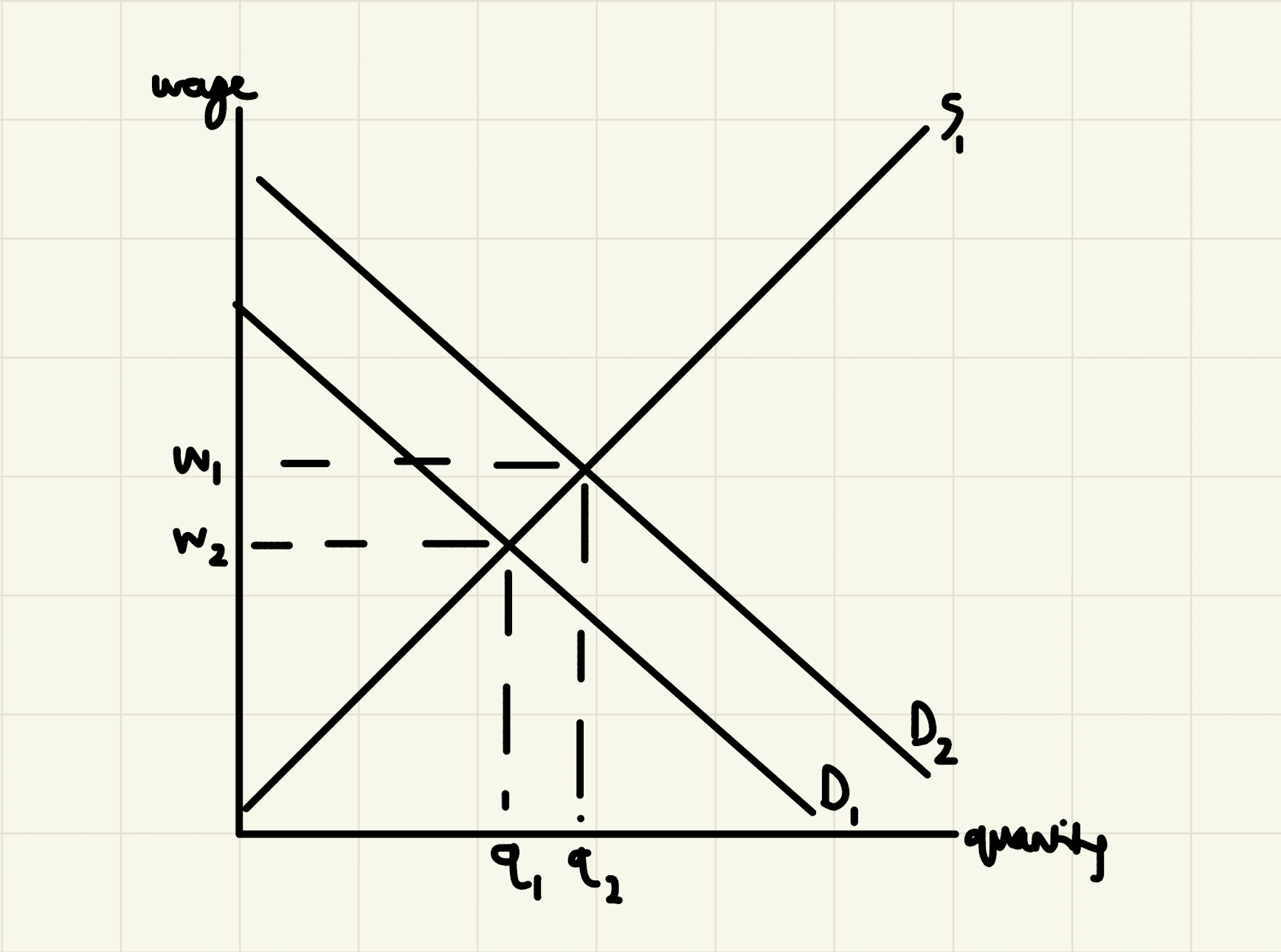
However, improving education and training has a high opportunity cost as well, and also a large time lag. If the government introduced better training schemes, it would take a few years for people to enrol and benefit from higher wages. It is also not guaranteed if firms would respect the training schemes and increase pay, as they could have the perception that MRP has remained low. Overall, better education and training schemes are arguably worth introducing as they are more of a permanent solution to the gender pay gap issue rather than a quick fix such as an increase in the minimum wage which distorts markets.
A-Level Economics Tutoring
I offer one-to-one and small group A-Level Economics tutoring for students across the UK and internationally. With 87+ five-star Google reviews and tutoring experience since 2017, I specialise in helping students understand difficult concepts and improve their exam technique.