Economic Development | A-Level Economics Notes

These revision notes cover everything you need to know about Economic Development for A-Level Economics. They're designed for students studying AQA A-Level Economics, Edexcel A-Level Economics, and Edexcel International A-Level Economics. Written by Jaisul Naik, UCL Economics graduate and A-Level Economics tutor since 2017.


What is the key measure of economic development?

The key measure of economic development is the Human Development Index.

The HDI measures improvements in health, education and living standards. It tracks

  1. average life expectancy at birth
  2. mean years of schooling
  3. GNI per capita at PPP

What are two alternative measures to economic development?

The Inequality-adjusted HDI (IHDI) is the HDI adjusted for inequalities in the distribution of achievements in each of the three dimensions of the HDI (health, education and income). The IHDI will be equal to the HDI value when there is no inequality, but falls below the HDI value as inequality rises. The difference between the HDI and the IHDI represents the ‘loss’ in potential human development due to inequality and can be expressed as a percentage.

The Multi-dimensional Poverty Index (MPI) identifies deprivations across the same three dimensions as the HDI (in health, education and standard of living). It shows the number of people who are multi-dimensionally poor (suffering deprivations in 33% of weighted indicators) and the number of deprivations with which poor households typically contend. It can be deconstructed by region, ethnicity and other groupings as well as by dimension, making it a useful tool for policymakers.

Economic growth is necessary but not sufficient for economic development.

Barriers to development

What is the Harrod-Domar model?

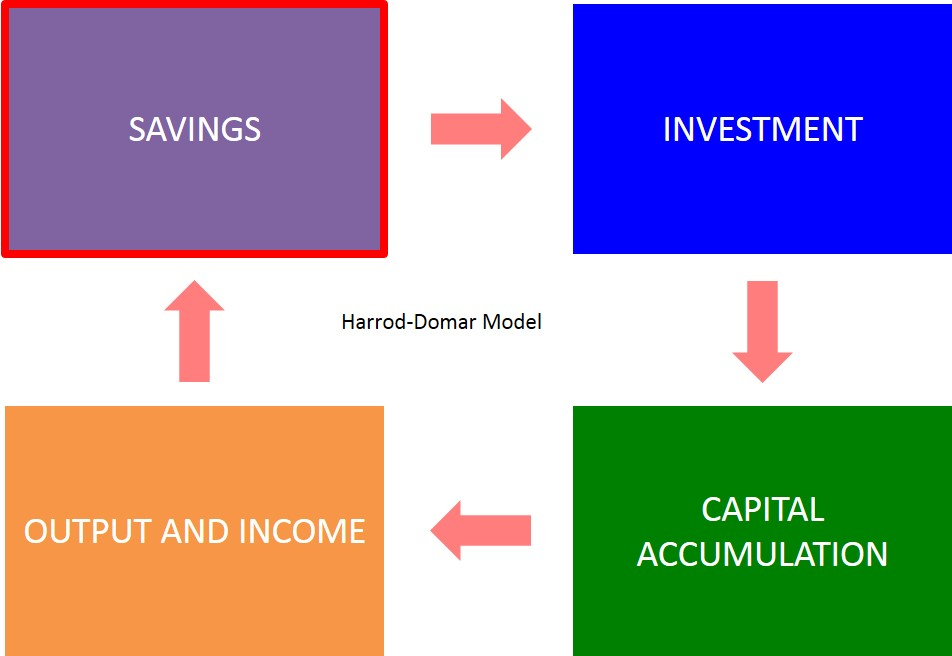
The Harrod-Domar model shows that economic growth is strongly correlated to a country's savings ratio and their capital output ratio.

Rate of growth of GDP = savings ratio/ capital output ratio

Savings ratio

  1. as people are able to increase their average propensity to save, this provides banks with more funding to provide to firms.
  2. this means that investment increases (higher spending on capital goods).
  3. this means that the economy can benefit from an increase in long-run economic growth (potential growth).
  4. for example, farmers that now own tractors would see an increase in their capacity.
  5. economic growth can lead to an increase in job creation and an increase in incomes.
  6. this can lead to further increases in savings and investment.

Capital output ratio

A lower capital output ratio means that investment is more efficient (the same given investment in capital can lead to a greater increase in output).

Explain how poor access to credit and banking can constrain development

  1. poor access credit and banking services means that individuals are unable to secure loans
  2. this makes it more difficult for individuals to start businesses
  3. this restricts economic growth

Explain two reasons why primary product dependency can constrain development

Primary products are natural resources or raw materials such as rice, sugarcane, coffee beans.

Volatile commodity prices

  1. commodity prices are volatile because they can be easily affected by supply-side shocks such as changes in the weather.
  2. additionally, demand for commodities is more likely to be price inelastic
  3. this means that a small change in supply can lead to a large change in price
  4. this can lead to unstable incomes which can cause fluctuations in economic growth and deter investment

Falling relative prices (Prebisch-Singer Hypothesis)

  1. primary products like rice have a lower YED (closer to 0) compared to manufactured goods like a TV or a phone
  2. this means that when incomes increase, demand for primary products remains low whilst demand for secondary products increases.
  3. low demand for primary products leads to declining relative prices.
  4. this leads to low incomes and slow economic growth and rising inequality compared to the rest of the world.
  5. additionally, it can worsen the foreign currency gap

Explain how a foreign currency gap can constrain development

A foreign currency gap occurs when developing countries face a shortage of foreign currency.

This may be because of the following reasons:

  1. low earnings from exports (primary products have declining prices)
  2. increase in world oil prices
  3. high debts with increased interest rates

This can reduce a country's terms of trade, which means a country has to export significantly more output in order to afford certain exports.

Explain how a lack of property rights can constrain development

Property rights refer to legal ownership of a good, such as a home, or land,

A lack of property rights makes it difficult for individuals to secure loans since they have no collateral.

Explain how poor education can constrain development

  1. increased government spending on education can lead to workers gaining more skills
  2. this improvement in human capital can lead to greater productivity
  3. this can lead to an increase in productive potential, and long-run economic growth
  4. this can increase competitiveness and also attract FDI.

Explain how poor infrastructure can constrain development

  1. increased government spending on infrastructure (such as roads and transport) can lead to lower costs and greater productivity, which can lead to long-run economic growth
  2. better infrastructure can also attract FDI inflows.

Explain how capital flight can constrain development

  1. capital flight occurs when wealthy individuals and firms move money out of developing countries to avoid taxes or seek safer investments abroad.
  2. this reduces domestic savings available for investment.
  3. this means that there is less funding for infrastructure, education, and productive capital, which constrains long-run economic growth and development.

Explain how debt can constrain development

  1. high levels of national debt means a significant portion of government revenue goes to debt servicing rather than spending on education, healthcare, and infrastructure.
  2. this reduces investment in human and physical capital, which can restrict long-term economic growth.

Explain how corruption can constrain development

  1. corruption diverts government spending away from infrastructure and public services, which can slow down long-term economic growth.
  2. secondly, corruption deters foreign direct investment as firms face unpredictable costs and regulatory uncertainty.

Strategies influencing growth and development

What is a multinational corporation?

A multinational corporation (MNC) owns and controls the production of goods or services in at least one country other than its home country.

What is foreign direct investment?

Foreign direct investment (FDI) is when a company invests and takes control of capital in a new country.

Explain how the government can attract FDI in an LEDC

Governments of LEDCs can attract FDI by using interventionist or market-based strategies

Interventionist

  1. increase spending on education and training
  2. increase spending on infrastructure

Market-based

  1. lower corporation taxes
  2. lower income taxes
  3. deregulation

Explain how FDI can benefit an LEDC

Promoting FDI can benefit LEDCs through job creation, external economies of scale and greater tax revenue

Job creation

  1. MNCS can create jobs in developing economies 
  2. This leads to higher incomes, which has two benefits.
  3. Firstly, higher incomes can lead to higher levels of consumer spending, which can lead to an increase in aggregate demand, and positive multiplier effects
  4. Secondly, higher incomes allow people to increase savings, which can lead to more investment and more long-term economic growth
  5. More income and output and growth allows the government to collect more tax revenue, which can allow for more spending on infrastructure and education and health.

Education and infrastructure

  1. Since FDI refers to an MNC taking long-term control of capital, they are likely to want to improve both the skills of their workers and nearby infrastructure and transport.
  2. This investment has external economies of scale as other firms can also benefit from better transport and infrastructure, as well as more skilled workers if they change jobs in the future.
  3. As local businesses are able to decrease their long run average costs, this can lead to an increase in productive potential, and long-run economic growth.

Tax revenue

  1. MNCs are able to make substantial levels of profits, since they are often selling goods in other currencies whilst benefiting from low costs in the LEDC
  2. This allows the government to collect corporation tax, as well as income tax from the jobs that are created

Explain the limitations of FDI to an LEDC

Impact on infant industries

  1. small businesses are not likely to be able to compete with MNCs
  2. this makes it difficult for them to grow, and exploit economies of scale
  3. this means that a country cannot develop a comparative advantage in the secondary and tertiary sectors, leading to further problems that come from primary product dependency

Explain how microfinance schemes can promote development

  1. microfinance schemes provide small loans to entrepreneurs who lack access to traditional banking.
  2. this allows small business owners to invest in capital directly, bypassing the savings gap.
  3. this increases productivity and long-term economic growth.
  4. it also allows businesses to grow, which can lead to job creation and higher tax revenues for the government.

Explain how trade liberalisation can promote development

  1. trade liberalisation involves the removal of tariffs and other trade barriers.
  2. as LEDCs form trade agreements, they have access to more markets, including those with stronger currencies.
  3. this allows developing countries to increase injections from exports and earn foreign currency.

Explain how floating exchange rates can promote development

  1. floating exchange rates allow the currency to adjust automatically to economic conditions.
  2. one benefit of a floating exchange rate is that it allows for a self-correcting current account
  3. for example, if a country has a trade deficit, the currency depreciates, making exports cheaper and imports more expensive.
  4. this can improve the trade balance and attract foreign currency.
  5. this also helps developing countries adjust better to external shocks.

Explain how protectionism can promote development

  1. Protectionism can allow infant industries to increase output and benefit from economies of scale
  2. A tariff diagram can show how imports become more expensive, which allows local firms to compete with foreign firms to a greater extent
  3. as firms benefit from economies of scale, they are able to reduce their long run average costs.
  4. this allows LEDCs to develop a comparative advantage in a new industry, which can boost exports and reduce primary product dependency.

Explain how spending on education and training can promote development

  1. increased government spending on education can lead to workers gaining more skills
  2. this improvement in human capital can lead to greater productivity
  3. this can lead to an increase in productive potential, and long-run economic growth
  4. this can increase competitiveness and also attract FDI.

Explain how spending on infrastructure can promote development

  1. increased government spending on infrastructure (such as roads and transport) can lead to lower costs and greater productivity, which can lead to long-run economic growth
  2. better infrastructure can also attract FDI inflows.

Explain how managed exchange rates can can promote development

  1. managed exchange rates allow the central bank to prevent or correct large and sudden fluctuations in the exchange rate.
  2. this provides stability for businesses, as it allows for them to have predictable costs of production when raw materials are imported.

Summary questions

Factors that promote economic development

  1. What is the key measure of economic development?
  2. What are two alternative measures to economic development?
  3. What is the link between economic growth and economic development?
  4. Explain how low savings can constrain development
  5. Explain how poor access to credit and banking can constrain development
  6. Explain two reasons why primary product dependency can constrain development
  7. Explain how a foreign currency gap can constrain development
  8. Explain how a lack of property rights can constrain development
  9. Explain how poor education can constrain development
  10. Explain how poor infrastructure can constrain development
  11. Explain how capital flight can constrain development
  12. Explain how debt can constrain development
  13. Explain how corruption can constrain development

Strategies that promote economic development

  1. What is a multinational corporation?
  2. What is foreign direct investment?
  3. Explain how the government can attract FDI in an LEDC
  4. Explain how FDI can benefit an LEDC
  5. Explain the limitations of FDI to an LEDC
  6. Explain how microfinance schemes can promote development
  7. Explain how trade liberalisation can promote development
  8. Explain how floating exchange rates can promote development
  9. Explain how protectionism can promote development
  10. Explain how spending on education and training can promote development
  11. Explain how spending on infrastructure can promote development
  12. Explain how managed exchange rates can can promote development


A-Level Economics Tutoring

I offer one-to-one and small group A-Level Economics tutoring for students across the UK and internationally. With 87+ five-star Google reviews and tutoring experience since 2017, I specialise in helping students understand difficult concepts and improve their exam technique.