Discuss the best policies to reduce inflation
One way to reduce the inflation rate is the use of contractionary monetary policy. This involves the central bank raising interest rates, in order to influence the level of aggregate demand (AD) in the economy. AD = C + I + G + (X-M) and higher interest rates can lead to lower levels of consumption (C), investment (I) and net trade (X-M). Higher interest rates mean that there is a higher cost of borrowing and higher reward for saving. For consumers, there is a greater incentive to save rather than borrow and spend. Additionally, there could be a negative wealth effect as higher interest rates reduce the demand from houses due to potentially higher monthly repayments. This reduces house prices which can reduce the wealth of homeowners and reduce consumer confidence. Overall, consumer spending falls. Higher interest rates also mean that it is more expensive for businesses to take out loans, so they are less likely to invest in capital. Additionally they anticipate that there will be spare capacity due to lower consumer spending, so investment will fall. Finally, higher interest rates can cause a net movement of hot money flows into the UK, which causes the pound to appreciate. This makes imports cheaper and exports more expensive, which can cause the trade deficit to worsen. Overall, aggregate demand falls, as shown in the diagram below. This causes the price level to fall from pl1 to pl2 as there is less demand chasing the same number of goods and services. Additionally, the real GDP decreases from y1 to y2.
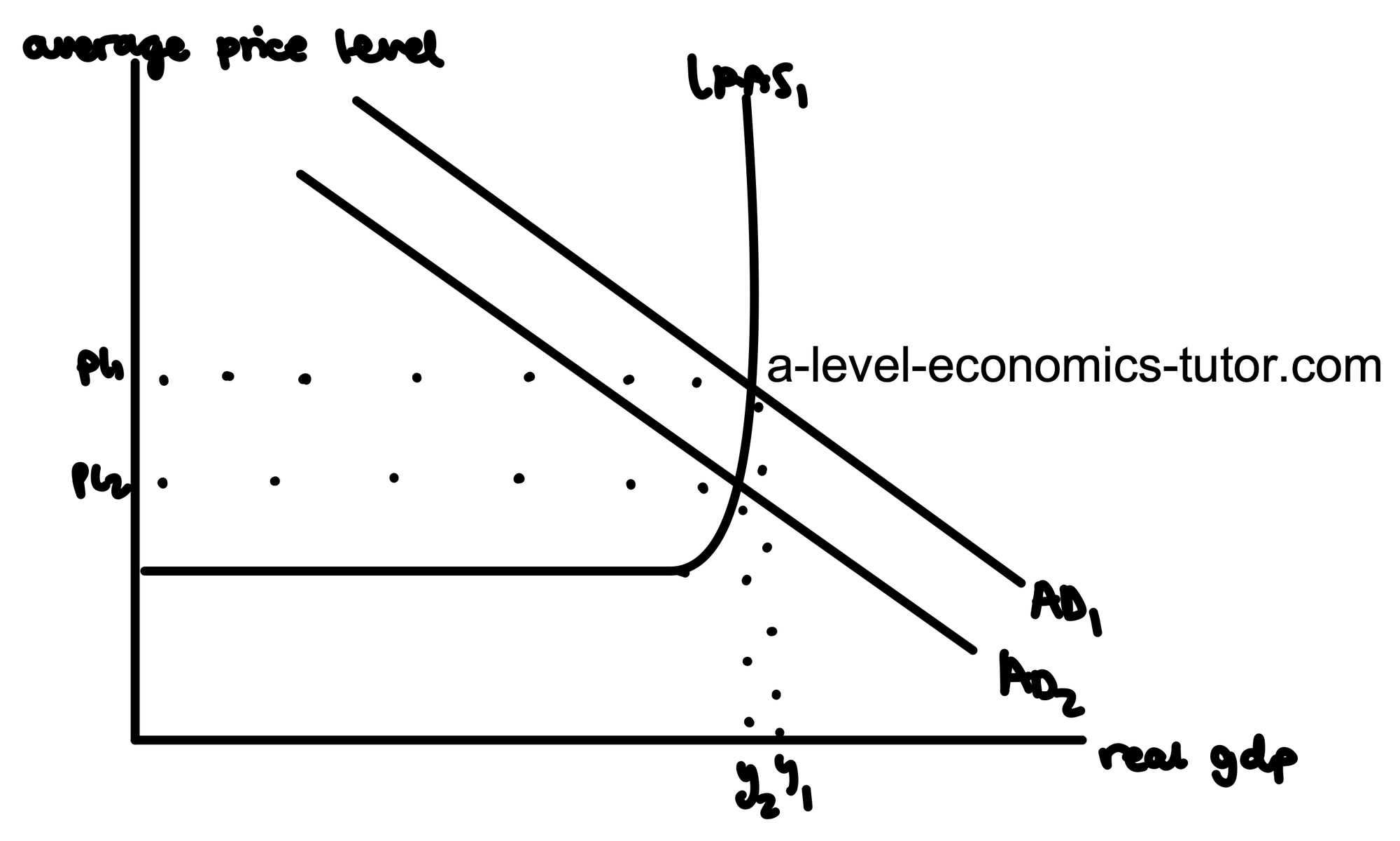
One way to reduce the inflation rate is through the use of contractionary fiscal policy. This is when the government decrease spending or increase taxes to influence the level of aggregate demand (AD). For example, the government could raise income tax rates. In the UK, real incomes are being taxed more every year as the income tax bands are frozen (until at least 2028) despite workers earning pay rises due to inflation. Higher income taxes mean that consumers have less disposable income. This is likely to lead to lower consumer spending, which is a component of AD, causing it to fall from AD1 to AD2 as shown in the diagram below. This causes real GDP to fall and it also causes the price level to fall from pl1 to pl2 as there is less demand chasing the same number of goods and services.
A-Level Economics Tutoring
I offer one-to-one and small group A-Level Economics tutoring for students across the UK and internationally. With 87+ five-star Google reviews and tutoring experience since 2017, I specialise in helping students understand difficult concepts and improve their exam technique.