Analyse the impact on grocery consumers of interdependence between supermarkets
AQA A-Level Economics Paper 1 June 2022
Extract E (lines 16–17) states that, ‘Supermarkets set prices interdependently, and price wars look very likely.’ With the help of a diagram, analyse the impact on grocery consumers of interdependence between supermarkets. (9 marks)
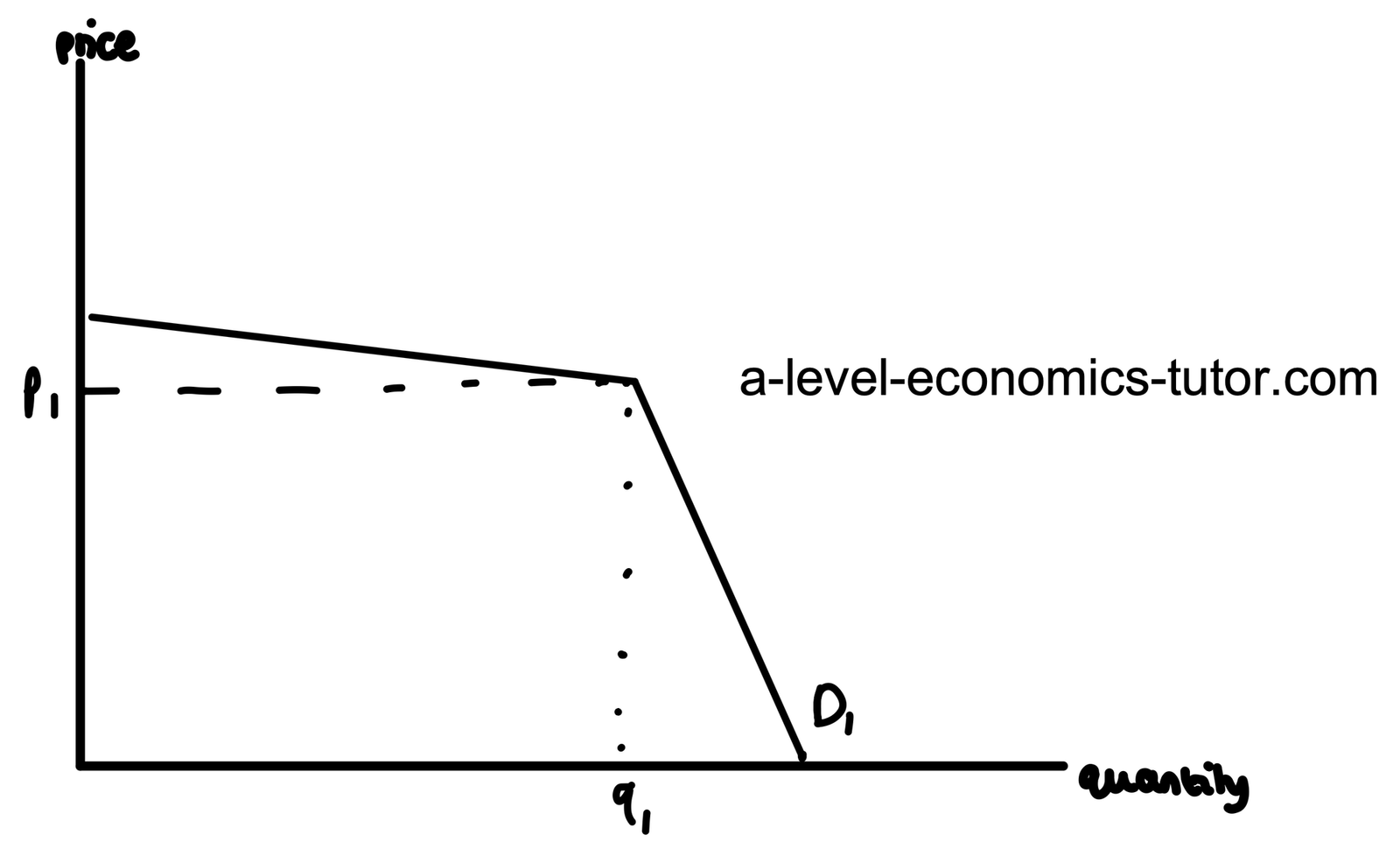
Supermarkets are part of an oligopoly; this means that there are a few firms dominating the market. In an oligopoly, there are usually relatively high barriers to entry and there is some degree of product differentiation. Firms in an oligopoly are interdependent, which means that one firm's decisions affect the other firms, especially in terms of pricing. The kinked demand curve shows how it is difficult for firms to compete on price. At prices above p1, average revenue is elastic, which means that a higher price leads to a greater proportional decrease in quantity demanded. This is because customers are likely to buy from other firms in the market, who are cheaper. At prices below p1, average revenue is inelastic, which means a lower price leads to a smaller proportional change in quantity demanded. This is because other firms will also charge a lower price to prevent being undercut, due to a fear of losing market share. Lower prices could also start an unnecessary price war. Therefore, both higher prices and lower prices would lead to a fall in total revenue for the firm. Overall, the model explains why consumers can expect prices to be quite stable in an oligopoly, and why firms instead compete on non-price factors such as branding and customer loyalty.
A-Level Economics Tutoring
I offer one-to-one and small group A-Level Economics tutoring for students across the UK and internationally. With 87+ five-star Google reviews and tutoring experience since 2017, I specialise in helping students understand difficult concepts and improve their exam technique.