Supply-Side Policies | A-Level Economics Model Paragraph
One way to increase potential growth is through interventionist supply-side policies like increased spending on training schemes. Potential growth, also known as long-run economic growth, is when there's an increase in the productive capacity of the economy. One example of a new training scheme is the implementation of T-Levels which allow 16-19 year olds a chance to gain technical qualifications. Policies like this can improve human capital, as workers develop more skills. This leads to an increase in labour productivity, as there is an increase in the amount of output produced per worker per hour. As a result, businesses are able to produce more goods and services when all factors of production are fully employed. This increases the productive potential of the economy, shown by a rightward shift in the long-run aggregate supply (LRAS) curve. This leads to a decrease in the price level from pl1 to pl2 as there is the same demand chasing more goods and services. Also, this causes an increase in economic growth from y1 to y2. The increase in LRAS represents the potential growth.
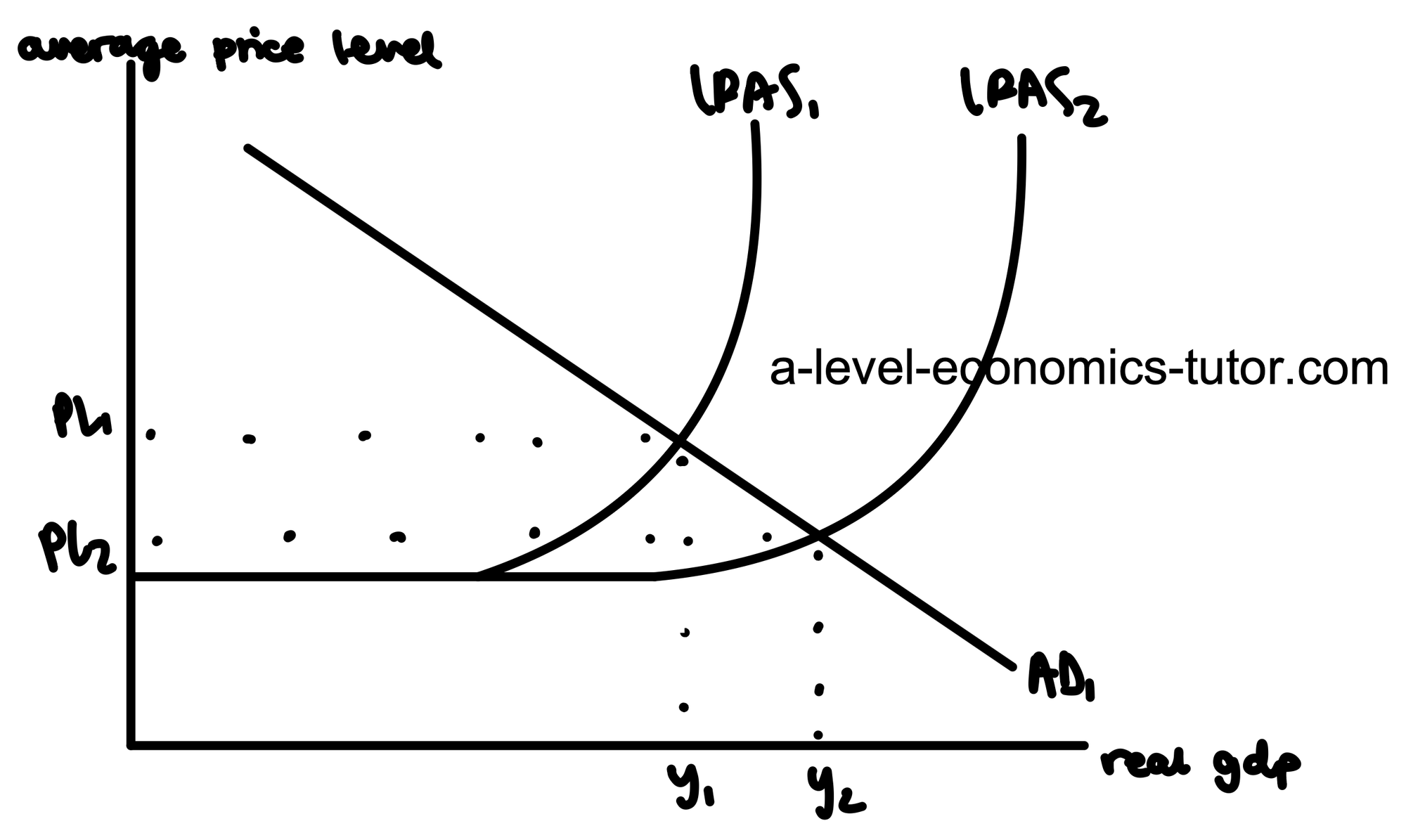
One way to increase potential growth is through interventionist supply-side policies like increased spending on infrastructure. For example, the government have spent around £40bn on HS2. Policies like this lead to improved transport links, which can reduce journey times. This makes it easier for staff and business owners to commute around the UK. This should lead to an increase in the output produced by any factors of production per hour, therefore increasing productivity. As a result, businesses are able to produce more goods and services when all factors of production are fully employed. This increases the productive potential of the economy, shown by a rightward shift in the long-run aggregate supply (LRAS) curve. This leads to a decrease in the price level from pl1 to pl2 as there is the same demand chasing more goods and services. Also, this causes an increase in economic growth from y1 to y2. The increase in LRAS represents the potential growth.
One way to increase potential growth is through market-based supply-side policies like lower corporation tax. This means that businesses are taxed less on their profits. For example, Ireland had one of the lowest corporation taxes in Europe of around 12.5% until 2021. Firstly, the potential for higher retained profits incentivises more firms to set up. Secondly, higher retained profits allow businesses to increase investment in capital. Improvements in capital can allow work to be done faster. As a result, businesses are able to produce more goods and services when all factors of production are fully employed. This increases the productive potential of the economy, shown by a rightward shift in the long-run aggregate supply (LRAS) curve. This leads to a decrease in the price level from pl1 to pl2 as there is the same demand chasing more goods and services. Also, this causes an increase in economic growth from y1 to y2. The increase in LRAS represents the potential growth.
One way to increase potential growth is through market-based supply-side policies like lower income tax. Income taxes in the UK are progressive, meaning that as income increases, the proportion that is taxed also increases. Lower income tax rates increase the incentive for people to work, as they get to keep more of their pay. This incentivises people to enter the workforce, work overtime, or seek promotions. Lower income tax rates also attract skilled workers from abroad who may have otherwise chosen to work in places with lower income tax rates like Dubai. This increases the quantity and quality of labour in the economy which leads to an increase in labour productivity; the amount of output produced per worker per hour. As a result, businesses are able to produce more goods and services when all factors of production are fully employed. This increases the productive potential of the economy, shown by a rightward shift in the long-run aggregate supply (LRAS) curve. This leads to a decrease in the price level from pl1 to pl2 as there is the same demand chasing more goods and services. Also, this causes an increase in economic growth from y1 to y2. The increase in LRAS represents the potential growth.
One way to increase potential growth is through market-based supply-side policies like cutting welfare payments. For example, the government could reduce unemployment benefits like Jobseeker's Allowance, or they could increase the pension age. This reduces the incentive for people to remain out of work, and encourages more people to enter the labour market. The supply of labour increases, putting downward pressure on wages, reducing firms' average costs of production. As a result, businesses are able to produce more goods and services when all factors of production are fully employed. This increases the productive potential of the economy, shown by a rightward shift in the long-run aggregate supply (LRAS) curve. This leads to a decrease in the price level from pl1 to pl2 as there is the same demand chasing more goods and services. Also, this causes an increase in economic growth from y1 to y2. The increase in LRAS represents the potential growth.
A-Level Economics Tutoring
I offer one-to-one and small group A-Level Economics tutoring for students across the UK and internationally. With 87+ five-star Google reviews and tutoring experience since 2017, I specialise in helping students understand difficult concepts and improve their exam technique.