Inequality (Macroeconomics) | A-Level Economics Notes
These revision notes cover everything you need to know about Inequality for A-Level Economics. They're designed for students studying Edexcel A-Level Economics, and Edexcel International A-Level Economics. Written by Jaisul Naik, UCL Economics graduate and A-Level Economics tutor since 2017.
What is absolute poverty?
Absolute poverty occurs when a person cannot meet their basic needs. The World Bank set a threshold of $1.25 a day in 2008.
What is relative poverty?
Relative poverty occurs when someone is poor in comparison with other people in society. For example, one way to measure relative poverty is to consider those who earn below 60% of the country's median income.
What is the difference between income and wealth?
Income is a flow of money, and wealth is a stock of assets.
One way to accumulate wealth is through saving income, but wealth can also be inherited.
How is inequality measured?
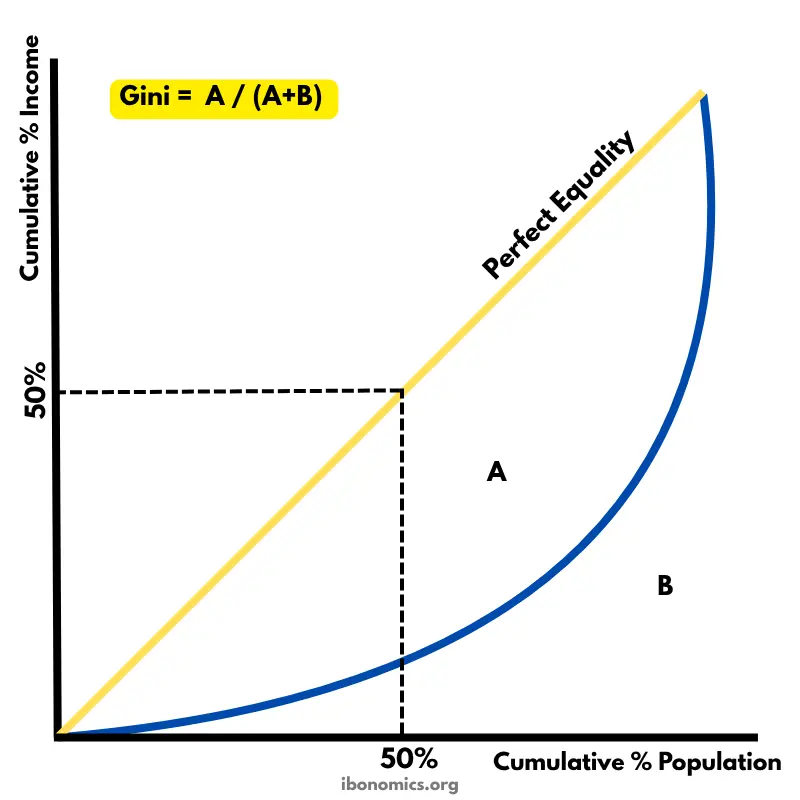
Inequality is measured by the Gini coefficient, and is shown with a Lorenz curve.
The Lorenz curve shows how income is distributed amongst the population.
The gini coefficient is the areas of A/(A+B).
Perfect equality: 0
Perfect inequality: 1
What are two factors that affect income inequality?
Two factors that can affect the level of income inequality are:
The system of income taxes and benefits
Progressive taxes are when the proportion of income that is taxed increases as income increases.
Proportional taxes are when the proportion of income that is taxed stays the same as income increases.
Regressive taxes are when the proportion of income that is taxed decreases as income increases.
The UK tax bands are 0%, 20% and 40% for incomes up to £12570, £50270, and £125,140.
Education and training schemes
Free high quality education provides people with equal opportunity to gain skills, which increases occupational mobility of labour, and makes it easier for people to earn higher incomes regardless of their wealth.