Indirect Taxes | A-Level Economics Notes
These revision notes cover everything you need to know about Indirect Taxes for A-Level Economics. They're designed for students studying AQA A-Level Economics, Edexcel A-Level Economics, and Edexcel International A-Level Economics. Written by Jaisul Naik, UCL Economics graduate and A-Level Economics tutor since 2017.
What is an indirect tax?
An indirect tax is an extra cost of production imposed by the government on firms.
How does an indirect tax affect equilibrium price and quantity?
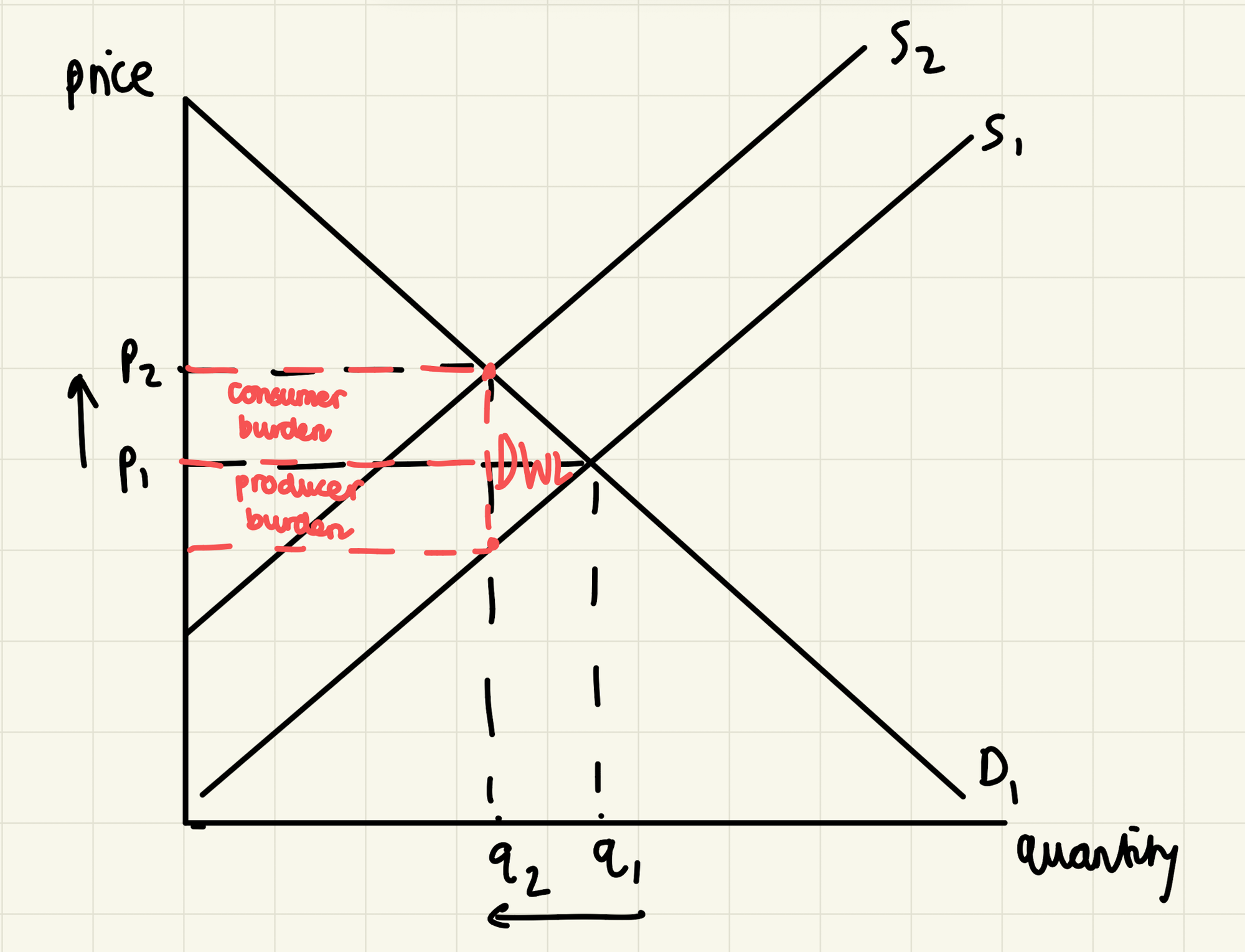
- An indirect tax causes market supply to decrease.
- This causes a contraction in demand.
- This causes price to increase from p1 to p2 and quantity to fall from q1 to q2.
What is the impact of an indirect tax on consumers, producers and the government?
producers
- an indirect tax is an extra cost of production that producers have to pay.
- the producer burden of the tax is shown by the bottom rectangle.
consumers
- firms are able to pass on the burden of an indirect tax to consumers through a price increase.
- the consumer burden of the tax is shown by the top rectangle.
- consumer surplus falls as consumers have to pay a higher price for the good or service.
- furthermore, indirect taxes are regressive. this means they have a larger impact on low income households.
government
- the entire shaded rectangle shows the tax revenue collected by the government.
- this can be useful as it can allow the government to increase spending on the impacted area, such as the NHS
- for example, smokers end up paying towards the NHS' costs, the externality is now internalised.
deadweight loss
- deadweight loss refers to the welfare (consumer or producer surplus) that is lost from the market as a result of the indirect tax.
What is the impact of price elasticity of demand on indirect taxes?
- An indirect tax has different effects on a market if the good or service is price inelastic in demand.
- Demand is inelastic if percentage change in demand is small in relation to the price change caused by the indirect tax.
- Demerit goods may be inelastic if they are addictive but also if they cost a small proportion of total income.
- The effects can be seen on the diagram below.
- It shows that while price increases from p1 to p2, quantity only falls a small amount from q1 to q2.
- This is an example of government failure in the form of unintended consequences and imperfect information. If the government did not foresee how addictive cigarettes are, the intervention would fail to reduce consumption to the socially optimal target.
- Furthermore, firms know that they can raise prices and increase their total revenue when a good is inelastic.
- This causes consumer burden to increase significantly.
- The one benefit in this case is that it is now quite easy for the government to collect more tax revenue. This could be used in other forms of government intervention such as provision of information.
What are the possible sources of government failure with indirect taxes?
- market distortions - deadweight loss
- imperfect information - the size of the externality, PED.
- unintended consequences - if demand is inelastic, black markets
Summary questions
- What is an indirect tax?
- How does an indirect tax affect demand and supply in a market?
- Using an indirect tax diagram, label and explain
- consumer burden
- producer burden
- tax revenue
- deadweight loss
- Using a diagram, explain the impact of PED on an indirect tax?
- How can an indirect tax lead to government failure?
A-Level Economics Tutoring
I offer one-to-one and small group A-Level Economics tutoring for students across the UK and internationally. With 87+ five-star Google reviews and tutoring experience since 2017, I specialise in helping students understand difficult concepts and improve their exam technique.