Explain why the value of a currency may fall in a floating exchange rate system
AQA A-Level Economics Paper 2 June 2019
Explain why the value of a currency may fall in a floating exchange rate system. (15 marks)
Exchange rates are the price of a currency in terms of another. A floating exchange rate is when the exchange rate is determined by market forces (supply and demand of the currency).
- One factor that can cause a currency depreciation is lower interest rates.
- Interest rates are the cost of borrowing or the reward for saving.
- Lower interest rates mean that there is a lower reward for saving in the UK is lower.
- This means that there would be more hot money flows out of the UK as people would want to take advantage of higher savings rates abroad.
- This causes a decrease in demand for the pound and an increase in supply of the pound.
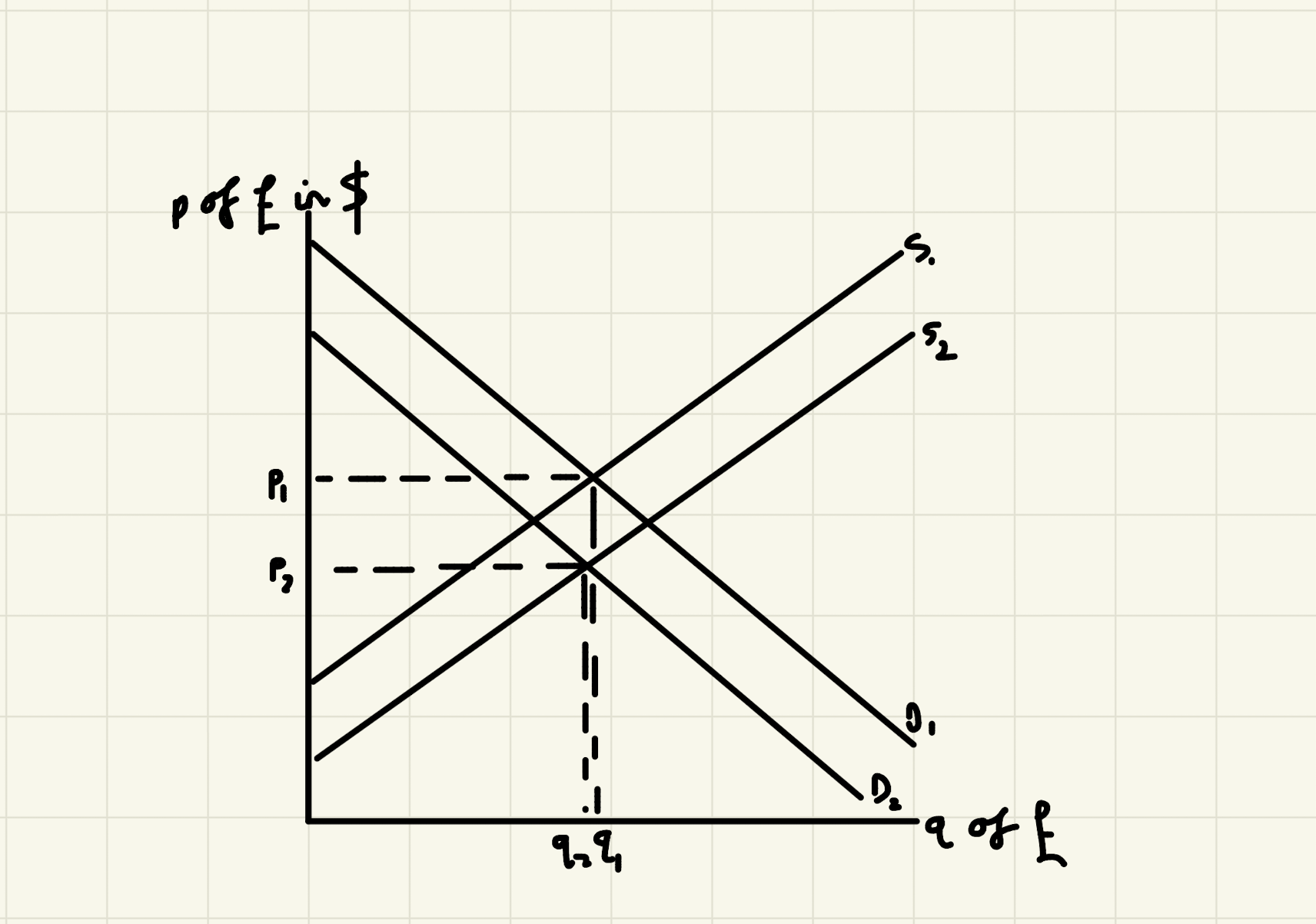
- The value of the pound would fall as shown by the diagram below.
- Another factor that can cause a currency depreciation is a worsening of the current account deficit.
- A current account deficit is when the value of imports exceed the value of exports.
- If there is an increase in the value of imports increase, then the supply of pounds would increase as consumers would need to sell pounds to buy a different currency.
- Furthermore, if there is a decrease in the value of exports, this would cause demand for the pound to decrease because less pounds are needed.
- Demand for the pound can be derived demand from the demand for UK exports.
- The diagram above shows that this causes the value of the pound to fall from p1 to p2 as a result of an increase in supply and decrease in demand.
A-Level Economics Tutoring
I offer one-to-one and small group A-Level Economics tutoring for students across the UK and internationally. With 87+ five-star Google reviews and tutoring experience since 2017, I specialise in helping students understand difficult concepts and improve their exam technique.