Explain how the multiplier and accelerator affect the overall level of economic activity
AQA A-Level Economics Paper 2 June 2024
Explain how the multiplier and accelerator affect the overall level of economic activity. (15 marks)
- The overall level of economic activity could be measured as the level of output, income or expenditure.
- Real GDP measures the total value of goods and services produced in the economy, adjusted for inflation.
- The multiplier effect is when an initial increase in aggregate demand leads to further increases in aggregate demand.
- For example, if the government increases spending on welfare payments such as pension, this leads to an increase in AD as AD = C + I + G + (X-M)
- As pensioners benefit from an increase in disposable incomes and consumer confidence, they are likely to increase their spending.
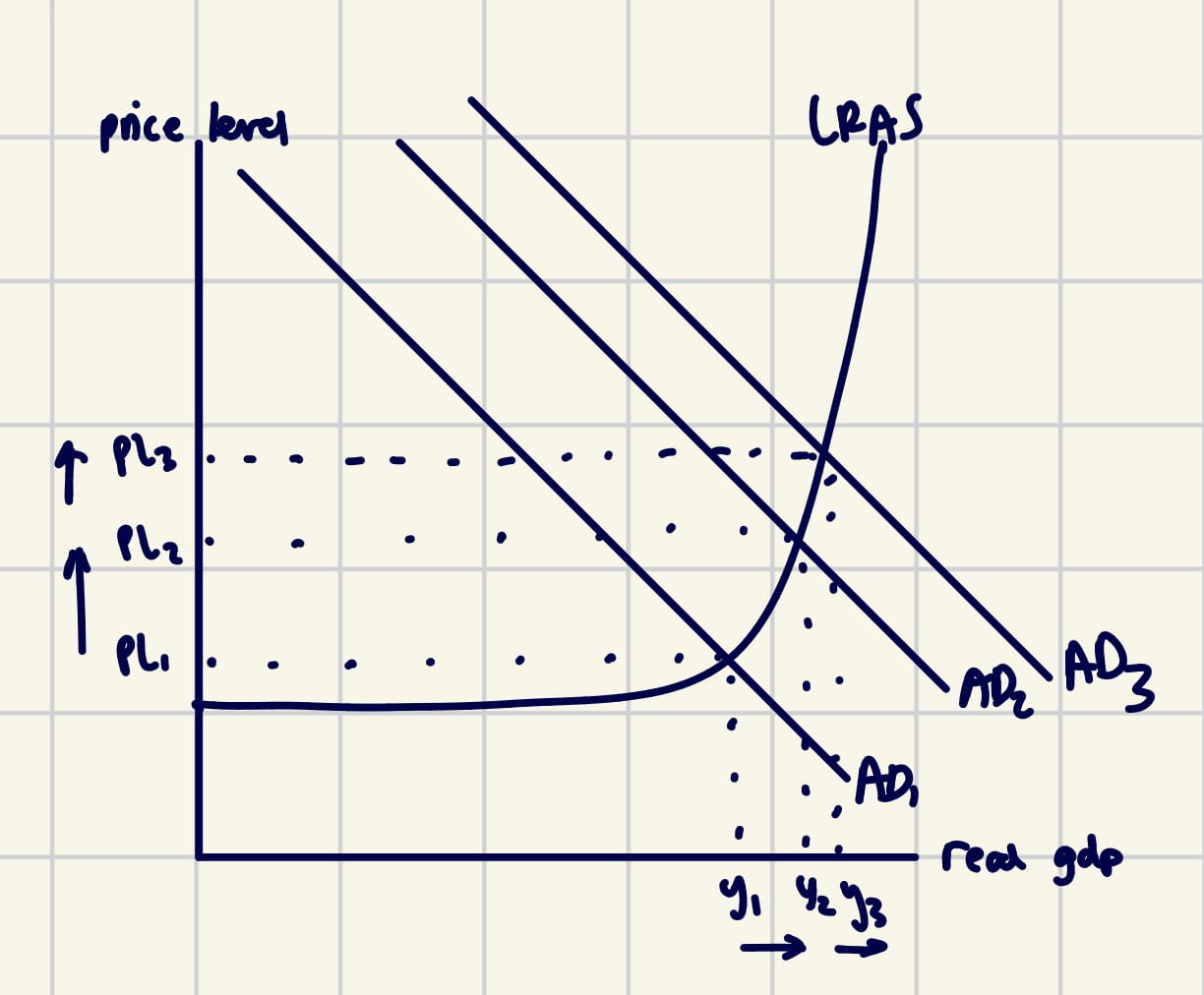
- Consumer spending is another component of aggregate demand. Therefore, it will increase further, as shown by the diagram below.
- The size of the multiplier would depend on consumers' marginal propensity to consume. This is the proportion of an increase in income that consumers will spend rather than withdraw (savings, taxes, spending on imports).
- A higher MPC leads to a higher multiplier as k = 1/(1-MPC).
- Pensioners' marginal propensities to consumer can vary as some may have high levels of savings and some may have low incomes.
- As a result of the multiplier effect, economic activity measured by real gdp increases from y1 to y2 to y3.
- The accelerator theory suggests that businesses are more likely to increase investment when there is an increase in the rate of economic growth.
- Investment is one of the components of aggregate demand.
- Investment is business spending on capital goods.
- When aggregate demand shifts to the right, this causes an increase in economic growth from y1 to y2 in the diagram above.
- Business demand for capital will increase if they expect to get close to full capacity due to an increase in consumer spending.
- As a result, an increase in demand for capital is derived from the increase in demand for goods and services.
- For example, if Lidl expected more daily customers, they might invest in more self-checkout machines.
- This increased investment is another injection of aggregate demand.
- This causes aggregate demand to increase further, causing a multiplier effect of its own.
- This causes real gdp to increase further.
- An increase in spending on capital can also lead to an increase in the productive potential of the economy.
- This can be shown by an increase in the trend rate of growth.
A-Level Economics Tutoring
I offer one-to-one and small group A-Level Economics tutoring for students across the UK and internationally. With 87+ five-star Google reviews and tutoring experience since 2017, I specialise in helping students understand difficult concepts and improve their exam technique.