Explain how price and output are determined for a firm in a monopolistically competitive market, in both the short run and the long run
AQA A-Level Economics Paper 1 June 2017
Explain how price and output are determined for a firm in a monopolistically competitive market, in both the short run and the long run. (15 marks)
- Monopolistic competition is a market structure with low barriers to entry and slight product differentiation.
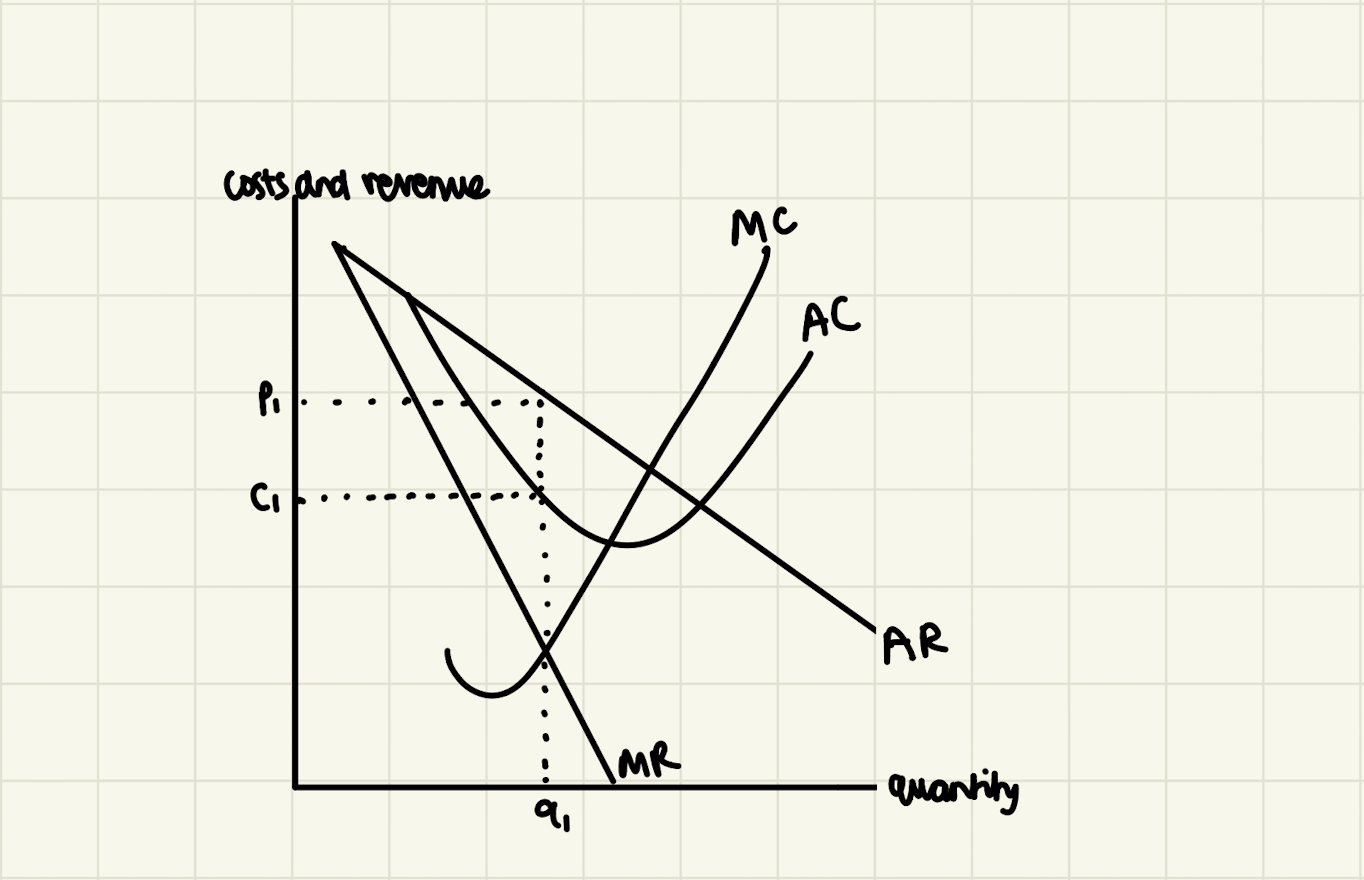
- The diagram below shows a firm’s cost and revenue curves in the short-run.
- Firms are profit maximisers so they would set output and price where marginal cost equals marginal revenue
- The firm reads down from the point where MC = MR to determine their output.
- From this output, average revenue shows the price that they can charge customers, and average cost shows the cost.
- Therefore the shaded rectangle shows the firm’s supernormal profit.
- Since existing firms are making supernormal profit, new firms are incentivised to join the market.
- This is possible since there are low barriers to entry.
- As a result, market supply increases.
- Each firm therefore loses market share causing marginal revenue and average revenue to decrease.
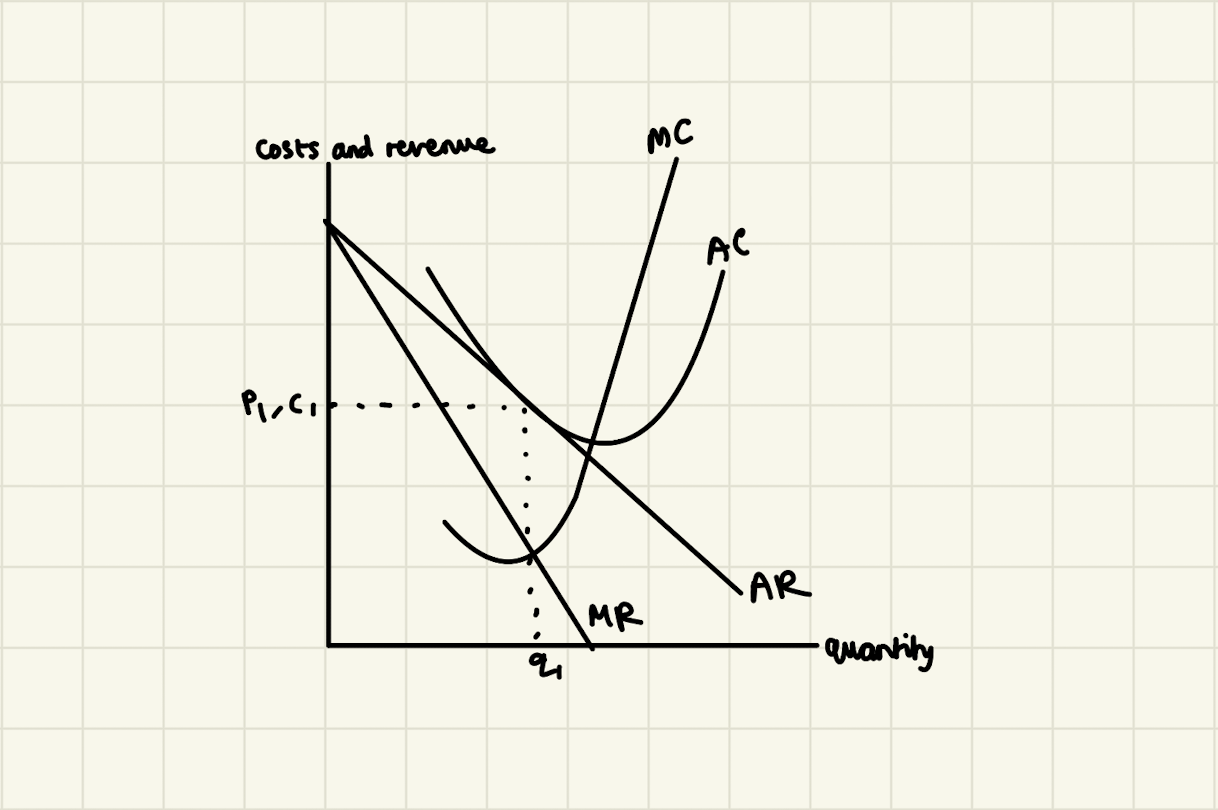
- The diagram below shows that in the long-run, firms are only able to make normal profits.
- Firms continue to aim to profit maximise so they set output at the level where MC=MR.
- At this point, average revenue is equal to average cost.
- Normal profit is the level of profit needed to stay in business.
- It means that the level of profit equals the opportunity cost of running the business.
A-Level Economics Tutoring
I offer one-to-one and small group A-Level Economics tutoring for students across the UK and internationally. With 87+ five-star Google reviews and tutoring experience since 2017, I specialise in helping students understand difficult concepts and improve their exam technique.