Evaluate whether a monopoly is likely to operate efficiently
Edexcel A-Level Economics 25 Mark Question
Tesla held an 82% market share of the electric vehicle market in the United States during the first half of 2020. Evaluate whether a monopoly is likely to operate efficiently. Refer to at least one monopoly of your choice. (June 2022)
Plan
- Paragraph 1
- Argument: a monopoly is likely to be allocatively inefficient.
- Diagram: monopoly diagram
- Evaluation: However, a monopoly is very likely to achieve dynamic efficiency because of this.
- Paragraph 2
- Argument: a monopoly is likely to be productively inefficient.
- Diagram: economies of scale diagram
- Evaluation: However, a monopoly can improve productive efficiency through economies of scale.
A monopoly is a market structure dominated by one firm. A pure monopoly means that one firm has 100% of the market share, and the CMA deems a firm has monopoly power when their market share is 25% or more. One example of a monopoly in the smartphone industry is Apple.
Firstly, a monopoly is likely to be allocatively inefficient. This is because monopolies aim to profit maximise. They are able to do so because they can exploit high barriers to entry and their price-setting power. Profit maximisation occurs at the level of output where marginal cost equals marginal revenue. This can be seen at the quantity Q1 on the diagram below, which has a price of P1 and a cost of C1. As a result, the monopoly is able to make supernormal profits, as shown by the rectangle. This level of output is not allocatively efficient. Allocative efficiency occurs at the point where average revenue equals marginal cost. Allocative efficiency is when consumer surplus is maximised in the market. With the context of Apple, they are producing devices that are often too expensive to benefit the whole of society. Therefore, consumer surplus will not be maximised. Consumer surplus is the difference between the price consumers pay compared to the highest price they would be willing to pay.
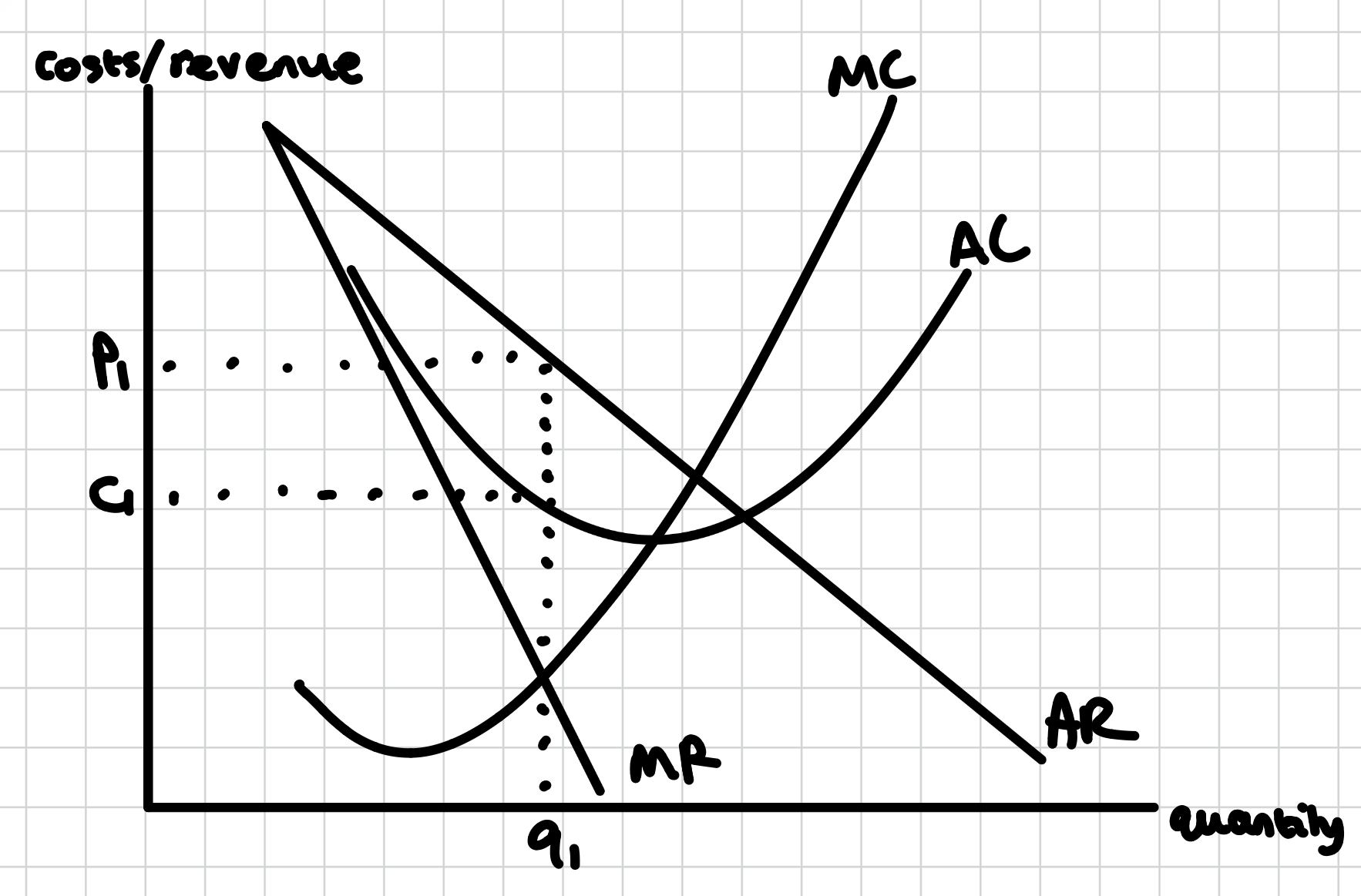
However, due to their high prices, monopolies like Apple are actually more likely to achieve dynamic efficiency. The rectangle shows Apple's supernormal profit, which is what gives them the ability to both pay shareholders but more importantly to reinvest more into their product. As they invest more, consumers benefit from higher quality. For example, Apple is able to make at least some improvements to their product every year. Additionally, the profit gives them a chance to take risks and innovate with new products such as AirPods, which even have features like hearing aids. The more Apple differentiates its products, the more market share that gives them, which allows this to continue over a long period of time.
Secondly, monopolies like Apple are also unlikely to achieve productive efficiency. Because of their strategy of profit maximisation, they have little incentive to increase output to the point where marginal costs equal average costs. Instead, they will choose the output that maximises their own profits. As a result, they may limit output. This means that, in the long-run, they are not fully exploiting their economies of scale, and costs are not completely minimised. For example, if they were to increase their output even further, closer to their minimum efficiency scale, they would be able to enjoy even greater economies of scale. This would allow them to save money through bulk buying things like chips, camera lenses and even their packing material. The diagram shows that Apple are more likely to operate at q1, c1 rather than q2, c2.
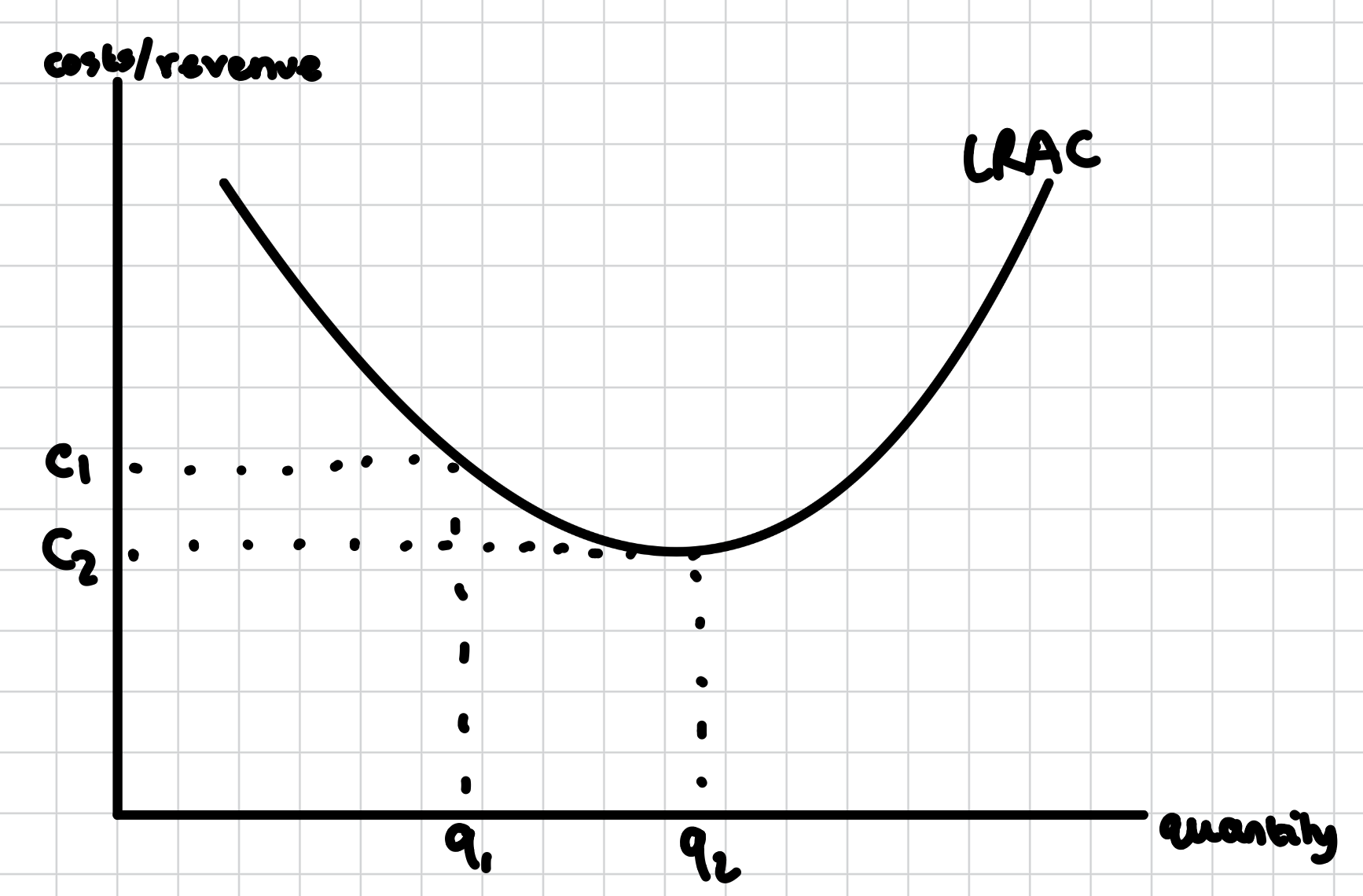
However, you could also argue that monopolies like Apple are actually going to be more productively efficient compared to if there was competition and a lack of monopoly power. If monopoly power was lower, and therefore barriers to entry were lower, new firms would enter the market. As new firms entered the market, Apple would have a lower market share, which means they actually have to decrease their output and they enjoy even fewer economies of scale. Therefore, they would have become even less productively efficient. This suggests that actually there is an argument that Apple are as close as they could be to achieving productive efficiency whilst maintaining other benefits such as dynamic efficiency.
Overall, my conclusion is that Apple is extremely likely achieve some efficiencies, especially dynamic efficiency, but they are far less likely to achieve allocative efficiency due to their price-setting power.
A-Level Economics Tutoring
I offer one-to-one and small group A-Level Economics tutoring for students across the UK and internationally. With 87+ five-star Google reviews and tutoring experience since 2017, I specialise in helping students understand difficult concepts and improve their exam technique.