Efficiency | A-Level Economics Notes
These revision notes cover everything you need to know about Efficiency for A-Level Economics. They're designed for students studying AQA A-Level Economics, Edexcel A-Level Economics, and Edexcel International A-Level Economics. Written by Jaisul Naik, UCL Economics graduate and A-Level Economics tutor since 2017.
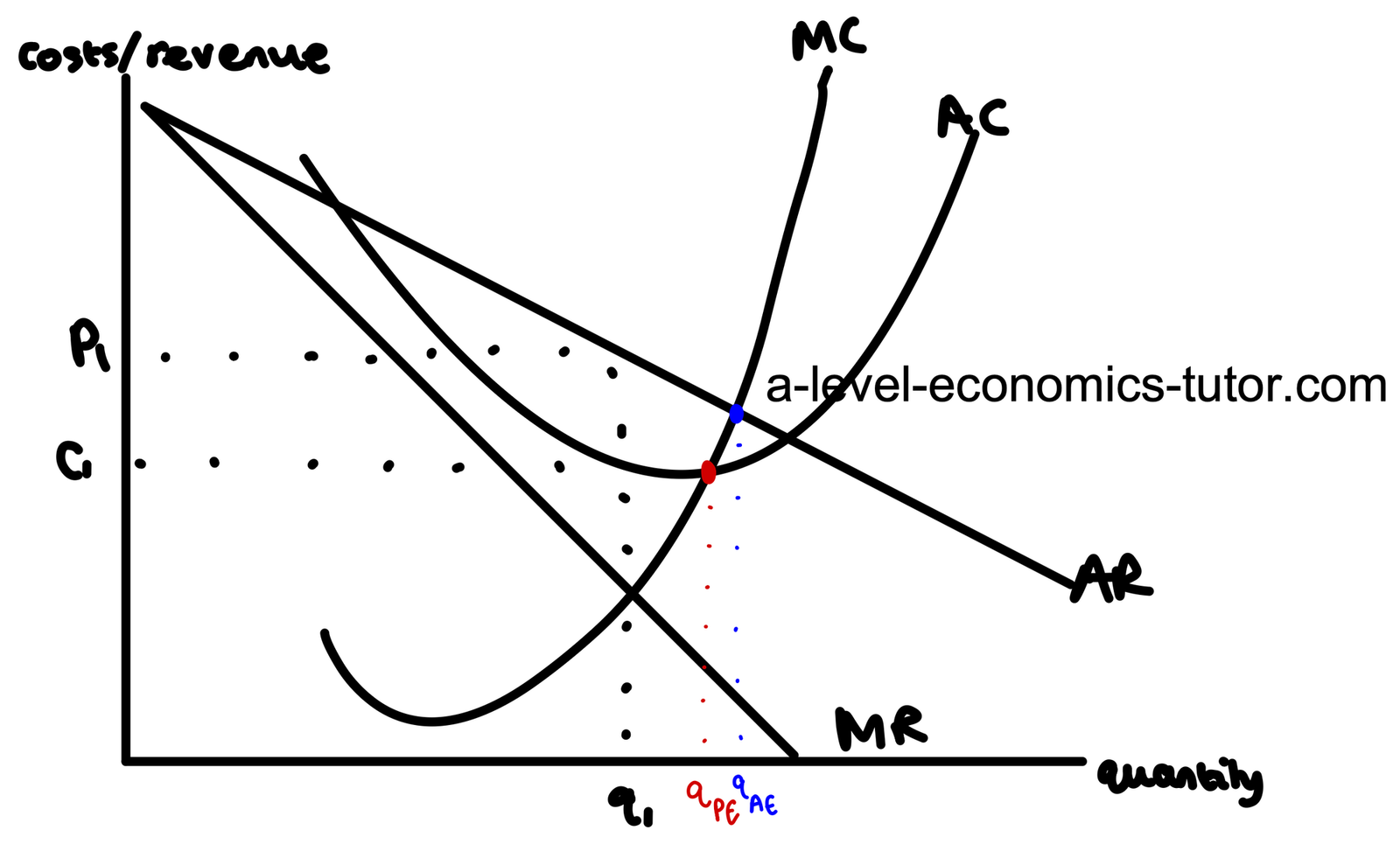
What is productive efficiency?
In general, productive efficiency is when it is not possible to produce more of one good or service without producing less of another good or service e.g. all points on the PPF.
A firm is productively efficient when they are producing at the lowest point of their average cost curve.
This occurs at the quantity where MC=AC.
In the long-run, this means that firms are able to fully exploit their economies of scale
What is allocative efficiency?
Allocative efficiency is achieved when a firm is producing at the point where MC=AR.
This is good for consumers because they benefit from an increase in output and a decrease in price.
This means that consumer surplus is maximised.