Discuss the functions of the price mechanism in allocating housing
Edexcel AS Economics Paper 1 June 2016 Extract
With reference to Figures 1 and 2 and your own knowledge, discuss the functions of the price mechanism in allocating housing. (15 marks)
Paragraph 1
- The functions of the price mechanism are to ration, signal and incentivise.
- Figure 2 shows that the UK house prices index has risen from 300 in Q1 2009 to nearly 375 in Q1 2015.
- Equilibrium is the price and quantity at which supply meets demand.
- In a free market, the equilibrium price increases whenever these is excess demand at the current market price.
- For example, the population could increase in the UK.
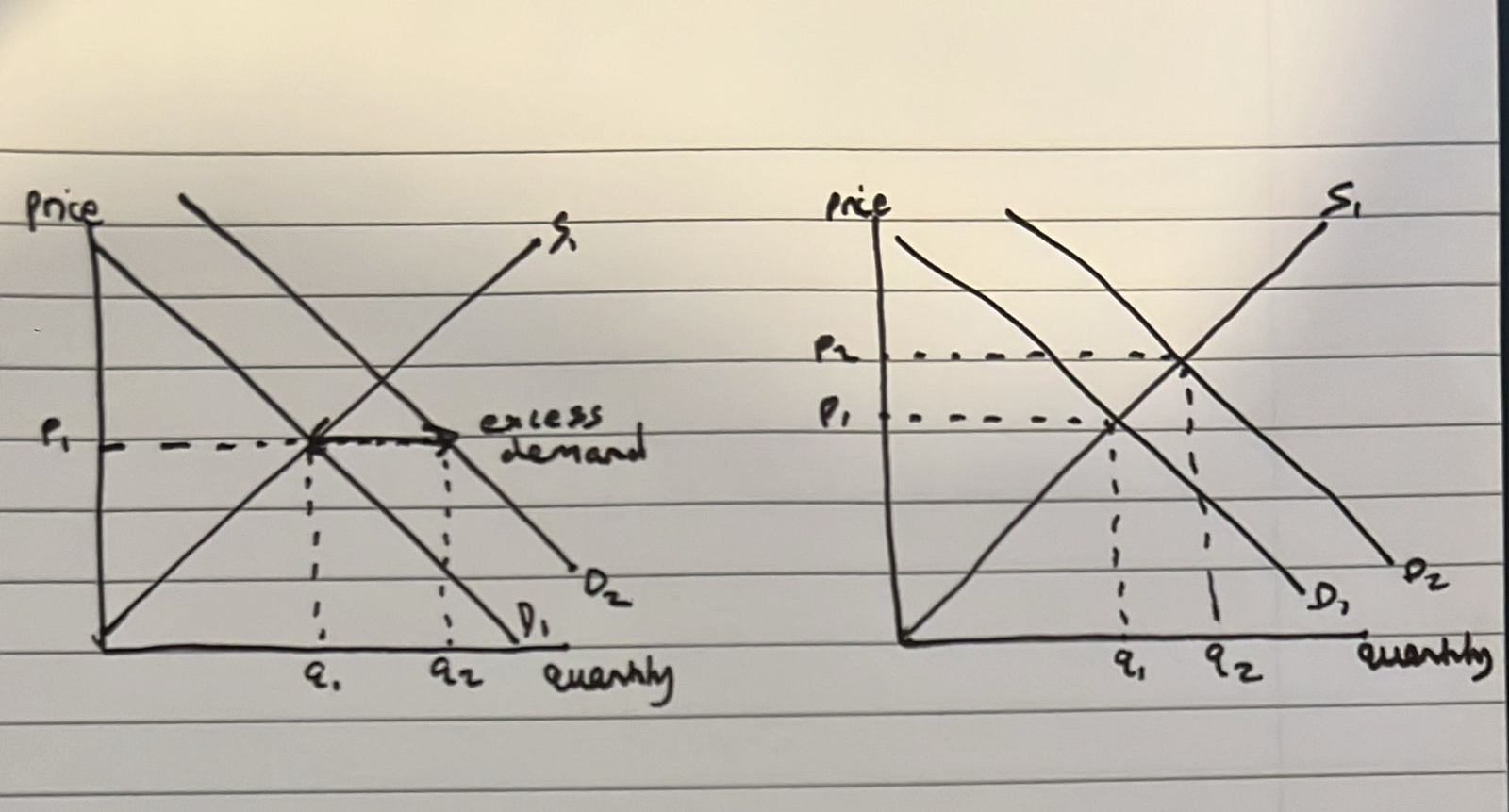
- This would lead to a right shift in the demand for housing.
- This is shown by the diagram below.
- At p1, there is an excess demand as shown by the difference between q1 and q2.
- This is because the price is low enough that there are more houses that people are willing and able to buy compared to the number of houses that people are willing and able to sell.
- This information is signalled to firms. Firms would notice that there are a lot of customers making enquiries or placing orders or queuing up.
- Firms decide to increase prices in order to ration away the excess demand.
- As a result of higher prices, demand contracts along the curve D2 and supply expands along the curve S1. This is the incentive function of the price mechanism.
- Supply increases because firms are willing and able to increase supply due to an increase in the potential profit.
Evaluation
- However, in the UK, the housing market may not be perfect in reality.
- This is because of various imperfections.
- For example, firms with monopoly power may have more price making power than other firms so prices won't always be at the market-clearing equlibrium.
- Also, due to asymmetric information, firms may not be fully aware of the extent of changes in market demand and this could cause delays in price changes.
- Lastly, the government intervenes in markets like housing, such as with grants or social housing, which can cause further changes to prices or quantities that are independent of the price mechanism.
- For example, line 5 says that the government has a 'Help to Buy scheme' where they subsidise new homes for first time buyers. This would artificially cause an increase in the demand for homes at any given price. It also creates differences between buyers as younger people are more likely to qualify for the subsidy.
A-Level Economics Tutoring
I offer one-to-one and small group A-Level Economics tutoring for students across the UK and internationally. With 87+ five-star Google reviews and tutoring experience since 2017, I specialise in helping students understand difficult concepts and improve their exam technique.