Discuss policies businesses and government might implement to reduce labour immobility to benefit the energy sector
Edexcel A-Level Economics Paper 1 June 2018 Extract
With reference to Extract C and your own knowledge, discuss policies businesses and government might implement to reduce labour immobility to benefit the energy sector. (15 marks)
Paragraph 1
- One policy the government could implement to reduce labour market immobility is to increase spending training schemes, such as apprenticeships that are relevant to the energy sector.
- This would solve the problem caused by occupational immobility of labour.
- Extract C mentions that 'a long time period is required for training and developing workers' skills'.
- Occupational immobility means that there is low supply of labour due to a lack of relevant skills in the given labour market.
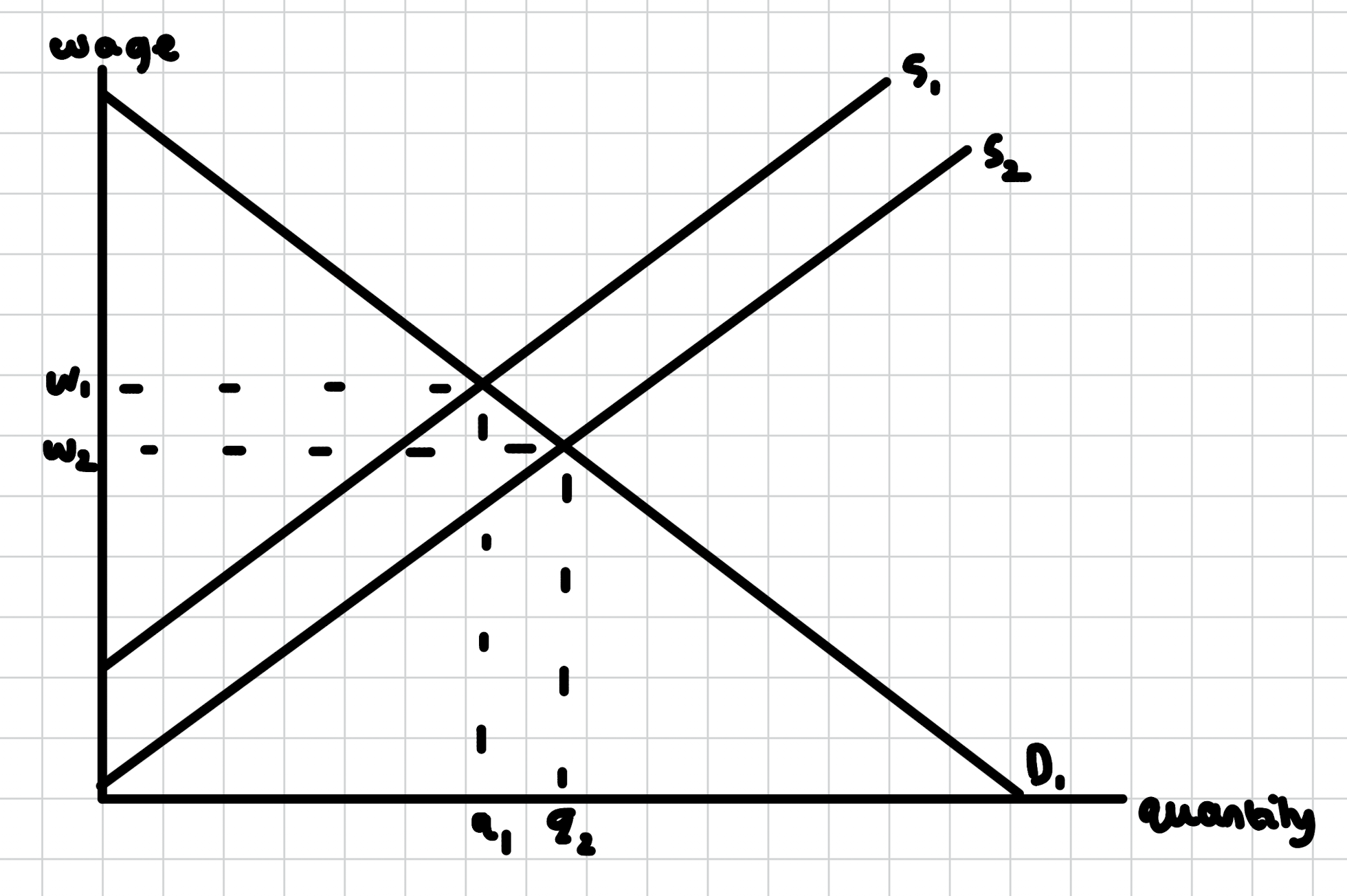
- An improvement in training schemes makes it more attractive for people to train or re-train in the energy sector, which means more people will be willing and able to work in the energy sector at each given wage.
- This can be shown by a right shift in supply of labour, which causes an increase in the quantity of workers from q1 to q2.
- Extract C mentions the idea to 'recruit more skilled workers from overseas'.
Evaluation 1
- However, there is an opportunity cost to the government spending more on training schemes.
- The government should consider if this is a better idea than the next best alternative, such as spending more on training schemes in other areas instead and forcing firms to do more themselves to attract workers.
- Additionally, even if the government were to go ahead with training schemes, there is a time lag to this.
- Even if people want to take up apprenticeships, it may take a couple of years before they complete their qualifications, and that delays how quickly firms can benefit from an increase in labour supply.
Paragraph 2
- Another policy that firms could implement to reduce labour market immobility is to impr0ve working conditions.
- One example of this might be to offer staff the possibility to work remotely or work from home where possible.
- This would reduce immobility in the labour market, and increase labour supply, since more workers would be willing to work at each given wage rate if working conditions were better.
- The extract mentions that 'two-thirds of workers are aged over 50', and offering a remote/hybrid working structure, where possible, would be a great way to retain more of them and disincentivise them from taking early retirement.
- This would prevent labour supply from falling whilst workers age, ensuring that labour market mobility improves.
Evaluation 2
- However, this policy of offering better working conditions and increasing remote work could lead to other issues.
- For example, it could cause a fall in productivity of workers as communication becomes more difficult.
- This would lead to an increase in costs for firms in the energy sector at all levels of output as workers are slower to complete tasks.
- This could mean that firms generate less profit and therefore have a reduced ability to reinvest in the re-training of their workforce as well as their services.