Discuss methods of government intervention to protect consumers within the utilities markets, such as energy and telecommunications
Edexcel A-Level Economics Paper 1 June 2019 Extract
Discuss methods of government intervention to protect consumers within the utilities markets, such as energy and telecommunications. (15 marks)
Paragraph 1
- One method of government intervention that can protect consumers within utilities markets is price regulation.
- Many firms in utilities markets have monopoly power.
- An example of this is BT who account for two third of the UK's landline only customers.
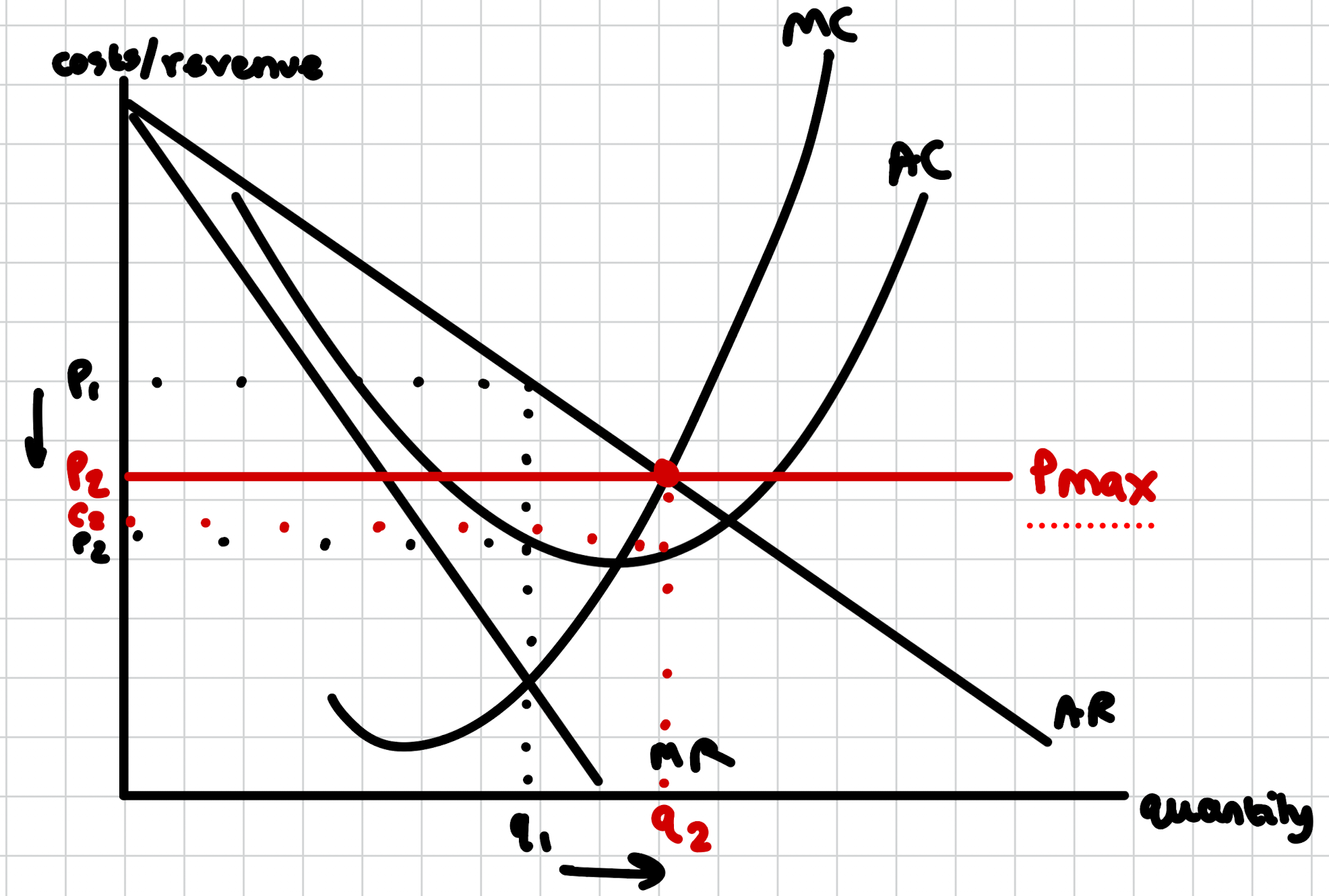
- Monopolies would typically set prices where marginal costs equal marginal revenue (MC=MR) so that they can maximise their profits.
- Regulators can set a price cap at the point where marginal costs equal average revenue (MC=AR), as shown in the diagram below.
- This protects customers from being exploited by the price-setting power that monopolies had and allows them to benefit from an increase in consumer surplus.
- MC=AR is the allocatively efficient level of output for a firm.
- The price charged by the firm would fall from p1 to p2 and they would also increase their output from q1 to q2.
Evaluation
- However, price controls can be difficult to implement in industries like energy.
- This is because firms in the energy industry set their prices based on a markup over their costs.
- These firms are unable to control their own costs as it is dependent on factors like global oil prices, which have been rising in 2026 due to conflict.
- In situations like this, a profit control may be more appropriate as it allows firms to maintain their margins without over-charging customers.
- Additionally, price regulation can reduce the amount of supernormal profits that firms can make and this can then limit the amount of reinvestment that is possible.
- Regulators should consider whether this would eventually benefit or harm customers in terms of lower quality services.
Paragraph 2
- Another form of government intervention that can protect customers is nationalisation.
- Nationalisation is when the government buy or buy back an industry from the private sector.
- If the government were to purchase firms in the energy sector, this would allow them to take control of decisions such as pricing and output.
- As the government is not a profit-maximiser, and they are interested in maximising social welare, they can confidently set prices closer to the allocatively efficient level of output and take full advantage of economies of scale.
- This is even more appropriate in the energy industry because it is arguably a natural monopoly, which exists when the most efficient number of firms in the market is one.
- Rather than firms like E.ON and British Gas competing and each having a smaller output, a nationalised energy firm would be able to increase output closer to the minimum efficient scale.
- The diagram below shows how output can increase from q1 to q2 as a result of nationalisation, which allows for lower costs due to economies of scale such as bulk-buying, which can lead to lower prices for consumers.
Evaluation
- However, nationalisation comes with other issues. Firstly there is a huge opportunity cost in buying back an industry, as the government would have to forego spending in other areas.
- Additionally, once nationalised, firms can become X-inefficient.
- X-inefficiency occurs when firms have average costs that are higher than they could be at every level output.
- This would happen because a state-owned firm is not a profit-maximiser and therefore does not have enough incentives to completely minimise costs, which leads to some level of slack.
- This could suggest that nationalisation of utilities could fail to improve social welfare.
A-Level Economics Tutoring
I offer one-to-one and small group A-Level Economics tutoring for students across the UK and internationally. With 87+ five-star Google reviews and tutoring experience since 2017, I specialise in helping students understand difficult concepts and improve their exam technique.