Assess the view that increased globalisation has been beneficial for the UK economy
AQA A-Level Economics Paper 2 June 2023
Assess the view that increased globalisation has been beneficial for the UK economy. (25 marks)
- Paragraph 1
- Argument: lower prices
- Diagram: tariff removal diagram
- Evaluation: tax revenue is lost
- Paragraph 2
- Argument: structural unemployment
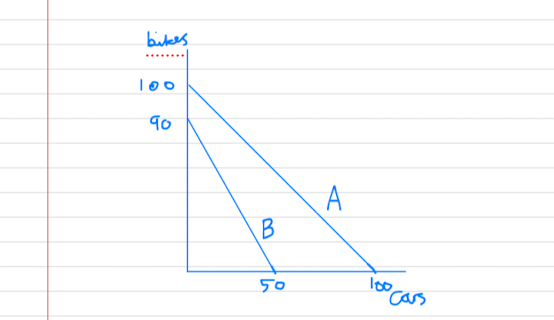
- Diagram: comparative advantage diagram
- Evaluation: supply-side policies
One of the main advantages of globalisation to the UK is lower prices. Globalisation involves the UK forming more free trade agreements, where countries agree to remove protectionist measures from each other. The effects of this can be shown by the diagram below, which shows the reduction of tariffs. Tariffs are the tax on imports. The diagram shows world supply shifting down. This leads to a fall in prices from p1 to p2, causing an expansion in the UK demand curve and a contraction in the UK supply curve. This means that the quantity of imports increases from q1-q1 to q3-q4, and domestic output decreases from 0-q1 to 0-q3. One example of this is the UK recently forming a free trade agreement with South Korea, which will lead to an increase in trade and lower prices for goods and services from each of the countries.
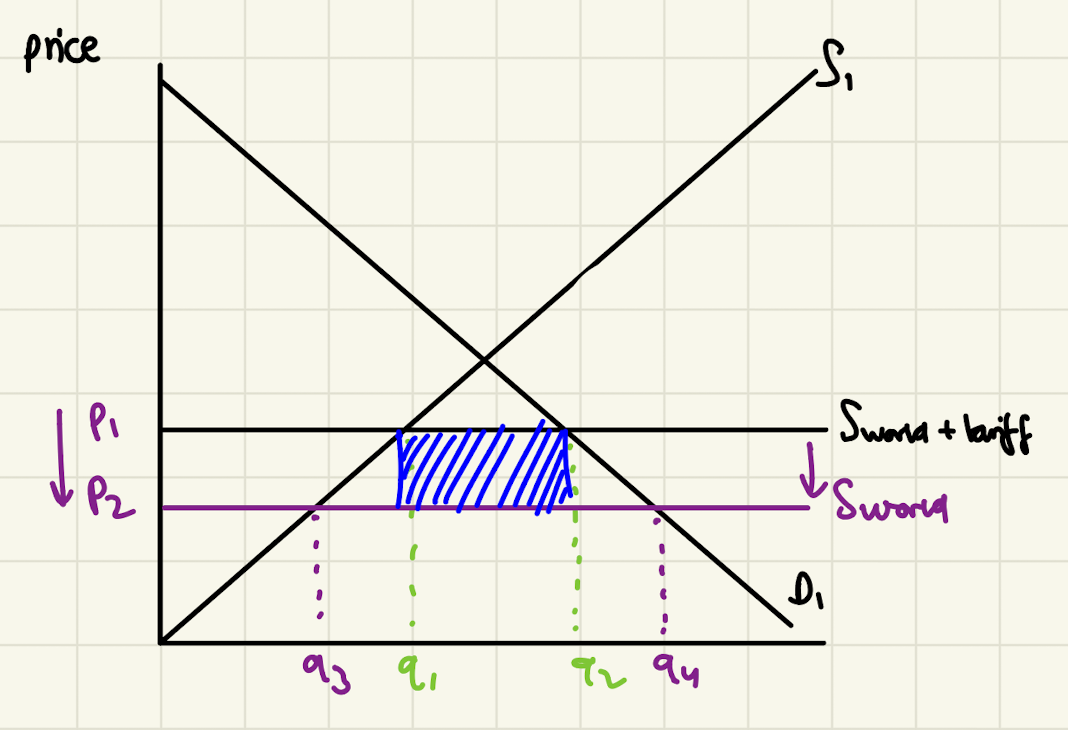
However, the UK would lose tax revenue from free trade agreements. This is shown by the blue shaded rectangle, which was the tax revenue from previous tariffs. If tax revenue is lost, this can lead to an increase in the budget deficit, which may mean that the government otherwise have to cut spending or raise taxes. If the government choose to cut spending on infrastructure or other supply-side improvements, this can lead to a decrease in productivity, which can lead to higher costs and higher prices in the future.
On the other hand, one downside of globalisation to the UK is that it has caused structural unemployment to increase. This is when an industry declines causing workers to lose their jobs. This is made worse if workers do not have transferrable skills. With globalisation, countries are encouraged to specialise in producing the goods and services where they have a comparative advantage. This is when countries can produce goods and services at a lower opportunity cost. The diagram shows that country A has an opportunity cost of 1 bike per car, whereas country B has an opportunity cost of 1.8 bikes per car. This means that country A would specialise in cars and country B would specialise in bikes. With the UK forming trade deals, we can increase the production of services which we have a comparative advantage in. This means that those working in industries like steel lose their jobs, as the UK chooses, over time, to import these goods instead. China has a comparative advantage over the UK in steel.
However, although this is damaging to the UK, the government could invest in policies to help increase geographical and occupational mobility of labour so that certain parts of the UK do not decline. For example, the government have invested over £40 billion in the HS2 project, which in theory should allow workers to move more freely across the UK, which would give them access to more jobs despite their original jobs in the manufacturing industry declining.
In conclusion, my opinion is that globalisation has been beneficial to the UK as it has allowed for more economic growth and lower prices. Structural unemployment is a downside but it was a sign that the UK is not able to compete in industries like steel, however that can be resolved if the government invest in appropriate supply-side policies to re-train workers and increase labour market mobility. The only other thing that the UK should be concerned is becoming over-dependent on the rest of the world. As we have seen recently, conflict in other parts of the world can heavily affect the UK economy. Fuel shortages lead to higher prices, which cause cost-push inflation in the UK, which can reduce living standards temporarily.
A-Level Economics Tutoring
I offer one-to-one and small group A-Level Economics tutoring for students across the UK and internationally. With 87+ five-star Google reviews and tutoring experience since 2017, I specialise in helping students understand difficult concepts and improve their exam technique.